What Does Frankenbiting Mean in Reality TV?
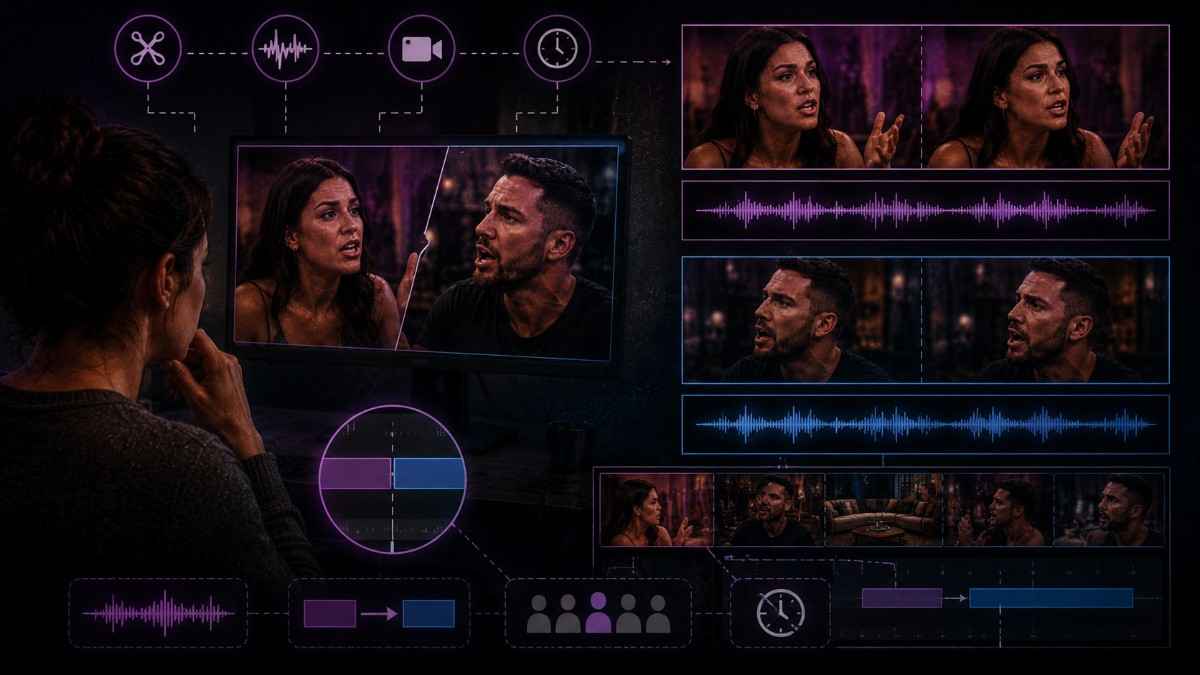
A Frankenbite is an audio clip on reality TV that sounds like a single, unbroken statement but is actually built from multiple pieces of dialogue recorded at different times. The word combines “Frankenstein” (something assembled from parts) and “soundbite.” The result is a line the subject technically said, but may never have meant as a complete thought.
The term was coined within the television post-production industry and gained wider use during the early 2000s reality TV boom. Wiktionary traces the etymology directly to the Frankenstein construction metaphor, which is apt: just as the monster was assembled from mismatched pieces of different bodies, a frankenbite is assembled from mismatched pieces of different conversations.
A regular edit cuts between speakers or between scenes. A frankenbite cuts within a single person’s speech to construct a new statement. The written equivalent would be pulling individual words from different paragraphs of someone’s email and presenting them as one sentence. Technically their words. Never their meaning.
How Does Frankenbiting Work in Post-Production?
Frankenbiting is not magic. It relies on specific production conditions and specific editorial techniques. Understanding the mechanics makes it much harder to miss when it is happening.
The Raw Material: Confessionals and OTFs
Reality TV shoots two main types of interview footage. Sit-down confessionals are staged interviews recorded in a designated room, usually lit and mic’d properly. OTFs, short for on-the-fly interviews, are recorded quickly on location and often look less polished.
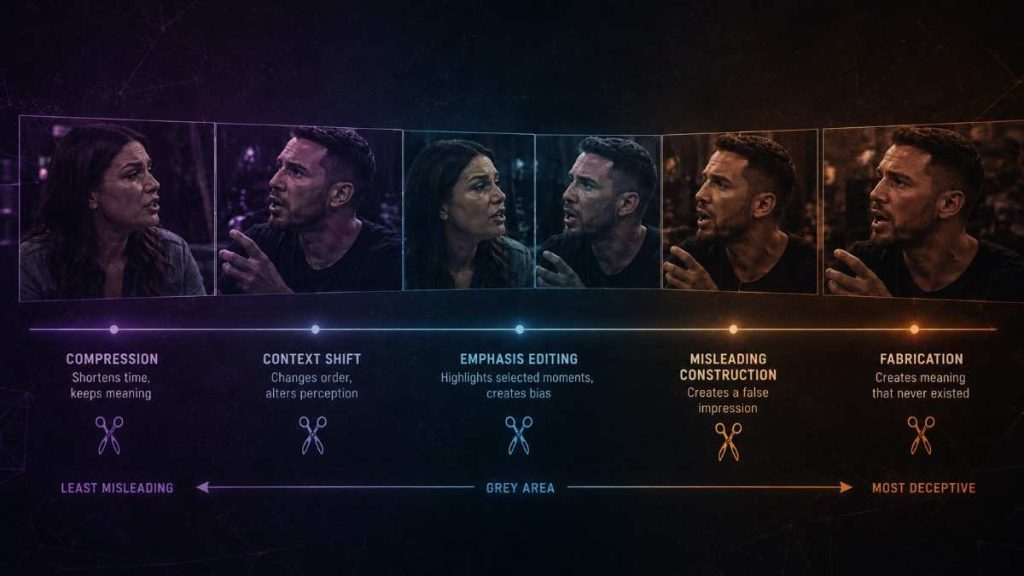
Contestants are frequently asked the same question multiple ways across multiple sessions, sometimes weeks apart. This generates a large pool of usable audio fragments. A contestant asked “how do you feel about Sarah?” in week two, week five, and week eight has given producers three separate answer pools. An editor working with those three sessions can select syllables, words, and phrases from any of them.
According to the Frame.io editorial guide on frankenbiting, a line that an interviewee “didn’t say” can sometimes be assembled from “various parts of their recording” to manufacture that line entirely. That is the upper limit of what the technique can do when pushed to its extreme.
The Join and the Cover
The audio join itself is often obvious on the raw track. Different room tone, slight pitch shifts, and gaps in ambient noise all give away the seam. The editor’s job is to hide it.
B-roll footage is the most common cover. A cutaway shot of hands, a landscape, or another cast member reacting pulls the viewer’s eyes away from the speaker at the exact moment the audio seam occurs. Music cues serve the same function, masking changes in ambient room noise by replacing the background entirely.
The reaction shot is particularly effective at manufacturing false continuity. If the edit shows Person A speaking, then cuts to Person B looking visibly hurt, then cuts back to Person A finishing the thought, the viewer reads the whole sequence as one live exchange. That reaction shot from Person B may have been filmed hours or days later in a completely different context.
Frame.io’s guide also notes that audio editors specifically search for “similar syllables” when assembling frankenbites, rather than just matching words, because the phonetic join needs to sound natural at the point where two separate recordings are spliced together.
Is Frankenbiting Always Deceptive? The Spectrum from Compression to Fabrication
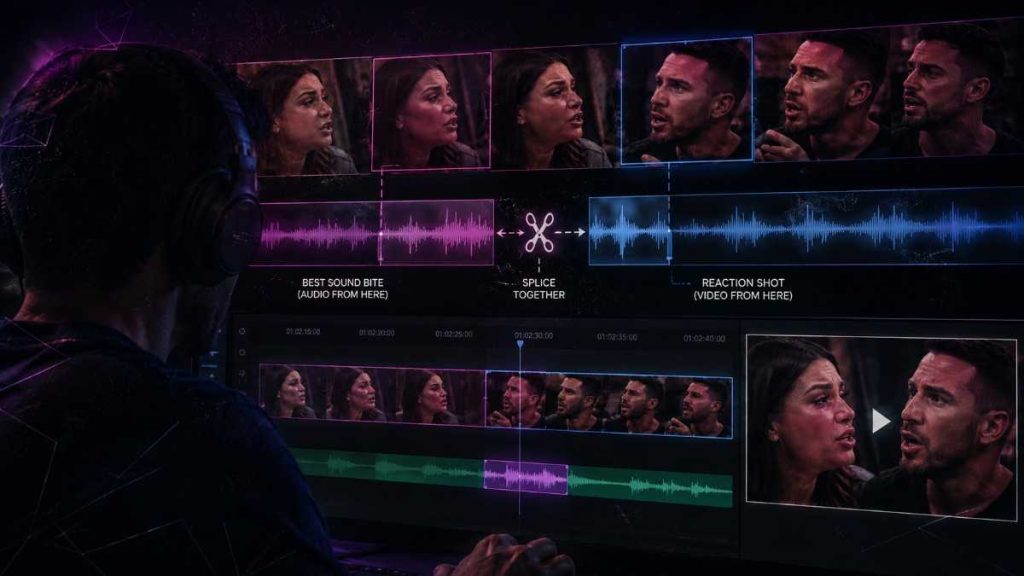
This is the part most articles skip entirely, and it is the most important thing to understand. Frankenbiting is not one technique. It is a range of techniques with very different ethical weights attached to each end of that range.
Level 1: Compression (Mostly Harmless)
The mildest form involves removing filler words such as “um,” “like,” and “you know,” along with false starts and long pauses from within a sentence. The meaning is unchanged. The speaker would agree the edited version reflects exactly what they meant.
This practice happens in virtually every interview-based program ever made, including news broadcasts, documentaries, and podcasts. It is standard editorial practice and has been since the earliest days of recorded audio. Nobody calls it deceptive because the speaker’s intent is preserved perfectly.
Level 2: Reframing (Ethically Murky)
The middle of the spectrum is where things get genuinely complicated. This level involves taking a statement made in one emotional context and placing it inside a different narrative context entirely.
Picture a contestant who says “I’m not here to make friends” as a self-aware joke during a lighthearted moment in week one. The editor places that audio over footage of that same contestant in a heated argument during week five. The words are accurate. The implication, that the contestant is genuinely cold and competitive, is a product of the edit rather than the original moment. This is where the real editorial power lives, and it is where the vast majority of contestant complaints originate. A show like The Bachelor can use this technique to build or destroy a person’s audience reputation without inventing a single word.
Level 3: Fabrication (Clearly Problematic)
The far end of the spectrum involves assembling words from entirely separate conversations to create a statement the person never made as a coherent thought. A 2021 New York Post report quoted production staff and cast members describing edits that made contestants “seem far more horrible” than their actual documented behavior. Several sources described clips that assembled remarks from different shoot days into what appeared, on screen, to be a single damning statement.
This level is rarer than Levels 1 and 2, but it is documented, and it is what most viewers imagine when they hear the term frankenbiting.
Why Do Reality TV Editors Use Frankenbiting?
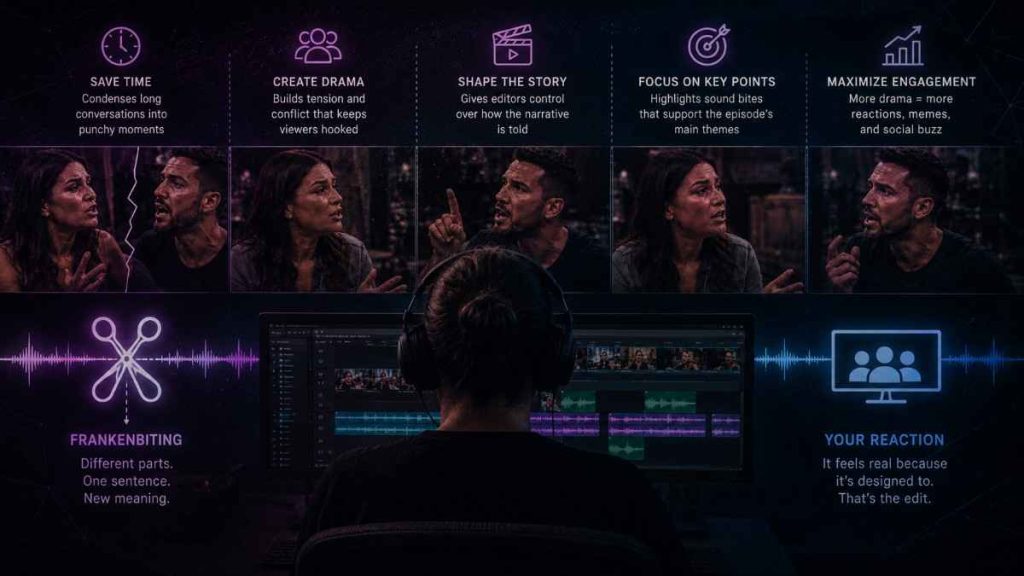
The structural reality of reality TV production makes some form of frankenbiting almost inevitable. A typical episode covers days or weeks of real-time events and compresses them into under an hour of screen time. Without aggressive editing, the story would be incomprehensible to any viewer.
Producers are also building narrative arcs across an entire season. Characters need consistent traits for the audience to track. If a person comes across as a villain in episode one but says something genuinely sympathetic in episode three, the edit will often suppress the sympathetic version to protect the arc that has already been established. That is not an accident. It is a deliberate creative choice driven by the economics of keeping viewers engaged episode to episode.
The CinED post-production guide describes frankenbiting as sitting at the intersection of “creative necessity” and ethical concern. That framing reflects exactly how professionals inside the industry talk about the technique privately. It explains why frankenbiting is persistent without making the deceptive end of the spectrum acceptable.
Contestants sign contracts before filming that grant producers extremely broad editorial control over how footage is used. If you are curious about what those contracts actually permit, the specifics covered in reality TV contract details make for genuinely eye-opening reading.
What Have Reality TV Contestants Said About Frankenbiting?
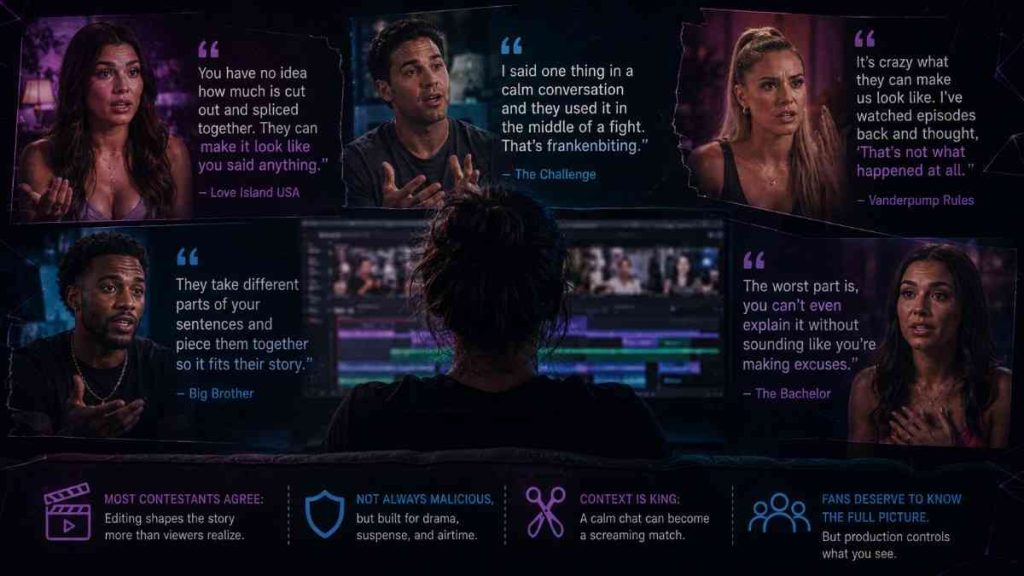
Contestants have been talking about this for years, and the accounts are remarkably consistent in their details. The picture they paint is of edits that are not necessarily lying word-for-word but are routinely lying about context, tone, and sequence.
The 2021 New York Post investigation remains the most cited public accounting of contestant grievances on this specific topic. Multiple unnamed production workers and named cast members described how the technique was applied to reshape how specific people were perceived by audiences at home. What stood out across those accounts was not that words were invented. It was that the assembled version bore no emotional resemblance to the actual conversation.
Contestants from franchise shows have described watching episodes and not recognizing the version of themselves on screen. That disorientation is not just emotional. It has real consequences. A person edited into a villain across an eight-week season carries that reputation into their professional and personal life well after filming ends.
The Bachelor franchise has been the center of numerous frankenbiting discussions, particularly on fan forums where viewers break down edit patterns with impressive technical detail. Those conversations are worth reading because they demonstrate that engaged audiences are already doing informal frankenbite analysis on their own, just without a formal vocabulary for what they are noticing.
How Can You Tell If a Reality TV Clip Has Been Frankenbited?
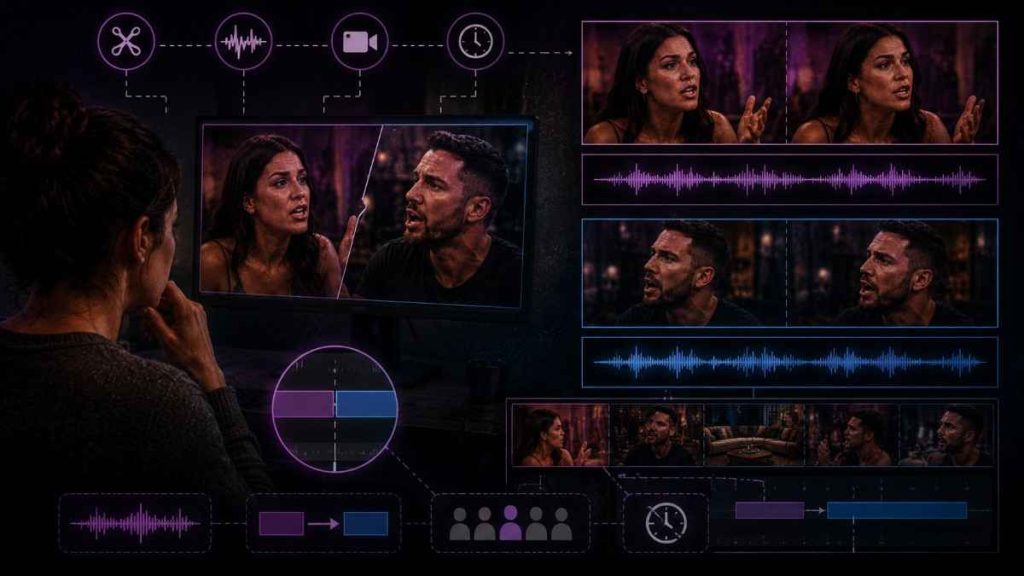
Most coverage of frankenbiting stops at the definition. None of it tells viewers what to actually look for. Here are the specific signals worth noticing when you suspect an edit has been constructed.
Audio room tone shifts are the most reliable indicator. Listen for a change in background sound or ambient noise mid-sentence. A clip recorded in a car sounds different from one recorded in a confessional booth, even when the edit places them in sequence. The background hum will shift slightly, and on headphones it becomes surprisingly detectable.
Mismatched b-roll is the second signal. If the cutaway shot shows different lighting or clothing from the interview segment surrounding it, that reaction may have been filmed separately. Reality TV crews are not always meticulous about matching eyeline and light temperature across insert shots.
Clothing and hair continuity breaks are a more obvious tell. Contestants wear different outfits on different shoot days, and a quick costume change in the middle of what is presented as a single conversation is a strong signal the clip spans multiple recording sessions.
The “floating statement” is the fourth thing to watch for. A quote that contains no clear conversational context with no visible response from another person is often an assembled fragment rather than a live exchange. Real conversations have flow. Frankenbited statements often feel slightly contextless when you pay attention.
None of these are proof on their own. They are signals worth noticing, and noticing them is the first step toward watching reality TV with a calibrated eye rather than a credulous one. For a broader look at how The Bachelor specifically constructs its storylines, the breakdown of whether The Bachelor is scripted covers the production side in useful detail.
Does Frankenbiting Mean Everything on Reality TV Is Fake?
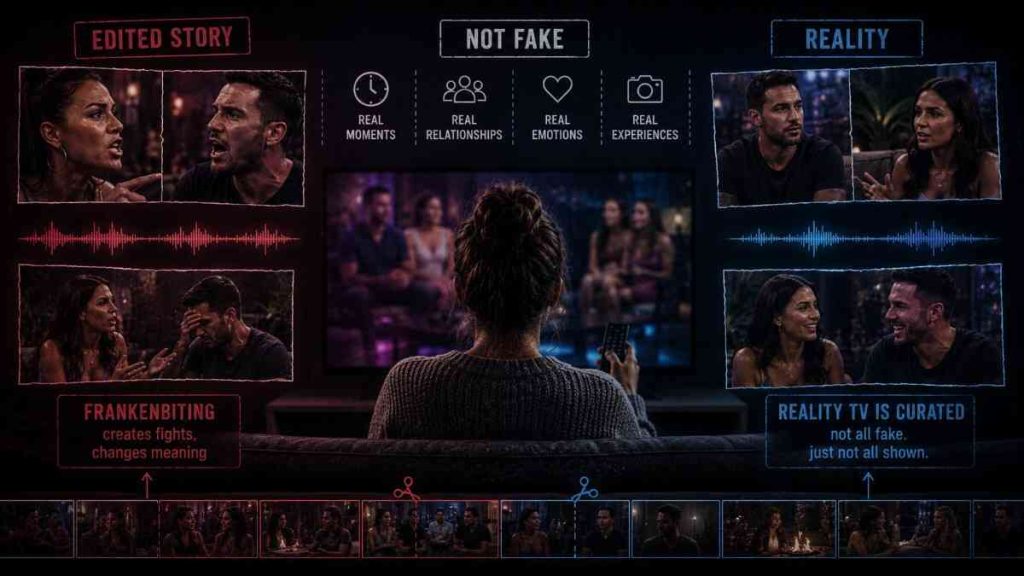
No, and treating it that way misses the more specific and more useful truth. Frankenbiting proves that the edit is constructed. It does not prove the underlying sentiment was invented.
A contestant who behaved rudely across an entire season cannot point to frankenbiting as a complete defense. The raw footage has to exist somewhere for the edit to draw from. What frankenbiting can do is amplify a real behavior beyond its actual proportion, strip it of context that would explain or soften it, and sequence events to imply a causality that did not exist in real time.
The most honest framing is this: reality TV is edited nonfiction, not live documentary. The footage is real in the sense that cameras were rolling and people were present. The narrative built from that footage is a creative product shaped by producers with specific storytelling goals. Holding any given clip to the same standard as a verbatim quote in a news article is a category error.
What this means practically is that you can watch reality TV and enjoy it while understanding that the villain you are watching may be a partially constructed character. The behavior happened. The specific version of that behavior you are seeing has been shaped.
Frequently Asked Questions About Frankenbiting
Is frankenbiting illegal?
No. Reality TV contestants sign contracts before filming that grant producers broad editorial control over how their footage is used. No US court has successfully held a network liable for frankenbiting under defamation law, primarily because the statements use the subject’s own recorded words. A defamation claim requires proving a false statement of fact was made about you. When the words are technically yours, even if assembled deceptively, the legal threshold becomes very difficult to meet. Contestants who feel misrepresented have limited legal recourse once they have signed a standard reality TV participation agreement.
Does The Bachelor use frankenbiting?
No network or production company has formally confirmed using frankenbiting as a deliberate editorial practice by name. Former Bachelor contestants and sources close to production have publicly described edits that recontextualized their statements in ways they found unrecognizable. The franchise has not commented on the specific technique by name. What is documented is that Bachelor episodes compress weeks of real-time events into hours of television, which creates the exact structural conditions that make some form of audio assembly almost unavoidable during post-production.
When did frankenbiting start?
The term emerged from within the television post-production industry and gained wider documented use during the early 2000s reality TV boom, when shows like Survivor and Big Brother were establishing the genre’s commercial viability. The underlying technique predates the word significantly. Documentary film editors have assembled dialogue from multiple takes since the earliest days of recorded film. What changed in reality TV was the scale, the frequency, and the willingness to use the technique not just for compression but for narrative construction.
Is frankenbiting different from a scripted show being scripted?
Yes, in a meaningful way. A scripted show produces dialogue that actors read from a written page. The characters are fictional and both the production and the audience understand that. Frankenbiting assembles audio from things a real, named person actually said, then sequences those fragments to produce a new or altered meaning. The subject’s voice and words are genuine. The editorial sequence is constructed. This distinction matters because viewers watching frankenbited reality TV are being invited to form opinions about a real human being based on an assembled version of that person’s speech.
Can frankenbiting affect a contestant’s life after the show ends?
Yes, and this is one of the most underreported aspects of the practice. A contestant’s public reputation is built largely from the edited version of themselves that audiences watched, not from who they actually were on set. Contestants who were edited into villains have described ongoing consequences including lost job opportunities, hostile interactions from strangers, and lasting public personas they did not create. The assembled version of what someone said becomes, in practice, the official record of who they are. For contestants who build post-show careers in public life, that gap between the real person and the edited character can have significant long-term effects.
Do documentary filmmakers use frankenbiting too?
Yes. The technique is not exclusive to reality TV. Documentary editors regularly assemble dialogue from multiple takes and separate interview sessions to build coherent, watchable narratives from hours of raw footage. The ethics track the same spectrum: compression is accepted practice, meaning fabrication is not. The difference is that documentary subjects are often less commercially vulnerable than reality TV contestants, and the genre’s editorial conventions are slightly more transparent to audiences who understand they are watching a shaped narrative rather than an unmediated record of real events.
The Part That Actually Matters
The point is not to watch reality TV with permanent suspicion, tallying up every cut looking for evidence of manipulation. That removes all the entertainment value and still does not give you certainty about any specific clip.
The point is to hold one accurate belief while watching: the edit is a construction, not a recording. What someone said and what the edit implies they meant are two different things, and only one of them was in the contestants’ control. When a villain gives a confessional that sounds devastating, the question worth asking is not “did they say those words” but “what was the original context of each of those words.”
Reality TV is worth watching on its own terms as an entertainment genre with its own conventions. Those conventions include the Frankenbite. Knowing it exists does not ruin the show. It just means you are watching it with your eyes open.