What Happened When Netflix Cancelled The OA
Netflix cancelled The OA on August 5, 2019, with no public warning to viewers and, reportedly, no advance signal to the creators. The announcement came through Netflix’s standard press release process. Marling and Batmanglij responded the same day with a joint statement describing themselves as “deeply sad” and acknowledging they had not been able to finish the story they set out to tell.
The timing is worth paying attention to. Season 2 dropped in March 2019. Netflix had roughly four months of performance data before making the cancellation call. That gap matters because it means the decision was not reactive or panicked. It was made after Netflix had watched what Season 2 did to the audience and concluded the show could not go where it needed to go next.
The cancellation was announced approximately two days before Brit Marling’s birthday. That detail sounds trivial, but it became the seed of a full fan conspiracy theory. Fans convinced themselves that Marling and Netflix were collaborating on an ARG, designed to blur the line between fiction and reality in a show that had always played with that line. That theory was not true.
The show had sixteen total episodes across its two seasons, each running between sixty and seventy-one minutes. That is a film-length runtime per episode, which matters when you start calculating production cost. The OA was not a cheap, bingeable procedural. It was closer to a prestige cable drama in its ambition and its budget, and it sat on a platform that was beginning to think very differently about what that kind of show was worth.

Was The OA Cancelled Because of Low Ratings?
The OA was not cancelled purely because of low ratings, though ratings were part of it. The real answer is that viewership decline combined with high production cost combined with a scalability problem that Netflix could not see a way around. All three things together made the cancellation feel inevitable from Netflix’s side of the table, even if it felt shocking from the audience’s side.
What Netflix’s Viewership Data Actually Showed
Netflix does not publish official viewership figures, and in 2019 third-party measurement of streaming audiences was even less reliable than it is today. What is documented across industry reporting from that period is that Season 2 underperformed Season 1 in audience retention.
The reason is not hard to understand. Season 1 of The OA was strange but still grounded. It followed a missing woman telling a story about captivity and NDEs. Season 2 introduced interdimensional travel, a character who was also a character from a completely different narrative layer, and a plot that required viewers to have paid close attention to every preceding scene. Casual viewers from Season 1 did not necessarily follow.
The audience that stayed was intensely devoted. But Netflix’s evolving measurement model cared about total hours viewed globally, not fan intensity. A smaller passionate audience watching every episode twice did not score better in that model than a larger casual audience watching one season and dropping off.
Production cost compounded the problem. Season 2 used elaborate practical sets and had the kind of production design that shows up on screen as ambition but shows up on a budget spreadsheet as a problem. The per-episode cost of The OA was not publicly confirmed by Netflix, but reporting from that period consistently placed it in the range that made renewal for three more seasons a significant financial commitment.
The Other Shows Netflix Cut at the Same Time
The OA was not cancelled alone. The 2019 wave included Jessica Jones, Santa Clarita Diet, Tuca & Bertie, and One Day at a Time. All of them were critically regarded. Several had passionate fanbases. Netflix cut them within roughly the same window.
This pattern is the part most coverage on The OA misses entirely. If one critically praised show with a devoted audience gets cancelled, that might be a show-specific judgment. When five such shows get cancelled in the same year, that is a platform strategy revealing itself. Netflix was not evaluating each of these shows in isolation. It was recalibrating what kind of originals it would fund long-term.
The shows that survived that period tended to have broader mass appeal, required less prior knowledge to enjoy, and could perform across diverse global markets without a steep entry curve. The shows that didn’t survive tended to be exactly the opposite. The OA fit the profile of the cancellations, not the renewals.
The Real Reason Had More to Do With Netflix’s Strategy Than The OA’s Numbers
Netflix in 2019 was operating under different pressures than Netflix in 2016, when it greenlit The OA. By mid-2019, subscriber growth in the US was starting to plateau. Disney+ was three months away from launching. Netflix was looking hard at its content spend and asking which originals could justify their costs against a global audience, not just a devoted American niche.
Cindy Holland, the former Netflix executive who oversaw original content for nearly two decades, addressed The OA directly. She said it had become clear “it was going to be unsustainable as an ongoing project.” That language is precise and worth sitting with. She did not say it was bad. She did not say it didn’t perform. She said it was unsustainable. That is an operational word, not a quality word.
The OA had a structural feature that made it incompatible with Netflix’s emerging content model. It had no casual entry point. You could not drop into Season 2, Episode 4 and understand what was happening. You needed to have watched every prior episode in sequence, engaged with them seriously, and retained the mythology. In Netflix’s model, which was shifting toward shows that could attract new viewers from any starting point and perform across international markets, that kind of density was a liability.
The five-season plan made it worse. Marling and Batmanglij were asking Netflix to commit to funding a story that wouldn’t pay off for five full seasons. Netflix was moving away from exactly that kind of long-term creative bet on niche prestige projects. The financial math on a show that requires five seasons to justify its existence looks very different from a show that works season by season.
This is the angle that almost no coverage on The OA’s cancellation addresses directly. Netflix did not cancel The OA because it decided the show was a failure. Netflix cancelled The OA because the type of show The OA was had become structurally incompatible with where Netflix was going. Shows following a similar pattern, like Archive 81, would later face the same calculus for similar reasons.
That distinction matters for understanding why the fan campaign, which came next, was always going to run into a wall.
The Save The OA Campaign Was Real, Organized, and Didn’t Work
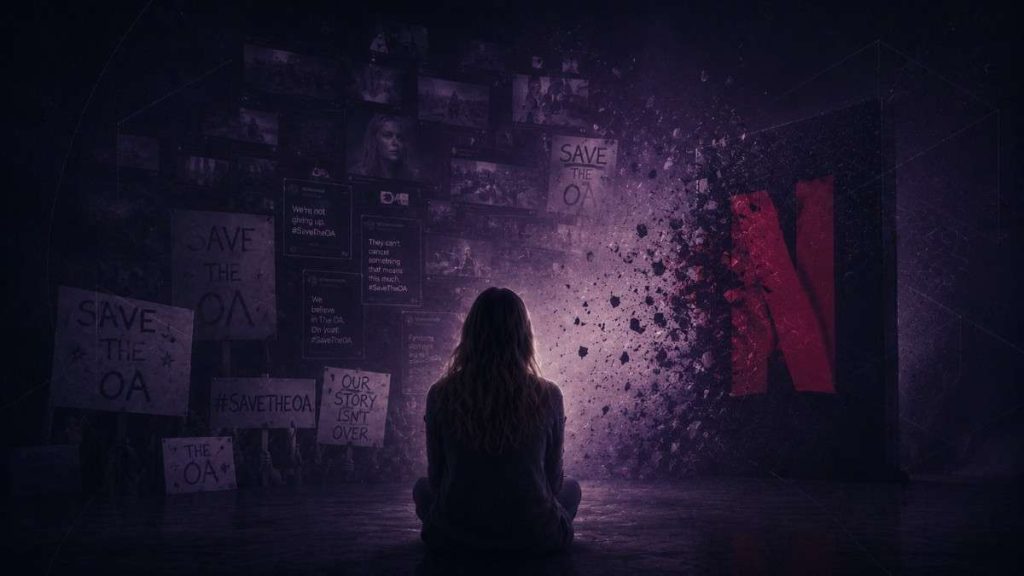
Within days of the August 5 announcement, fans organized a protest outside Netflix’s Los Angeles headquarters. People showed up and performed the Five Movements on the sidewalk in front of the building. On a public street, in front of a corporate headquarters, it was striking enough that it got real press coverage.
This was not a Twitter pile-on or a change.org petition that five thousand people signed and then forgot about. It was a physical, coordinated public event. The hashtag SaveTheOA trended. There were letter-writing campaigns and organized social media efforts. The fan community for The OA was small but extremely motivated, and they used every tool available.
The response from the fan community also included genuine confusion about whether the cancellation was real. Vulture ran a piece at the time taking seriously the possibility that Netflix and the creators might be staging the cancellation as an extension of the show’s themes. The show had trained its audience to question what was actually happening. They applied that training to the cancellation announcement itself.
Netflix did not reverse course. No other platform stepped in. No rescue announcement ever came.
The structural reason the campaign couldn’t work is important to understand, because it wasn’t about effort or intensity. The people protesting outside Netflix headquarters were already watching the show. They were already in the audience. What Netflix needed, in order to justify three more seasons of a high-cost prestige drama, was evidence that The OA could significantly grow its audience beyond the people who already loved it. A protest organized by existing fans does not demonstrate new audience potential.
The rights situation added another layer of difficulty. As a Netflix original, The OA’s intellectual property belongs to Netflix. Any other platform wanting to continue the story would need Netflix’s cooperation or a licensing agreement. Netflix has not shown interest in those arrangements for cancelled originals.
What Brit Marling Has Said About the Cancellation
Brit Marling has been more specific about the cancellation than most cancelled showrunners ever are, and what she’s said goes beyond disappointment into a coherent structural argument about streaming itself.
The initial joint statement with Batmanglij in August 2019 was measured. They said they were “deeply sad” and acknowledged they hadn’t been able to finish what they started. That’s the version most people saw.
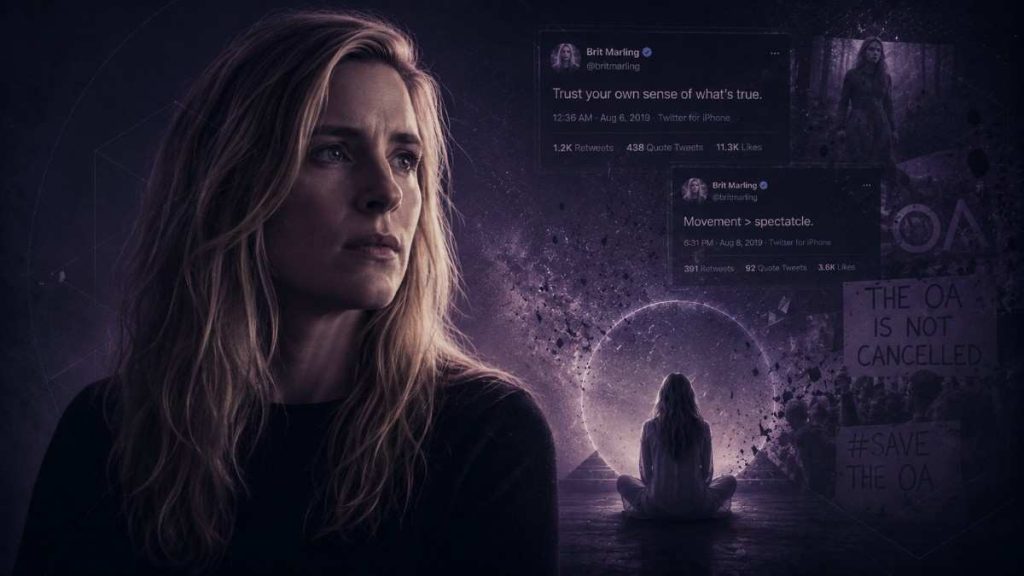
The more developed thinking came in later interviews. Marling has described the cancellation as a “harbinger” of a broken business model in streaming. Her argument is not that Netflix made a bad call on The OA specifically. Her argument is that streaming platforms measure success on short cycles, and that measurement is structurally incompatible with long-form storytelling that builds across multiple seasons.
This is a real critique, not just creator frustration. The economics of a five-season story are fundamentally different from a show that works as a self-contained season. The audience for an ambitious multi-season arc builds slowly, through word of mouth and cultural conversation. Netflix’s model rewards immediate scale and punishes slow builds. The OA was a slow build by design.
Cindy Holland’s statement about unsustainability, from the executive side, confirms Marling’s framing from the opposite direction. Both of them are describing the same incompatibility. The creative plan required a long runway. The business model doesn’t offer one.
Marling has not announced any active effort as of 2025 to revive the show on another platform. What’s been described publicly about the remaining seasons involves OA assembling a group across multiple dimensions, with the stakes escalating across each part. It was built to be a complete five-part work. Right now it is an incomplete two-part fragment.
Will There Ever Be an OA Season 3?
As of 2025, there is no Season 3 of The OA in development. No platform has announced a pickup. Neither Marling nor Batmanglij has indicated an active revival is in motion.
The five-season plan exists. Marling and Batmanglij have confirmed it in interviews, and details about the intended shape of later seasons have come out over time. A plan is not a production. A production requires a buyer, a budget, and a rights agreement, and none of those three things are currently in place.
The rights situation is the most significant obstacle. Netflix holds the IP for The OA, meaning any revival on another platform would require Netflix to either sell or license the property. Netflix’s historical behavior on cancelled originals does not suggest they are motivated to do that.
The OA did experience a notable cultural resurgence around 2024 and 2025. New audiences discovered it, TikTok got hold of it, and a fresh wave of viewers started calling it one of the most affecting shows they had ever seen. Renewed cultural attention has occasionally prompted platform reconsideration in other cases. It has not moved Netflix to reopen the conversation about The OA.
Cultural love and platform economics are different things. The OA’s renewed popularity among new viewers is real and visible. For the people who want to know what would have happened: Season 3 was going to take the story into a new dimension and a new iteration of the characters, with each part expanding the scale and making the connections between dimensions more intricate. It would have been a genuinely ambitious five-part work. Right now it ends where it ends, and there is no credible sign that will change.
FAQ
Why did Netflix cancel The OA after only two seasons?
Netflix cancelled The OA in August 2019 because the show’s high production cost and declining viewership from Season 1 to Season 2 made continued investment difficult to justify. The cancellation also coincided with a broader Netflix strategy shift away from expensive prestige niche dramas toward broader-appeal content. Former Netflix executive Cindy Holland cited the show being “unsustainable as an ongoing project.” It was not a judgment on quality but on scalability and cost relative to the size of the audience the show could realistically reach.
Was the Save The OA campaign just people on the internet, or did they actually do something?
The campaign involved real-world action, not just online activity. Fans organized a physical protest outside Netflix’s Los Angeles headquarters and performed the Five Movements from the show on the street outside the building. The hashtag trended, letters were written, and the campaign received genuine press coverage. It did not change Netflix’s decision, because the fans protesting were already watching the show. What Netflix needed was evidence of new audience growth, and a protest by existing fans could not provide that.
Didn’t the OA have good reviews? Why would Netflix cancel a critically praised show?
Critical reception does not determine Netflix’s renewal decisions. Netflix makes renewal calls primarily on viewership data, specifically total hours watched globally, and on whether a show can justify its per-episode cost against its audience size. The OA had positive critical reception and a devoted fanbase, but the audience was relatively small by Netflix’s standards at the time. A show can be critically praised and still not meet the threshold Netflix sets for continued investment, especially when the show’s format requires a high-cost multi-season commitment.
Is it true the cancellation might have been fake, like an ARG?
No. The cancellation was real. The conspiracy theory emerged because the announcement came roughly two days before Brit Marling’s birthday and because The OA itself deals thematically with the blurry line between belief and reality. Some fans convinced themselves that Netflix and the creators were staging the cancellation as a meta-extension of the show. Marling and Batmanglij never confirmed that framing, and no continuation has materialized in the years since. The cancellation is real and has not been reversed.
What other shows were cancelled alongside The OA in 2019?
The 2019 Netflix cancellation wave included Jessica Jones, Santa Clarita Diet, Tuca & Bertie, and One Day at a Time, along with several others. All of them had critical credibility and devoted audiences. The pattern across those cancellations points to a platform-wide strategy recalibration rather than individual show failures. Netflix was moving away from niche prestige originals with high production costs and toward content with broader global appeal that could attract new subscribers across diverse markets.
Can another streaming service pick up The OA?
A pickup by another platform is theoretically possible but practically very unlikely. Netflix owns the intellectual property for The OA as a Netflix original. Any other platform wanting to continue the story would need Netflix to sell or license the rights, and Netflix has not shown interest in that kind of arrangement for its cancelled originals. As of 2025, no platform has announced any discussions about acquiring The OA, and neither Marling nor Batmanglij has indicated active negotiations are happening.
What did Brit Marling mean when she called the cancellation a broken business model?
Marling’s argument is that streaming platforms measure success on short cycles, season by season, and that measurement is incompatible with long-form storytelling designed to unfold across five seasons. A show built to pay off over five parts cannot demonstrate its full value in two. Streaming’s incentive structure rewards immediate scale and cuts shows that build slowly. Marling is saying the business model itself is the problem, not the specific decision Netflix made about The OA. It applies to any ambitious multi-season work that needs time to find its audience.
The OA Deserved Better Than It Got. So Did the People Who Made It.
The honest conclusion here is not that Netflix made an obvious mistake. Netflix made a financially defensible decision inside a business model that was changing in real time. From inside that model, a high-cost prestige drama with a declining viewership trajectory and a five-season commitment ahead of it was a genuinely difficult bet to make.
What Brit Marling identified, and what the pattern of 2019 cancellations confirms, is that the streaming model has a structural problem with ambition. A story that needs five seasons to breathe can’t prove its worth in two. The audience for that kind of work builds slowly, through recommendation and rewatching and cultural conversation. Quarterly measurement kills it before it gets there.
The OA is still on Netflix. New people are still finding it and being wrecked by it. The Five Movements still end up in comment sections every few months as another wave of viewers arrives at that scene for the first time. If you haven’t watched it yet, watch it knowing it doesn’t finish, and decide if that’s something you can live with. A lot of people decide it is.