
TL;DR
- Man on Fire is fiction, adapted from A.J. Quinnell’s 1980 novel of the same name.
- John Creasy has never existed as a documented real person.
- There are three separate adaptations: the 1987 film, the 2004 Denzel Washington film, and the 2026 Netflix series.
- The 2026 series relocates the story to Rio de Janeiro, a shift from the novel’s Italy and Malta setting.
- A circulating “John W. Creasy” gravestone detail from the franchise fuels the true-story confusion, but it’s a prop, not a biography.
- Kyle Killen created and wrote the 2026 series, which stars Yahya Abdul-Mateen II as Creasy.
No. Man on Fire is not based on a true story. It comes from A.J. Quinnell’s 1980 thriller novel, and John Creasy is a fictional character built for that book. The realism you’re picking up on comes from research into real kidnapping patterns, not one specific documented case. Three separate productions have adapted this same story, each one adjusting details but keeping the fictional bones intact.
Man on Fire Netflix True Story: What Is It Actually Based On?
Man on Fire is based on a novel by A.J. Quinnell, published in 1980, that kicked off a whole run of kidnapping-thriller fiction. It is not a memoir, a true crime book, or a dramatized retelling of a documented case. Every screen version, including the newest one, traces back to that same source material.
Quinnell wasn’t even a real name. It was a pen name for Philip Nicholson, and part of the reason the novel’s premise, a burned-out former operative turned bodyguard who ends up protecting a kidnapped child, took off is that it read like it could have happened. That believability is exactly what turned one book into a franchise spanning three formats over roughly four and a half decades.
| Version | Year | Setting | Lead Actor | Format |
|---|---|---|---|---|
| Novel | 1980 | Italy and Malta | N/A | Book |
| Film | 1987 | Italy | Scott Glenn | Feature film |
| Film | 2004 | Mexico City | Denzel Washington | Feature film |
| Series | 2026 | Rio de Janeiro | Yahya Abdul-Mateen II | 7-episode Netflix series |

Did John Creasy Really Exist?
No, John Creasy did not exist as a documented real person. He is a character invented for the 1980 novel, and every later adaptation kept that fictional foundation.
The character was shaped by patterns from real kidnapping-for-ransom cases, particularly the wave of abductions targeting wealthy families in parts of Latin America during the era the novel and its film adaptations reference. That’s different from being modeled on one specific person.
The “John W. Creasy Jan 21 1956 Dec 16 2003” search that’s been circulating comes from a gravestone prop used in the franchise, the kind of detail sharp-eyed fans screenshot and Google because it looks convincingly official. It’s set dressing, not a record. Wikipedia’s own framing of the franchise sticks with “loosely based” fiction rather than anything drawn from a documented biography.
How Much of Man on Fire Is Inspired by Real Events?
None of the plot matches a single real case, but the emotional texture draws from real patterns around kidnapping for ransom. Latin America saw a documented wave of high-profile abductions targeting wealthy families during the decades the novel and its adaptations reference, and that context is where the “based on real events” confusion tends to start.
“Based on” typically means a direct source, in this case the novel itself. “Inspired by real events” means the writers pulled tone, stakes, or plausible mechanics from real-world patterns without lifting an actual case’s plot. Man on Fire falls into the second bucket for its realism and the first bucket for its actual story origin.
Man on Fire 1987 vs. 2004 vs. 2026: What Changed Each Time?
The core story stayed the same across all three versions: a damaged protector, a kidnapped child, a violent reckoning. What changed each time was the geography, the runtime, and the lead performance built to carry it.
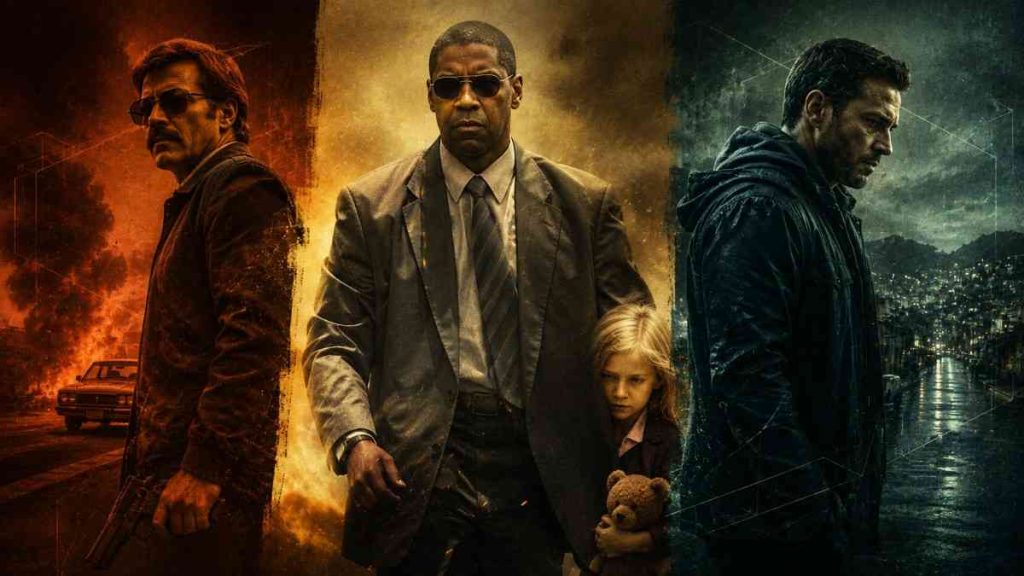
The 1987 film kept the novel’s Italian setting close to the source material. The 2004 Denzel Washington version, still the most widely known adaptation, moved the action to Mexico City to lean into that era’s real-world kidnapping anxiety around wealthy expatriate families. The 2026 Netflix series goes further still, relocating to Rio de Janeiro and stretching the story across seven episodes instead of compressing it into a two-hour runtime.
| Version | Runtime Format | Setting Choice | Why |
|---|---|---|---|
| 1987 | Feature film | Italy | Stays close to novel’s original geography |
| 2004 | Feature film | Mexico City | Taps into that era’s real kidnapping anxiety |
| 2026 | 7-episode series | Rio de Janeiro | Contemporary setting with a favela-adjacent security plot |
Rio de Janeiro gives the 2026 series a modern kidnapping and security backdrop that a 1980s or early-2000s setting couldn’t offer, and the episodic format lets the show slow down and actually sit in Creasy’s PTSD instead of rushing past it for runtime.
Who Plays Who in the 2026 Netflix Series?
Every named character in the 2026 series is fictional, built from the novel’s blueprint rather than pulled from real people. The cast is real, the characters are not.
| Actor | Character | Role Type |
|---|---|---|
| Yahya Abdul-Mateen II | John Creasy | Main |
| Billie Boullet | Poe Rayburn | Main |
| Alice Braga | Valeria Melo | Main |
| Scoot McNairy | Henry Tappan | Recurring |
| Bobby Cannavale | Paul Rayburn | Special guest |
Kyle Killen created the series and wrote it, and Steven Caple Jr. directed multiple episodes as an executive producer, which explains why the show feels like a cohesive vision instead of a loose adaptation stitched together by committee.
What Happens in Man on Fire? A Spoiler-Light Overview
Spoiler note: this section covers plot through roughly episode 2 and nothing past it. Creasy arrives in Rio carrying visible trauma from his past work, takes a bodyguard job protecting the Rayburn family, and slowly rebuilds a bond with Poe, the daughter he’s hired to guard. That fragile stability gets shattered when the family becomes the target of a bombing and kidnapping attempt, and Poe’s survival kicks the rest of the season into motion. If you want the full ending broken down beat by beat, Netflix’s own Tudum has a dedicated explainer that goes past the point where this section stops on purpose.
Is Man on Fire Getting a Season 2?
As of this writing, there’s no official second season announcement from Netflix. That could change quickly given the show’s Top 10 momentum, but nothing beyond the first season is confirmed yet.
If you’re wondering how Netflix actually makes that call, the pattern isn’t random. A lot of it comes down to second season cancellation patterns, which is worth understanding if you’re trying to predict Man on Fire’s odds instead of just hoping.
More Netflix Thrillers Based on Books, If You Liked Man on Fire
If the book-to-screen pipeline is what hooked you, Man on Fire is far from the only one worth chasing. There’s a whole lane of adaptations built the same way, novel first, prestige thriller second, and a few of them scratch the exact itch this one left behind.
For something in the same kidnapping-and-consequences register, a rundown of the best murder mystery shows is a solid next stop. If you’d rather stay in adaptation mode but shift toward classic mystery structure instead of modern thriller grit, a ranked look at Agatha Christie book adaptations covers that ground well.
FAQ: Man on Fire Netflix True Story Explained
Did John Creasy really exist?
No. John Creasy is a fictional character created for A.J. Quinnell’s 1980 novel and carried through every film and series adaptation since. He was shaped by patterns from real kidnapping cases, not modeled on one documented person. The viral gravestone detail with his supposed birth and death dates comes from a movie prop, not a genuine record.
How much of Man on Fire is true?
None of the plot is drawn from one real case, but the emotional realism comes from documented patterns around kidnapping for ransom, particularly cases targeting wealthy families in parts of Latin America. The franchise is fiction “inspired by” real-world patterns, not a dramatization of an actual event.
Is the 2026 Netflix series different from the 2004 movie?
Yes. The 2026 series moves the setting to Rio de Janeiro instead of Mexico City, expands the story into seven episodes instead of a two-hour film, and features an entirely new cast led by Yahya Abdul-Mateen II. The core premise of a damaged protector and a kidnapped child stays the same across both.
Is Man on Fire based on a real kidnapping case?
No single case matches the plot directly. The novel and its adaptations draw on the broader reality of ransom kidnappings targeting wealthy families, especially during the decades the story references, but there’s no documented individual case that the plot retells.
Why did the show move the setting to Brazil for 2026?
Rio de Janeiro gives the newest version a contemporary backdrop for kidnapping and private security storylines that older settings couldn’t offer in the same way. It also lets the series lean into a more current, urban tension rather than repeating the 2004 film’s Mexico City framing.
Man on Fire has now told the same fictional story three times across 45 years, and each version leaned on real-world texture to make invented characters feel like they could exist. Understanding that distinction is the difference between a flat “no, it’s not true” and actually knowing why the show gets under your skin. If you’re chasing that same based-on-a-book realism, the adaptation lists linked above are the natural next stop.