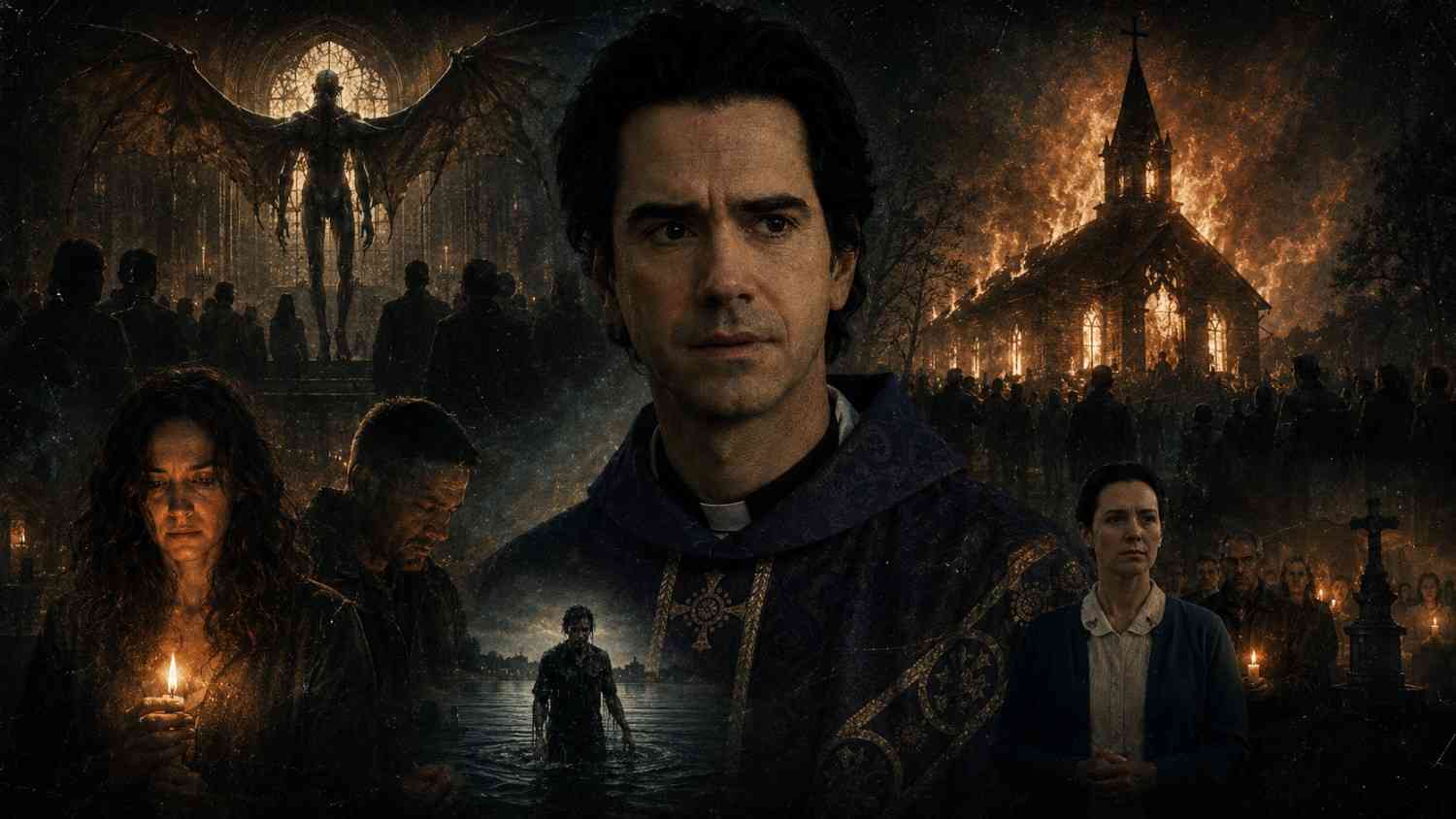
Two people survive Midnight Mass: Warren Flynn and Leeza Scarborough. Everyone else on Crockett Island dies or burns in the sunrise after Father Paul’s mass communion turns most of the town into the converted. The Angel’s own fate is the one thing the show never confirms on screen, and Mike Flanagan has said that ambiguity was intentional.
Who Actually Survived Midnight Mass: The Full Death Count
Two people survive Midnight Mass. Warren Flynn and Leeza Scarborough paddle away from Crockett Island in a canoe while the buildings collapse and the last of the converted burn in the sunrise. Everyone else dies before morning.
The Two Who Got Out: Warren and Leeza
Warren is one of the only people on the island who never takes communion. He is young enough, and peripheral enough to the church’s social gravity, that Father Paul’s miracle never pulls him in. Leeza is a different case. She had been paralyzed from the waist down after a shooting years before the show’s events, The shooting was an accident: Joe Collie, the island’s town drunk, hit her while hunting and her ability to walk returned after Father Paul used the Angel’s blood-infused wine in communion.
She received the blood’s effects without ever choosing to drink in full knowledge of what she was accepting. Flanagan’s positioning of these two as the survivors is not random. They represent the two people least captured by the system: one too young and too outside the congregation’s orbit to be swept in, one who was given something she never asked for and paid a price she never agreed to.
Everyone Else: The Deaths That Matter Most
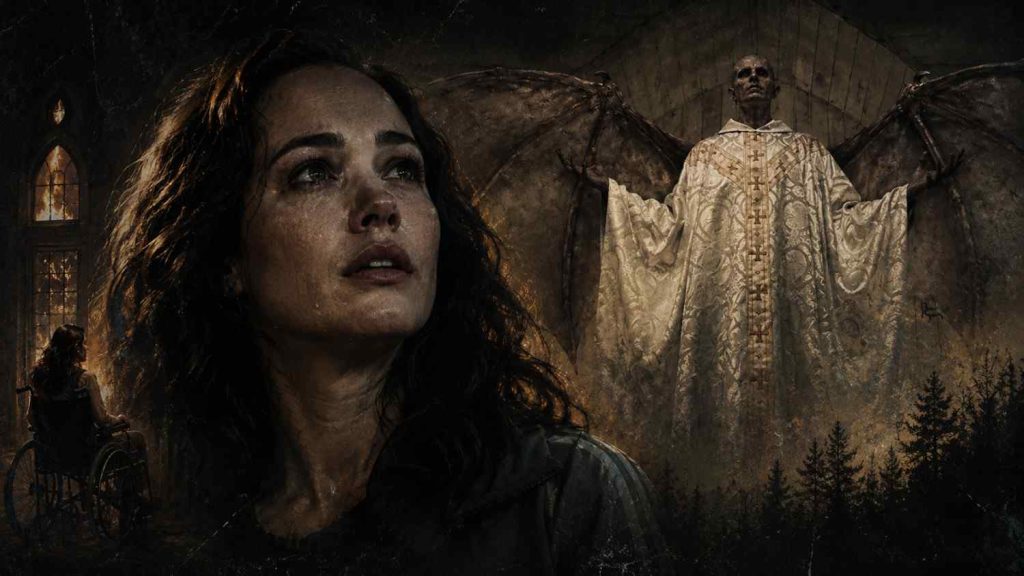
Father Paul (Monsignor Pruitt) chooses to walk into the sunrise alongside Mildred Gunning rather than hide. The man who smuggled an ancient creature back to his hometown dies holding the woman he loved. It is the only genuinely honest thing he does across the entire series.
Mildred Gunning, de-aged and converted by the Angel’s blood, walks into the sun with Pruitt. She goes willingly, beside the man she loved. The show does not editorialize on this.
Bev Keane’s death gets its own section below, because the specific way she dies is the show’s entire argument compressed into a single image.
Sarah Crowe and Sheriff Hassan are shot before the final sunrise. Neither of them took communion. They die permanently, with no possibility of the vampiric transformation that gives the converted a brief window between death and sunrise. The show frames their deaths as a particular kind of injustice: they never had a chance to choose.
Sturge dies in the sunrise alongside the other converted. He helped Bev burn the boats and the buildings, believing it would usher in a new age. It did not.
Every converted islander dies when the sun comes up. The mass conversion that Father Paul engineered ends with every single participant burning on the shore. Bev and Sturge’s plan to destroy the means of escape was meant to force a biblical flood scenario, with the church as the ark. The plan collapsed entirely.
What Erin Greene Did, and Why It Mattered
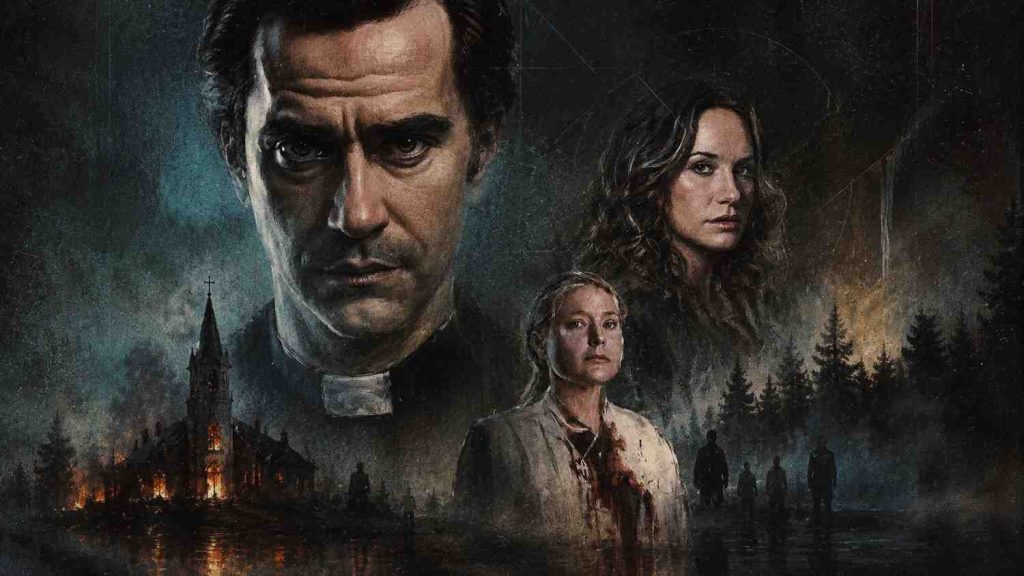
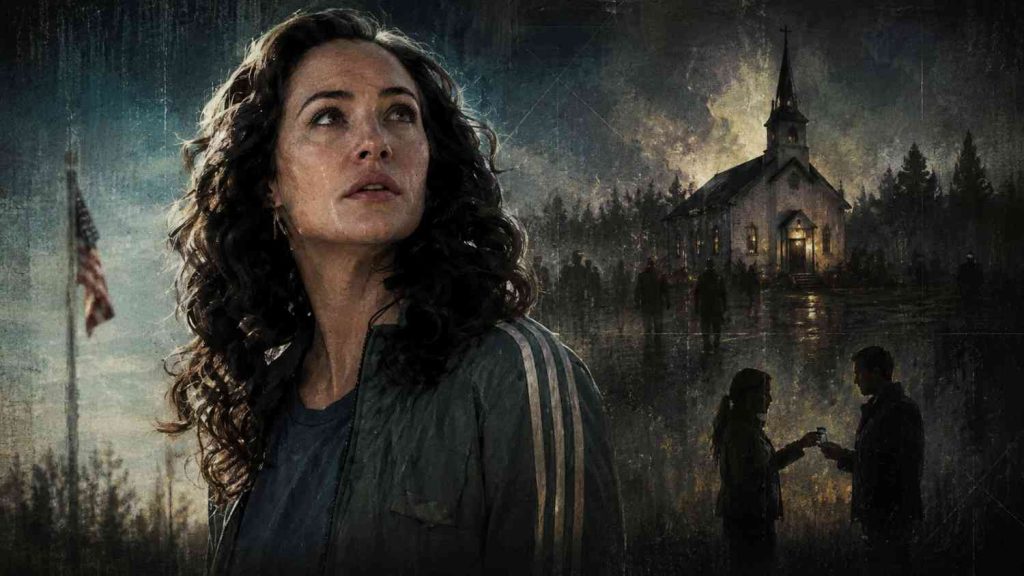
Erin Greene is the emotional center of Midnight Mass, and her death in the finale is the scene the whole series is building toward. She locates the Angel before dawn and slices its wings so it cannot fly to the mainland. She does not kill it. She grounds it.
The fight costs her badly. Erin’s own faith had already been tested once before: a pregnancy she was carrying earlier in the series ended in a miscarriage after she drank the Angel’s blood in communion, a loss the mainland doctors couldn’t even confirm had happened. She sustains severe injuries and bleeds out on the beach, dying alone in the dark before the sunrise she was trying to give everyone else.
Earlier in the series, Erin and Riley had a conversation about what they imagined death to feel like. Not the religious version, but the physical reality: atoms dispersing, consciousness releasing, the sensation of becoming part of everything rather than ending as a discrete thing. Flanagan shoots Erin’s death to match that description exactly. Her final moments are serene rather than violent.
The show frames this not as sacrifice in a theological sense but as a human choice made in full awareness. Bev Keane spent seven episodes willing to let other people die for her certainty. Erin died to protect people she would never meet. Same structure, trading your life for something larger, but the moral architecture is the precise opposite. One act comes from ego dressed as faith. The other comes from love with no audience.
The “I Can’t Feel My Legs” Meaning: Leeza’s Final Line Explained
Leeza’s last words in the series are quiet. She tells Warren, from the canoe, that she can no longer feel her legs. Her paralysis has returned. The effect the Angel’s blood had on her body is gone.
That much is clear. What the line implies about the Angel’s fate is where the debate starts.
The Most Popular Explanation: The Vampire Sire Theory
In traditional vampire mythology, the death of a sire severs the blood connection to everyone the sire turned or healed. If the Angel died from the wounds Erin inflicted, the effects of its blood on Leeza’s body would reverse. Her legs would stop working again. That is exactly what happens.
This is the cleanest in-universe explanation. It gives Leeza’s line causal weight: the feeling in her legs is not just gone, it is gone because the source is gone. The majority of fans landed on this reading after the finale aired, and the logic holds up against everything the show established about how the Angel’s blood operated.
What Mike Flanagan Actually Said
Flanagan addressed the Leeza question in post-release interviews, including a conversation with TheWrap. His position was that the line confirms her paralysis has returned and the blood’s effects have worn off. What it does not confirm, in his framing, is that the Angel died.
He argued those two things are separable: the blood could lose potency because enough time passed, because the connection broke through some other mechanism, or for reasons the show never defines. He was deliberate about leaving the Angel’s fate unresolved on screen.
The tension between Flanagan’s stated intent and the show’s internal logic is real and worth sitting with. The sire-blood theory is the most coherent in-universe answer. Flanagan’s authorial position is that the theory might be right, but the show does not confirm it. How you resolve that gap depends on whether you trust the narrative mechanics more than the author’s stated ambiguity.
Is the Angel Dead, or Did It Survive?
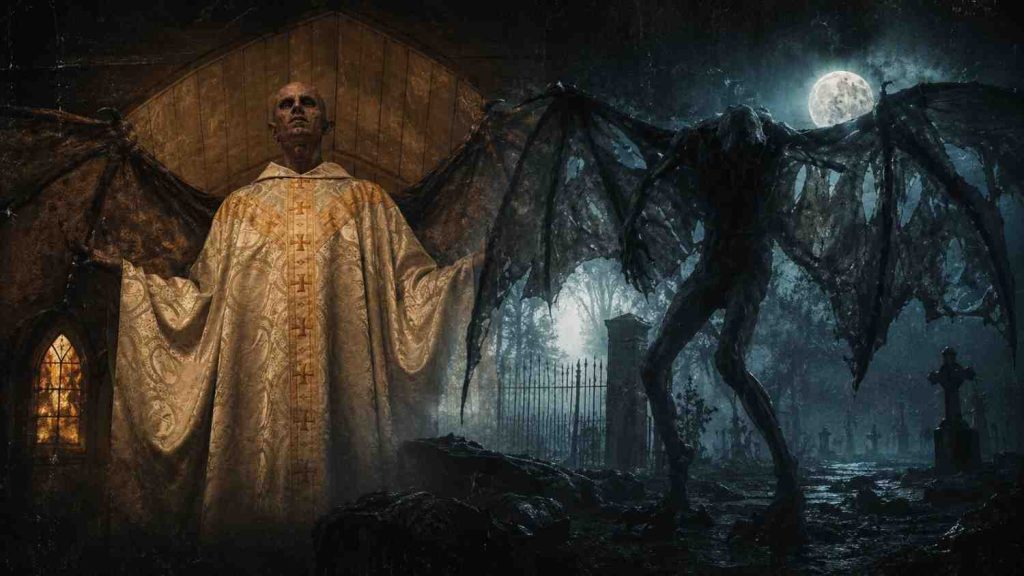
The Angel’s fate is the one question Midnight Mass deliberately refuses to answer. Both cases have legitimate support from what the show actually shows.
The Case That It Died
The Angel’s wings are destroyed by Erin before dawn. It is badly wounded, grounded, and bleeding, with the sunrise minutes away. Add to this the regression of Leeza’s paralysis, which tracks with the sire-death logic, and the case that the Angel did not survive the night is coherent and well-supported.
The Case That It Survived
The show never establishes a ceiling on the Angel’s durability. Father Paul survived being staked through the chest. The rules governing this creature are deliberately incomplete. The Angel is presented as ancient and unknowable, something that has outlasted civilizations. Flanagan never shows it dying on screen, and he has confirmed that choice was intentional.
Why Flanagan Left It Open
Flanagan has said across multiple interviews that the Angel was never meant to function as a genre vampire. The creature is a vessel for examining what happens when a corrupt belief system finds a willing host. His argument is that fanaticism does not die when a single carrier is destroyed. It migrates. It waits. It finds the next Pruitt, the next isolated community, the next person who mistakes the extraordinary for the divine.
Killing the Angel on screen would close the metaphor. Leaving its fate unresolved forces the audience to hold the same uncertainty the show’s survivors hold. The question “is it really gone?” is not a loose end. It is the thesis.
How Bev Keane Actually Died, and What It Means
Most summaries of the finale note that Bev Keane died in the sunrise. That is technically accurate and almost completely misses the point.
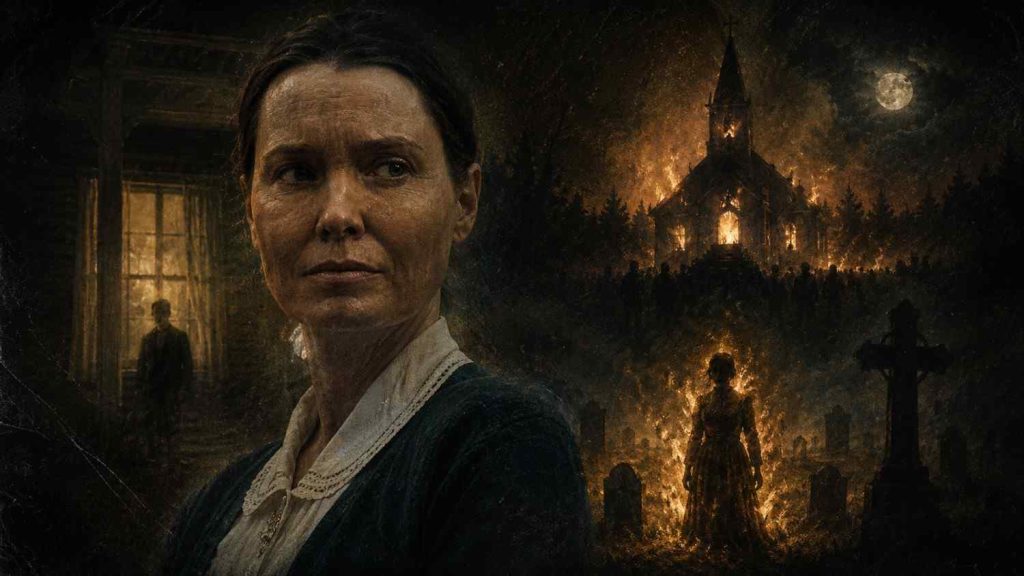
Bev Keane does not walk into the sun willingly. She digs a shelter, a hole in the ground, an improvised attempt to survive the daylight. The shelter fails. She dies inside it, alone, having done the math on her own survival and come up short.
This is the show’s entire argument about performative faith compressed into a single image. Bev spent the series justifying every act of violence with scripture. She burned buildings, poisoned children, and manipulated a congregation, wrapping every decision in the language of God’s will. When her moment came, she dug a hole.
Her faith was always, at its core, in service of Bev Keane. The church was a vehicle. The Angel was a tool. The congregation was an audience.
Compare this to Father Paul, who failed catastrophically and caused immense harm and still walked into the sunrise holding Mildred’s hand. His faith was corrupted by ego and catastrophically misapplied, but it was real in a way Bev’s never was. One man chose love at the end. One woman chose survival and got neither.
Will There Be a Midnight Mass Season 2?
No. Midnight Mass was created as a limited series, running seven episodes in total, and Flanagan has confirmed the story is complete. Since the show aired in 2021, he has produced The Midnight Club and The Fall of the House of Usher for Netflix, maintaining a consistent pattern of self-contained horror work. No one from the cast, the production, or Netflix has indicated a second season is in development.
A second season would also actively damage what the finale accomplishes. The ending works because it does not resolve everything. A continuation would need to either confirm the Angel’s death, collapsing the metaphor, or bring it back, turning a thematic argument into a franchise. Neither option improves on what exists.
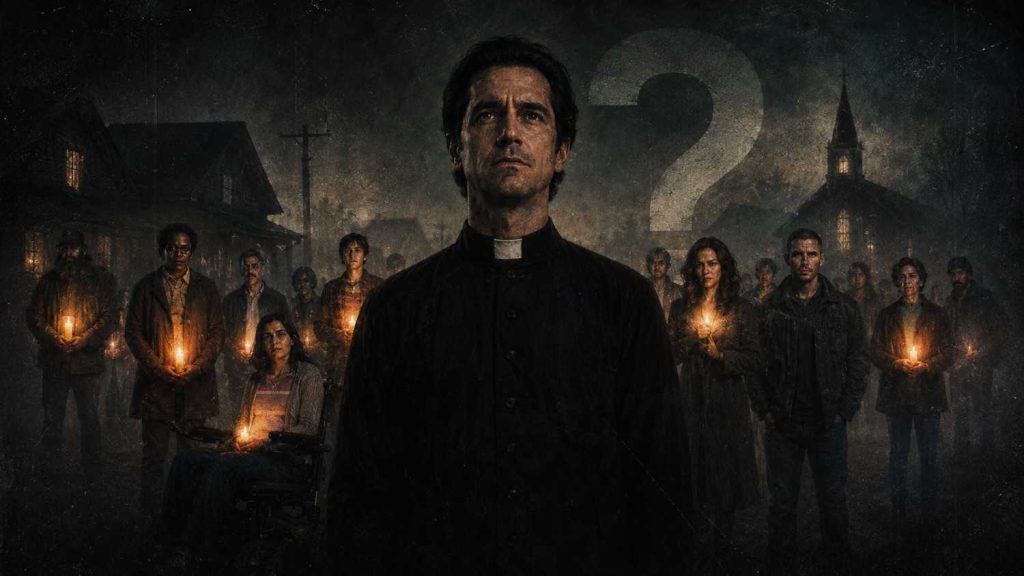
The Real Meaning of the Midnight Mass Ending
The show is not about a vampire. That distinction matters more than it might seem.
Flanagan built Midnight Mass as a story about what happens when belief meets someone willing to exploit it without asking permission. Father Paul did not set out to destroy Crockett Island. He set out to give his community eternal life, which he genuinely believed the Angel made possible. His catastrophic miscalculation was deciding, unilaterally, that this was a gift worth giving without consent.
The people who survive are not the most faithful or the most skeptical. They are the least captured. Warren never drank. Leeza received something she never chose and carries the cost of it in the final frame, sitting in a canoe, unable to feel her legs, watching the only home she knew disappear.
The show’s argument is not that religion destroys communities. It is that certainty, wielded without accountability, destroys communities regardless of what it calls itself. The final image earns its ambiguity. Two teenagers on open water, an island burning behind them, one of them losing something she had only briefly been given back.
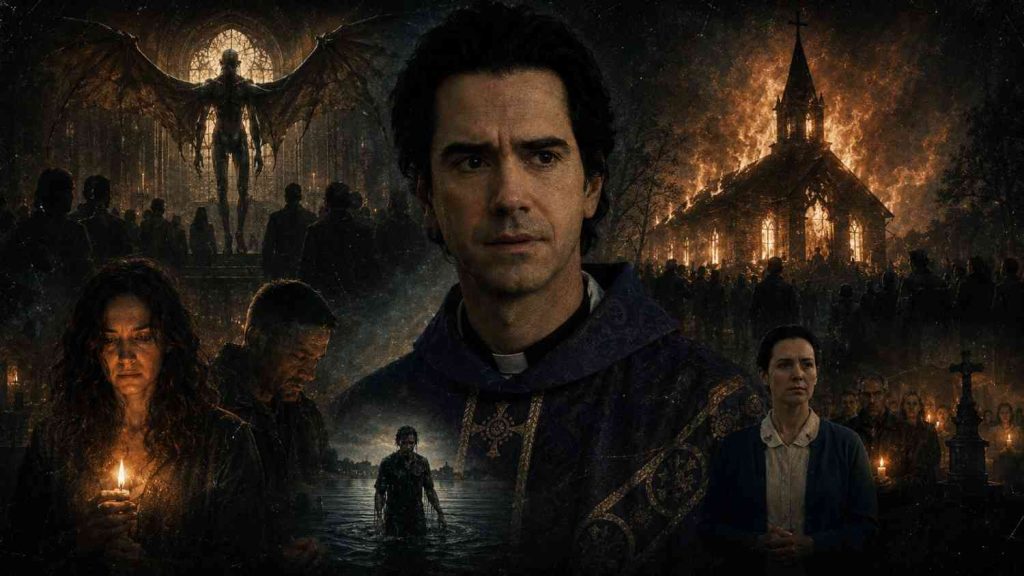
FAQ
Q: Did the Angel die at the end of Midnight Mass?
A: The Angel’s death is not confirmed on screen. Erin destroys its wings so it cannot fly, leaving it grounded and badly wounded with the sunrise approaching. Mike Flanagan has stated in interviews that he deliberately chose not to show the Angel dying, leaving its fate open. The most common fan interpretation is that it died because Leeza loses sensation in her legs in the final scene, which aligns with vampire-sire mythology: when the sire dies, the blood’s effects reverse. Flanagan’s position is that the line confirms the blood’s regression but does not confirm the Angel’s death.
Q: Why can’t Leeza feel her legs at the end?
A: Leeza lost the ability to walk due to a gunshot wound before the events of the show. Father Paul restored her mobility through communion wine infused with the Angel’s blood. When she says she can no longer feel her legs in the final scene, it means the blood’s effect has ended and her paralysis has returned. The most widely accepted explanation is that the Angel died, severing the blood connection. Flanagan has acknowledged the regression but stated the Angel’s fate is intentionally ambiguous, meaning the loss of sensation confirms the effect wore off without confirming how or why.
Q: Who survived Midnight Mass?
A: Two people survive: Warren Flynn and Leeza Scarborough. They escape in a canoe before the sunrise that kills every converted islander on Crockett Island. Warren never took communion and was never turned. Leeza had been healed by the Angel’s blood through Father Paul’s wine, but she never chose the full conversion. Everyone else on the island dies when the sun rises after Bev and Sturge burn the buildings and boats to prevent escape.
Q: What was Bev Keane’s plan, and why did it fail?
A: Bev believed that burning the island’s buildings and boats would force the community to shelter in the church, where the Angel would protect them through the daylight. The plan failed because the Angel could not provide shelter once Erin destroyed its wings and grounded it. Every converted islander burned in the sunrise. Bev herself tried to dig a physical shelter to survive, which also failed. She died alone in the hole she dug, having abandoned the faith she performed all series the moment her survival was at stake.
Q: Is Midnight Mass connected to other Mike Flanagan shows?
A: Midnight Mass shares thematic DNA with Flanagan’s other Netflix work, including The Haunting of Hill House, The Haunting of Bly Manor, and The Fall of the House of Usher, but it is not set in the same universe. Flanagan has a consistent preoccupation with grief, faith, and what people do with their terror of death, and those themes run through all of his Netflix projects. Midnight Mass is self-contained and does not cross over with his other series.
Q: Does the ending of Midnight Mass mean fanaticism always survives?
A: The ending argues that fanaticism cannot be conclusively killed the way an individual person can. Flanagan’s stated intent was to leave the Angel’s fate open specifically because the creature functions as a metaphor for how corrupt belief systems persist. Destroying the host does not destroy the pattern. The show is not saying fanaticism always wins, but it is saying that certainty it has been eliminated is exactly the kind of wishful thinking that allowed the problem to take root on Crockett Island in the first place.
Q: Why did Erin Greene have to die in Midnight Mass?
A: Erin’s death is structurally necessary because her earlier conversation with Riley established the show’s alternative to religious certainty: acceptance that death is not an ending but a dispersal, and that living well matters more than living forever. Her death, framed to echo exactly what she described to Riley, completes her arc. She chose to die for people she would never meet, with no faith in a reward, which is precisely the opposite of what Father Paul offered the congregation. Her death is the show’s counterargument to the entire premise of the Angel.
Q: Does Riley Flynn die in Midnight Mass?
A: Yes, well before the finale. The Angel attacks Riley in the fourth episode, and Father Paul revives him with its blood, turning him into one of the converted. Rather than live as an immortal predator, Riley takes Erin out on a boat at dawn in the fifth episode and lets the sunrise burn him to ash, choosing death on his own terms. That choice is what puts Erin, not Riley, in the room with the Angel during the finale: she already watched what the blood does to someone she loves, which is why she fights to ground the creature instead of accepting what it offers.
The one thing that holds across all of Midnight Mass is that the show knows what it is about. It is not about a vampire loose on an island. It is about what happens when a community’s existing faith is turned into a weapon by someone who believes his certainty justifies what he does in its name.
The ending does not resolve every question because that is not what endings of this kind are for. Leeza’s legs stop working. The Angel’s fate is unknown. The island is ash. Two teenagers are alive on open water, carrying something they did not ask for. If you walked away wanting one more season to close the loop, the show would say that wanting clean closure is the first step toward becoming someone who could justify burning the boats.
Watch it again knowing how it ends. The second time, the horror is not in the jump scares. It is in how reasonable every decision sounds right up until it isn’t.