What Actually Happened When Netflix Cancelled 1899
Netflix cancelled 1899 on January 30, 2023, six weeks after the show premiered on December 17, 2022. There was no press release from Netflix. No formal statement. Creators Baran bo Odar and Jantje Friese announced the news themselves on Instagram with a message thanking their audience and confirming that season 2 would not be happening.
The public numbers at the time looked strong by any conventional standard. Netflix’s own transparency data showed 115.1 million viewing hours in the first 28 days, placing 1899 among the most-watched non-English language shows in Netflix history at that point. The show had a critics score sitting at 67% on Rotten Tomatoes, which is not spectacular but is solidly in the range of shows that receive renewal consideration.
What made the cancellation particularly painful for fans was the scale of what got cut. Odar and Friese had conceived 1899 as the first part of a trilogy. Season 2 and season 3 were not vague possibilities sitting in a pitch deck. They were mapped out. The cancellation did not interrupt a show that was still figuring itself out. It ended a show whose creators knew exactly where they were going.
For viewers who found Netflix’s shows cancelled on cliffhangers pattern frustrating before 1899 even aired, this outcome felt like confirmation of a systemic problem rather than an isolated business decision.
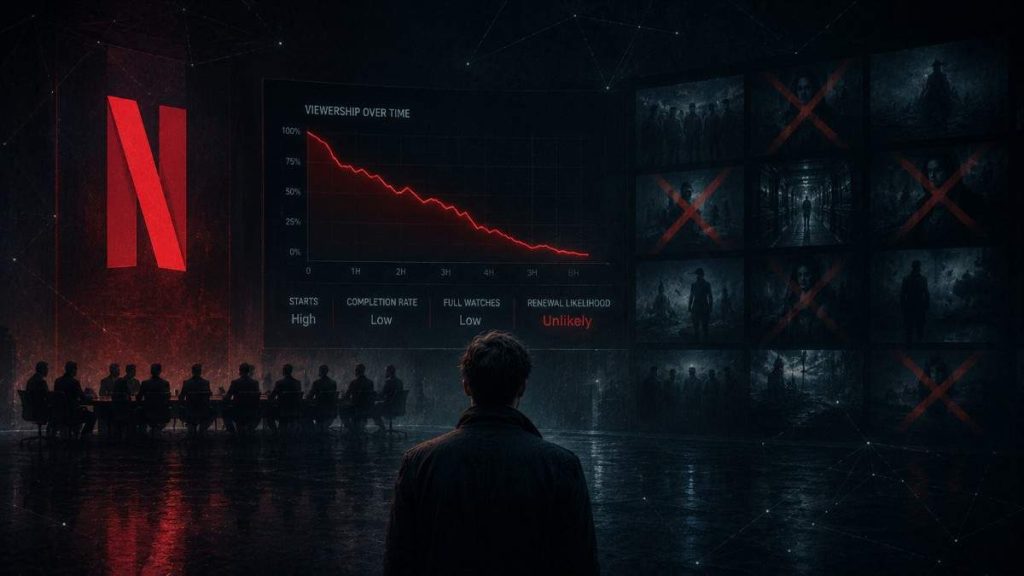
Why High Viewership Didn’t Save It — Netflix’s Completion Rate Explained
Netflix’s renewal decisions are not primarily driven by how many hours of a show get watched. They are driven by how many viewers who start a season actually finish it.
That metric is called the completion rate. If one million people watch episode one of a series and 400,000 of them make it to the finale, the completion rate is 40%. Netflix uses this number as a proxy for subscriber retention, because a viewer who finishes a show is demonstrably more likely to cite that show as a reason they stay subscribed. A viewer who dropped off after three episodes is not.
This is where the 115.1 million viewing hours figure becomes more complicated than it first appears. Eight episodes of 1899 average roughly 60 minutes each, meaning a full season requires about eight hours of viewing. If you divide 115.1 million hours by eight, you get roughly 14.4 million complete season views. That math only holds if everyone who contributed to those hours watched the whole thing. If a significant portion of viewers watched the first three episodes and stopped, the completed-season count drops substantially, and those partial-watch hours inflate the total while delivering none of the retention signal Netflix actually needs.
Reddit communities around 1899 observed this pattern anecdotally in real time. Within weeks of the premiere, r/1899 was full of comments from people who had watched the first two or three episodes and drifted away, citing the show’s density, its language demands, or simply the competition of other titles on their queue. Anecdotes are not data, but they pointed toward something the numbers were presumably confirming internally at Netflix.
Multilingual shows face a structurally specific problem on streaming platforms. Subtitle fatigue is a documented behavioral phenomenon in streaming research. Viewers watching subtitled content at scale show higher drop-off rates than viewers watching shows in their native language, particularly on platforms where passive, dual-screen, or background viewing is the dominant behavior. 1899 required active, focused attention across seven languages simultaneously. That is a significant ask on a platform where the default mode is not active and focused.
Dark, the 1899 creators’ previous series, was also multilingual and similarly complex. It also built a devoted audience across three seasons. The key difference is timing. Dark launched in 2017, before Netflix’s internal renewal models tightened considerably in response to post-pandemic subscriber losses. By the time 1899 arrived in late 2022, Netflix was operating under a fundamentally different calculus than it had been five years earlier.
How Much Did 1899 Cost to Make — and Why That Mattered
Budget is the second half of the completion-rate equation, and 1899’s production costs were not modest.
Netflix has not published per-episode budget figures for 1899, but industry reporting and production context establish the scale. The show was filmed almost entirely on LED volume stages in Berlin using virtual production technology, the same approach The Mandalorian pioneered. That technology is expensive to operate and requires significant pre-production investment.
Beyond the technical infrastructure, 1899 assembled a multilingual ensemble from across Europe, coordinating contracts, scheduling, and production logistics across multiple countries and languages. Premium international co-productions at that level consistently land in the range of tens of millions of dollars per episode.
Netflix’s internal renewal model weighs cost-per-engaged-viewer. A show that costs $10 million per episode and retains 90% of its audience through the finale looks like a different business proposition than a show that costs $10 million per episode and loses the majority of viewers before episode six. When completion rates are low and production costs are high, the renewal math moves quickly in one direction.
The broader streaming environment in early 2023 made this calculus even less forgiving. Netflix had just come off its first major subscriber loss in a decade and was in active cost-reduction mode across its content portfolio. Multiple expensive, critically acclaimed serialized shows were cancelled across the industry during this period. Not because they were failures in any creative sense, but because the economics of sustaining them could not be justified against the retention data.
Why 1899 Specifically Struggled to Hold Viewers
Nothing about what follows is a criticism of 1899 as a piece of television. The show’s creative choices were deliberate, coherent, and artistically defensible. They were also choices that created predictable friction on a specific platform with a specific viewer base.
The Mystery Required Homework
1899 operated the way Dark did: it rewarded viewers who paid close attention, caught visual callbacks, and theorized actively between episodes. That is a genuinely satisfying experience for a certain kind of viewer. On Netflix, where a large percentage of viewing happens on a second screen alongside a phone, or as background noise during other activities, that engagement model is a structural mismatch. A show that requires you to actually watch it is competing with shows that do not, on the same interface, with the same recommendation algorithm pushing alternatives constantly.
The Multilingual Cast Raised the Barrier Continuously
The show’s characters spoke English, German, French, Polish, Spanish, Portuguese, Cantonese, and Hindi. For viewers already comfortable with subtitled viewing, this was immersive world-building. For viewers who were not accustomed to subtitle-heavy watching, it represented a sustained cognitive load that persisted across every episode. There was no point in the season where the language demands relaxed.
The Pacing Front-Loaded Mystery Over Resolution
The opening three episodes of 1899 established atmosphere, character, and an expanding web of unanswered questions. Answers were not the priority in the early hours. For viewers who needed forward momentum and visible payoff to stay engaged, the show’s structure offered neither quickly. On a platform where the algorithm actively surfaces competing content during any perceived lull in engagement, that pacing created an exit window that a significant portion of the audience walked through.
1899 vs. Archive 81 — The Same Problem, the Same Result
Archive 81 was cancelled by Netflix in the same month as 1899, January 2023, and the structural parallels are specific enough to be worth examining carefully.
Archive 81 was a horror mystery series with a multilayered narrative, a passionate fan community, strong social media presence, and solid initial viewership numbers. It was also cancelled after one season, also left with an open storyline, and also never found a revival on another platform. The cancellation of Archive 81 followed the same mechanics: a cerebral, slow-build mystery that demanded active viewer attention on a platform optimized for passive consumption, with completion rates that could not support the production cost.
The simultaneity of these two cancellations in January 2023 is not a coincidence. It reflects a deliberate repositioning by Netflix away from a category of show: cerebral, serialized, mystery-dependent, completion-punishing, and expensive. Both shows had the viewers who loved them. Neither had them in the proportions the business model required.
This pattern extends further back. The OA was cancelled in 2019 despite a devoted following. Mindhunter was quietly shelved the same year. Sense8, Altered Carbon, and other ambitious serialized productions all hit the same ceiling. The audience for these shows is real and intensely engaged. The problem is that intensely engaged does not mean completing at rates that justify renewal when the production costs are high and the completion data is not.
For a useful parallel in seeing how far along a cancelled Netflix show’s creative plans can be before the platform pulls the plug, the piece on what The OA season 3 would have covered is worth reading.
Will There Ever Be a Season 2 of 1899?
As of mid-2026, no season 2 of 1899 exists, and no revival announcement has been made.
Netflix has not reversed the cancellation. No other major streaming platform, including Amazon, HBO, Apple TV+, Paramount+, or Peacock, has announced any interest in picking up the series. Odar and Friese have not publicly indicated that active revival negotiations are in progress.
The obstacles are structural rather than sentimental. 1899 was produced as a Netflix original, which means Netflix holds significant rights over the property. Any third-party platform interested in continuing the story would need to negotiate those rights from a position of limited leverage, since Netflix has no financial incentive to facilitate a competitor’s acquisition of a show it chose not to renew. The multilingual ensemble cast would need to be reassembled across multiple countries after a gap of years.
There are precedents for cancelled Netflix shows finding new homes. Lucifer moved to Netflix from Fox and completed its run. Arrested Development returned after years away. But serialized mystery shows are categorically harder to revive than procedurals or comedies, because their narrative momentum depends on viewer memory. An audience that watched 1899 in December 2022 has had more than three years to process the ending, move on to other shows, and lose the week-to-week emotional investment that a second season would need to immediately recapture. The window for a revival narrows with every month that passes.
One thing worth saying clearly for viewers still on the fence: watching 1899 knowing there is no season 2 is not a wasted experience. The season 1 finale is structured as a genuine revelation rather than a pure cliffhanger. It recontextualizes everything that came before it. Viewers who approach the show as a self-contained mystery with an open ending will find it more satisfying than the discourse around its cancellation might suggest.
Why Netflix Keeps Cancelling Shows Like This
The 1899 cancellation is frustrating when viewed in isolation. It makes complete sense when viewed as part of Netflix’s platform architecture.
Netflix’s business model requires subscriber retention at scale. The shows that best support subscriber retention are easy to start, accessible enough to finish, emotionally engaging without requiring active intellectual participation, and not structured in ways that make them feel incomplete if a second season never comes. Limited series with self-contained endings, reality competitions with episodic payoffs, and procedural dramas with accessible entry points all perform structurally well on Netflix’s completion metrics.
Open-ended serialized mysteries with multilingual casts, dense symbol systems, and narratives that deliberately withhold resolution are the opposite of that description. They serve a specific audience exceptionally well. That audience just does not complete at the rates Netflix’s subscriber retention model needs to justify the cost of production.
This is not a values judgment about which kind of storytelling is better. What it represents is a genuine incompatibility between a certain kind of ambitious storytelling and a platform whose business metrics reward a different kind of viewing behavior entirely. The creators of 1899 knew they were making a show for viewers who want to think. That audience found the show. They watched it, theorized about it, and cared about it deeply. The problem was never that the show was unwanted. The problem was that deeply wanted by a dedicated audience and completed at scale by a mass subscriber base are two different things, and Netflix’s renewal model only measures one of them.
FAQ
Why was 1899 really cancelled by Netflix?
Netflix cancelled 1899 in January 2023 because its completion rate, the percentage of viewers who actually finished the full eight-episode season, did not meet the threshold Netflix uses to justify renewal. Despite logging 115.1 million viewing hours in its first 28 days, a large portion of that total came from viewers who dropped off before the finale. Netflix uses completion as a subscriber retention signal rather than raw hours watched. 1899’s multilingual format, slow-burn pacing, and layered mystery structure made it one of the more demanding shows on the platform, which contributed to higher-than-average drop-off.
Will 1899 ever be picked up by another streaming service?
As of mid-2026, no other platform has announced a pickup. The rights situation is complex since Netflix produced the show as an original, which creates licensing barriers for any competitor. The multilingual ensemble cast would need to be reassembled after a significant gap. The longer a revival takes, the harder it becomes to recapture audience investment in a serialized mystery. Precedents for cancelled Netflix shows reviving elsewhere exist, but they are rare, and serialized mysteries are harder to revive than other formats.
Is 1899 worth watching if it was cancelled without an ending?
Yes, with one important framing adjustment. The season 1 finale is not a traditional cliffhanger. It is a narrative recontextualization that reframes the entire season in a meaningful way. Viewers who approach it as a self-contained mystery with an open-ended conclusion rather than as a setup for more seasons will likely find it satisfying. The cancellation removes future answers, but it does not remove the internal logic and craft of what season 1 accomplished on its own terms.
Did the creators of 1899 know the show was cancelled before they announced it?
Baran bo Odar and Jantje Friese announced the cancellation on Instagram in January 2023, which was the same moment the public learned about it. Netflix did not release a formal statement. The creators confirmed in their post that there would be no season 2 and thanked their audience directly. Whether they had advance warning from Netflix before the announcement or learned of the decision at the same time as the public has not been clarified in any subsequent interview.
How is 1899’s cancellation different from why Dark succeeded on Netflix?
Dark launched in 2017, years before Netflix’s internal renewal metrics tightened following its first major subscriber losses in the early 2020s. Dark also built its audience across three seasons during a period when Netflix was still willing to invest in slow-growth international prestige content. By 2022, Netflix’s calculus had changed significantly. The same format that was viable for Dark in a more permissive content environment became a completion-rate liability in a post-pandemic streaming landscape where the company was cutting costs and prioritizing retention-optimized programming.
Why do multilingual shows struggle to complete on Netflix specifically?
Subtitle fatigue is a documented behavioral pattern in streaming research. Viewers watching subtitled content show higher drop-off rates than viewers watching shows in their native language, particularly when the viewing context allows for divided attention. Netflix’s platform design, where hundreds of alternatives are always one click away and background viewing is extremely common, amplifies this effect. 1899 required focused, active attention across seven languages for eight full episodes. That demand did not relax at any point in the season, which created a sustained barrier that competing shows simply did not present.
The Real Reason This Keeps Happening
The 1899 cancellation is not the story of a show that failed. It is the story of a show that succeeded for a specific audience on a platform that can only financially reward success at a different scale.
If you are frustrated by what happened to 1899, that frustration is rational. The show was genuinely ambitious. The creators had a plan. The viewers who found it cared about it. None of that was enough, and the reason it was not enough has nothing to do with whether the show deserved to continue. It has everything to do with the fact that Netflix’s renewal model measures completion rates and cost-per-engaged-viewer, not artistic merit or fan passion.
Watch the show if you have not. Go in knowing it ends in a place that is genuinely interesting even without a resolution, and let it be what it is: one complete, strange, beautifully constructed season of television that got further than most shows do and ran out of runway before it could finish what it started.
The pattern that killed 1899 is still active. If you find yourself invested in any other expensive, multilingual, serialized mystery on Netflix, it is worth keeping one eye on the completion problem. The platform has not structurally changed the conditions that made 1899 a cancellation risk from day one.