

What Vanderpump Rules Cast Actually Made Per Episode
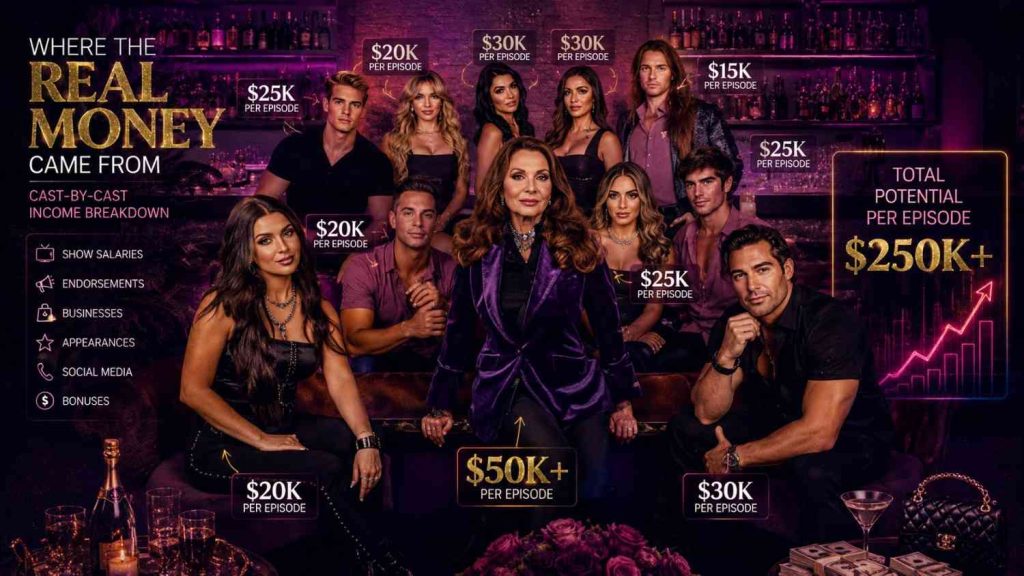
The cast operated on a three-tier pay structure, and the gap between tiers matters more than the top-line number. Reporting from Thomas Wictor placed top-tier cast salaries at approximately $25,000 to $30,000 per episode in the show’s later seasons. Mid-tier cast earned in the range of $10,000 to $15,000 per episode. “Friends of” cast members, who appeared on a recurring but non-contracted basis, received flat fees per appearance rather than a full episodic rate.
The annual math is where the real picture starts to form. A standard Vanderpump Rules season runs approximately 20 episodes, plus a three-part reunion that counts as separate filming days with separate compensation. That brings the total to roughly 23 paid appearances per season. At the top-tier rate, that works out to somewhere between $575,000 and $690,000 per year in base Bravo income before any outside work is counted.
Season 1 pay tells a different story. Early reporting from US Magazine indicated the original cast earned closer to $8,000 total for the first season, not per episode. The salary evolution across 11 seasons is one of the more dramatic compensation arcs in Bravo history, and it reflects both the show’s growing ratings and the cast’s growing negotiating leverage as they became recognizable enough to walk away for other deals.
| Tier | Per Episode Rate | Estimated Annual (23 appearances) |
|---|---|---|
| Top Tier (Sandoval, Shay, Maloney) | $25,000 – $30,000 | $575,000 – $690,000 |
| Mid Tier | $10,000 – $15,000 | $230,000 – $345,000 |
| Friends Of (flat fee per appearance) | Varies | Not applicable |
How Vanderpump Rules Pay Compares to Real Housewives
Placed against the broader Bravo ecosystem, VPR’s top-tier earnings land solidly in the middle of the pack. Real Housewives salaries range from roughly $75,000 per season for lower-profile cast members up to reported figures of $1 million to $2 million per season for franchise anchors like Kyle Richards and NeNe Leakes at their peaks.
The structure is different, though. Real Housewives deals are typically negotiated as flat seasonal fees, regardless of episode count or screen time. VPR’s per-episode model means a cast member with heavy storyline involvement in a given season earns more than one who appears in the background. When Scandoval became the dominant Season 11 storyline, Sandoval and Madix were almost certainly on screen more than any other cast members, and the per-episode structure rewarded that directly.
Do Vanderpump Rules Cast Get Paid for Reunions?
Yes, and the detail matters for the annual math. The three-part reunion is filmed as three separate production days. Reporting consistently indicates cast receive additional compensation for each one rather than having reunions folded into a flat season sum.
This is the number most salary breakdowns online get wrong by omission. A cast member who attended every reunion appearance across the show’s later run was adding tens of thousands of dollars annually to their base figure.

The Lisa Vanderpump Exception (And Why Her Pay Is in a Different Category)
Lisa Vanderpump’s compensation is not comparable to the rest of the cast. She is both the show’s namesake and an executive producer, which means her income from Vanderpump Rules comes from two structurally different places at the same time.
Being the namesake of a show is a separate commercial asset from being a cast member on it. The show’s title exists because of her restaurants, her brand, and her prior Real Housewives of Beverly Hills profile. That is worth something independent of her on-screen time.
Yahoo Entertainment reporting noted her salary was described as “more than double” what the main cast received, which places the floor estimate above $50,000 to $60,000 per episode. The executive producer credit adds a layer beyond talent fees entirely. EP credits on Bravo reality shows typically include some form of backend participation in the show’s production economics, meaning she earns from the show’s licensing and syndication value, not just from showing up to film.
The honest framing: Lisa isn’t a cast member who gets paid more. She’s the enterprise the cast members are employed by. Everyone else is talent. She owns a piece of the vehicle.
Where the Real Money Came From: Cast-by-Cast Income Breakdown
This is the section every other piece on this topic skips. The per-episode figures are the starting line. What the cast built outside Bravo is the finish line, and the gap between the two is where the real story lives.
Ariana Madix: The Highest Post-Scandoval Earner
Ariana Madix is the clearest proof of concept for what the Scandoval bump could do to a cast member’s commercial value. When the story broke in March 2023, she was a well-liked but not especially high-profile cast member. Within 12 months, she had landed endorsement deals with Uber Eats, the New York Times, and Bloomingdale’s, finished third on Dancing with the Stars Season 32, and taken on the hosting role for Love Island UK Season 6.
Dancing with the Stars typically pays cast members between $125,000 and $250,000 for a full season run depending on placement. The Love Island hosting credit is the most significant piece of that run, not because of what it paid in year one, but because of what it signals. Moving from reality cast member to mainstream TV host is a structural upgrade in career category, and the earning ceiling for a working television host is considerably higher and more stable than the earning ceiling for a recurring Bravo cast member.
Something About Her, the sandwich shop she opened with Katie Maloney in 2024, adds a brick-and-mortar business to the portfolio. Converting cultural moment into a physical business is rare in this space. Most cast members stick to the podcast-to-brand-deal pipeline. Madix and Maloney built something you can walk into.
The underlying mechanics are worth noting. Madix entered Scandoval as the sympathetic party in the most-watched Bravo storyline in years. Brands needed to associate with that sympathy quickly, before the news cycle moved on. The deals landed fast because the window was real and everyone knew it. Understanding how reality TV contracts actually structure talent relationships helps explain why she was free to sign those endorsement deals simultaneously rather than being locked into Bravo exclusivity.
Scheana Shay: Scheananigans and the Longevity Play
Scheana Shay has appeared in every season of Vanderpump Rules since Season 1. Over 11 seasons, that cumulative Bravo income alone places her among the highest all-time earners from the show in terms of total dollars collected, even if her per-episode rate isn’t the highest at any given moment.
Her podcast Scheananigans with Scheana Shay operates under an iHeartMedia deal. Mid-tier Bravo-adjacent podcasts with established iHeart distribution and consistent download numbers typically generate between $500,000 and $1 million annually across ad revenue and deal terms. Scheana has not disclosed specific figures, but the iHeart partnership puts a structural floor on the income.
Scheana’s model is the longevity play. She didn’t have one massive commercial moment like Scandoval. She built steady, stacked income across every available channel for over a decade.
Lala Kent: The Brand Stack
Lala Kent’s income picture by the end of her VPR run was already running on multiple parallel tracks. Her Give Them Lala podcast is one of the more commercially successful Bravo-adjacent content properties, and Kent has spoken publicly about ad revenue from the show. The Give Them Lala Beauty product line adds a separate revenue stream that doesn’t depend on podcast download numbers or Bravo airtime.
By Season 11, Kent had built a brand stack that made the Bravo salary almost incidental to her total income picture. The show kept her name in front of an audience. The product line converted that audience into buyers. That’s the formula, and Kent executed it earlier and more cleanly than most of her co-stars.
Tom Sandoval: The Villain Economy
Tom Sandoval’s post-Scandoval income trajectory is the most counterintuitive story in this entire cast breakdown. Being the villain of the most-watched Bravo scandal in years should, by normal logic, collapse your commercial value. What actually happened is more complicated.
Sandoval appeared on Special Forces and The Traitors Season 3. Competition shows in the Traitors tier reportedly pay top-draw cast members in the range of $200,000 or more per appearance cycle, according to The U.S. Sun’s reporting on competition show pay structures. Notoriety generates the same kind of booking value that sympathy does, at least in the short term, because producers want known names and Sandoval became one of the most-known names in reality TV overnight.
His band, Tom Sandoval and the Most Extras, continued to book gigs throughout the Scandoval fallout period. Music touring income is modest for a band at that level, but it’s real, and it’s income that existed before VPR and will continue after it.
The economic observation here is genuinely interesting. Sandoval and Madix both monetized Scandoval, one as the sympathetic party and one as the villain. They arrived at roughly the same commercial outcome through opposite entry points. Fame is fame in the attention economy.
Katie Maloney: Two Streams and a Sandwich Shop
Katie Maloney’s income structure reflects a mid-tier cast member who built outside revenue intelligently without landing a single massive commercial moment. Her You’re Gonna Love Me podcast contributes a content income layer above her Bravo salary. Something About Her with Ariana Madix, which opened in 2024, is the higher-profile piece.
The sandwich shop is worth examining as a case study in timing. Maloney and Madix opened it during peak Scandoval cultural saturation. The combination of Madix’s sympathetic positioning and Maloney’s established fan base created a built-in opening audience. A restaurant opening with a line out the door before anyone has tasted the food is a specific kind of cultural moment that doesn’t happen without a viral backstory.
Tom Schwartz: The Cautionary Note
Tom Schwartz is the most honest data point in this entire cast breakdown, and it’s the one most salary pieces skip because it complicates the “everyone gets rich” narrative.
Schwartz and Sandy’s, the bar he opened with Sandoval, closed in 2024. His outside income profile is thinner than almost any other long-running cast member. He has appeared on podcasts and maintained a social media presence, but the durable outside income streams that his co-stars built are largely absent from his portfolio.
Schwartz’s estimated net worth sits around $4 million, which is a real number but one that reflects 11 seasons of cumulative Bravo earnings more than it reflects outside business success. The show made him comfortable. It didn’t make him entrepreneurially independent. Not every cast member converts fame into business infrastructure, and Schwartz is the clearest example of that reality.
James Kennedy: The Independent Professional
James Kennedy is a useful counterexample to the whole “Bravo as launch vehicle” thesis, because he is the one cast member whose professional identity was never primarily dependent on the show.
Kennedy’s DJ career, including Las Vegas residencies and bookings, existed in parallel with his Vanderpump Rules tenure rather than downstream from it. His income as a working DJ is measurable in gig fees, residency contracts, and brand deals attached to his music profile. He has the most independent financial footing of anyone in the original cast because his core skill set has a market outside of reality television.
Stassi Schroeder and Kristen Doute: The Post-Exit Recovery
Both Stassi Schroeder and Kristen Doute were removed from the show in 2020 following a racially insensitive incident involving Faith Stowers. Neither career ended.
Stassi rebuilt through her Straight Up With Stassi podcast, book deals, and brand deals. Her income recovery after leaving the show is one of the more notable examples of Bravo name recognition outlasting show tenure. Kristen joined The Valley spinoff on Bravo and launched the Balancing Act podcast.
The pattern matters: being cut from VPR did not erase either of them from the Bravo ecosystem or from commercial relevance. The name recognition generated over multiple seasons proved more durable than the show contract itself.
Rachel Leviss: The Same Playbook, Different Entry Point
Rachel Leviss, who later went by Raquel, left Vanderpump Rules following the Scandoval fallout, citing compensation concerns and mental health. Her exit was the most-discussed individual departure from the show since it began.
She launched Rachel Goes Rogue under an iHeartMedia deal, converting her post-Scandoval notoriety into a content vehicle. Her pay in the final season has not been publicly confirmed, but she was believed to be on a mid-tier contract rather than a top-tier one despite being central to the biggest story in the show’s history. That compensation gap was part of the reported reason for her departure.
The structural observation: even at the center of the most-watched Bravo scandal in years, she followed the same playbook as everyone else. Leave the show, start a podcast, build on the attention. The template is now that consistent.
What Scandoval Actually Did to Reality TV Economics
Scandoval is studied as a drama. It should also be studied as a financial event. The two framings lead to very different conclusions.
The scandal broke during Season 11’s airing in March 2023. Ratings for the back half of the season were the highest VPR had seen in years, reportedly drawing numbers that hadn’t appeared since the show’s earlier peak. That ratings surge translated directly into advertising revenue for Bravo and into attention value for the cast.
The Scandoval bump in commercial terms was something the industry had not seen at that speed or scale before. Endorsement deals that typically require 12 to 18 months of relationship building between a talent, their management, and a brand were landing in weeks. Ariana Madix’s Uber Eats campaign reportedly came together faster than almost any comparable reality TV talent deal on record, because brands were moving on the cultural moment rather than on a standard talent pipeline timeline.
The broader lesson for the genre is structural. Scandoval proved that one viral season can generate more endorsement revenue for a cast member than years of baseline Bravo salary. It decoupled reality TV income from network pay in a way that hadn’t been demonstrated so cleanly before. A cast member willing to be at the center of a major story, on the right side of audience sympathy, can compress five years of commercial momentum into 18 months.
Every current reality cast is watching that math. The goal for an ambitious reality cast member is no longer “earn a multi-season run with steady escalating pay.” The goal is “go viral once, convert the attention fast.” Scandoval is now the template, and it changed the incentive structure of the entire genre. If you want to understand how reality TV contracts have started to evolve in response to that dynamic, the shift is visible in how brands are now building social media performance clauses directly into talent agreements.
Season 12 and What It Means for Original Cast Income
Season 12 of Vanderpump Rules premiered on December 2, 2025, with an entirely new SUR staff cast. Lisa Vanderpump returned. No other original cast member was brought back as a series regular.
For the original cast, this is effectively the end of the Bravo income stream. The show that generated $575,000 to $690,000 annually for top-tier cast is no longer their show. Whatever they earn going forward comes entirely from the infrastructure they built outside it.
The cast members who built durable outside income are in a materially different position than those who didn’t. Ariana Madix has a TV hosting career and a brick-and-mortar business. Scheana Shay has a multi-year podcast operation under a major distribution deal. Lala Kent has a product line. Tom Sandoval has a booking profile as a competition show personality and a working band. James Kennedy has a DJ career. Those income streams don’t require Bravo to continue.
Schwartz’s situation is the exception that defines the rule. Without a running show and without a portfolio of outside businesses generating consistent revenue, the cupboard is relatively thin. His net worth reflects what the show paid him, not what he built alongside it.
Season 12 also raises a forward-looking question for the new cast: can they replicate the original cast’s outside income trajectory without the Scandoval-scale cultural moment that turbocharged it? The template exists. The question is whether the audience attention follows a new group of faces, or whether the Vanderpump Rules brand itself was inseparable from the original personalities who defined it for a decade.
FAQ
How much did the Vanderpump Rules cast make per episode?
Top-tier cast members, including Tom Sandoval and Scheana Shay, earned approximately $25,000 to $30,000 per episode in Seasons 10 and 11. Mid-tier cast earned roughly $10,000 to $15,000 per episode. “Friends of” cast received flat per-appearance fees. With a standard season of 20 episodes plus a three-part reunion adding separate filming days, top-tier annual base income from the show ran between $575,000 and $690,000. Season 1 pay was far lower, with reports suggesting some cast members earned around $8,000 total for the first season.
How much does Lisa Vanderpump make compared to the rest of the cast?
Lisa Vanderpump’s compensation is not directly comparable to the cast’s per-episode structure because she earns as both the show’s namesake and as an executive producer. Reporting has described her salary as more than double what main cast members received, placing the floor estimate above $50,000 to $60,000 per episode in talent fees alone. The executive producer credit adds backend participation in the show’s production economics on top of that. She is not a highly paid cast member. She is a partial owner of the enterprise.
Did Ariana Madix make more money from Scandoval than from Vanderpump Rules itself?
Almost certainly yes, within 18 months of the scandal breaking. Madix landed endorsement deals with Uber Eats, the New York Times, and Bloomingdale’s, finished Dancing with the Stars Season 32 in third place (a competition that pays cast members between $125,000 and $250,000 for a full run), and took on the Love Island UK Season 6 hosting role. Combined, that post-Scandoval commercial run likely exceeded her cumulative Bravo earnings from her VPR seasons, particularly given that she entered the show on a mid-tier salary before escalating in later seasons.
Did Scandoval actually hurt Tom Sandoval financially?
In the short term, no. Sandoval’s post-Scandoval bookings include Special Forces and The Traitors Season 3, which reportedly pays top-draw cast members in the range of $200,000 or more per appearance cycle. His band continued to book gigs throughout the fallout period. In the attention economy of reality TV, notoriety generates booking value at roughly the same rate as sympathy. What Sandoval lost was public goodwill. What he retained was name recognition, and in his industry, name recognition pays.
What do Vanderpump Rules cast members make from podcasts?
The figures vary but the structural model is consistent. Scheana Shay’s Scheananigans operates under an iHeartMedia deal, with mid-tier Bravo-adjacent podcasts at that distribution level typically generating between $500,000 and $1 million annually across ad revenue and contract terms. Lala Kent’s Give Them Lala is among the more commercially successful Bravo-adjacent podcasts, though specific revenue figures have not been publicly confirmed. Rachel Leviss launched Rachel Goes Rogue under an iHeartMedia deal post-departure. The podcast is now the standard first move for any departing or transitioning Bravo cast member.
Why did Vanderpump Rules reboot with a new cast for Season 12?
The original cast had largely moved on from SUR Restaurant, which is the actual setting of the show, making the premise increasingly difficult to sustain. Bravo and production opted to recast with actual current SUR employees rather than continue following original cast members who no longer worked there. Season 12 premiered December 2, 2025. Only Lisa Vanderpump returned from the original lineup, preserving the show’s brand identity while resetting the talent roster entirely.
Do Bravo reality stars get residuals from reruns?
Standard reality TV contracts typically do not include SAG-style residual structures. Reality cast members are generally not members of SAG-AFTRA, which means the residual protections that apply to scripted TV actors do not automatically apply to them. Some contracts include backend participation clauses, but these are negotiated individually and are not standard. For most VPR cast members, income from the show stopped when filming stopped. This is part of why the pivot to podcasts, product lines, and outside business ventures is so consistent across the Bravo cast ecosystem.
What happens to the original Vanderpump Rules cast now that Season 12 has a new cast?
Their Bravo income is effectively over as a regular source. The cast members who built durable outside revenue, including Ariana Madix through hosting, Scheana Shay through podcasting, Lala Kent through her product line, and James Kennedy through his DJ career, are positioned to sustain their income independently of the show. Cast members who relied more heavily on Bravo salary without building substantial outside businesses face a more difficult transition. The Season 12 reboot is the clearest possible signal that the network’s commitment to the original cast has concluded.
The Bottom Line
The per-episode salary was never the point. The show was always a distribution mechanism, a way to put these people’s faces and personalities in front of a large, engaged audience repeatedly, until that audience cared enough to follow them somewhere else. The cast members who understood that early built businesses. The ones who treated the Bravo check as the destination ended up in a weaker position when the check stopped.
Scandoval accelerated the timeline for the people at its center in a way that had never happened in reality TV quite so visibly before. Ariana Madix didn’t just benefit from sympathy. She benefited from the speed at which that sympathy converted into commercial opportunities, before the cultural moment could fade. That compression of the standard fame-to-income timeline is the lasting economic lesson of the whole story.
If you’re trying to understand how reality TV fame actually turns into money, stop looking at the Bravo salary. Start looking at what each cast member built the moment Bravo stopped being the only camera pointed at them. That’s where the real financial picture lives.