

What Dating a Vegan Actually Means Day to Day
Dating a vegan does not mean your diet changes. It means your partner’s diet is different from yours, and some logistics shift to accommodate that. That’s the accurate version of what you’re signing up for.
Veganism exists on a spectrum. Some vegans are strict across every category: food, clothing, cosmetics, household products. Others are primarily focused on diet and more relaxed about everything else. The specific person you’re dating determines the specifics of the relationship, not a generalized vegan archetype. Anyone who tells you “all vegans are like this” about anything is working from a stereotype, not data.
The most common version of what day-to-day life looks like in a mixed-diet relationship: you eat what you eat, they eat what they eat, and the main coordination happens around shared meals and social plans. A roughly 700,000-person Veganuary participation cycle found that relationship influence was one of the factors people cited in trying plant-based eating, and the framing that came up most was exposure, not pressure. People tried it because their partner cooked something good, not because they were lectured into it.
The practical day-to-day is genuinely less dramatic than the pre-relationship imagination of it. You are not becoming a vegan by proximity. You are dating a person who is one.
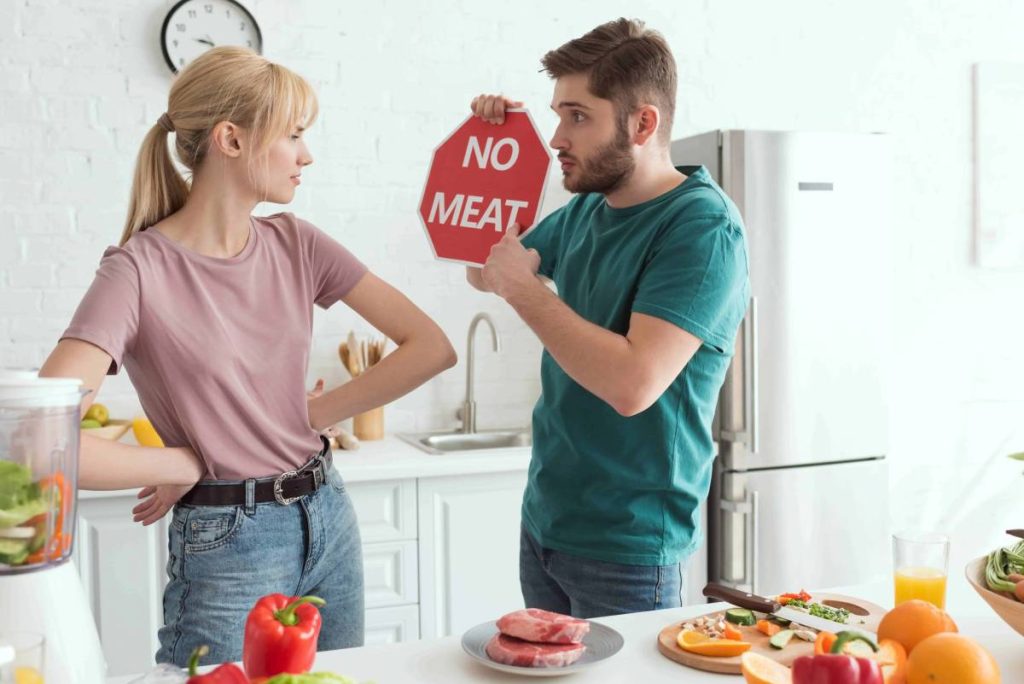
The Food Question: What Eating Together Actually Looks Like
Food is the most immediately practical concern, so it deserves a section that actually answers it rather than dancing around it with vague reassurance.
Restaurants and Date Nights
Finding a restaurant that works for both of you is easier than it was a decade ago, and significantly less complicated than people assume before they try it. Most mid-range restaurants now have real vegan options, not just the depressing “we can do a house salad without the cheese” kind. The practical lift is real but it’s not dramatic.
The app HappyCow exists specifically to solve this problem. It maps vegan-friendly restaurants by location and has solid coverage across most U.S. cities. Using it before a date takes about ninety seconds and removes most of the guesswork.
The honest version of the steakhouse question: some vegans are genuinely uncomfortable in environments where the entire menu is animal-based. Some are fine with it. This is worth a direct, low-stakes conversation early, something like “are there restaurants that feel off-limits for you?” rather than a guessing game or an assumption that one answer applies to all vegans.
Cooking and Eating at Home
This is where the most consistent negotiation happens in mixed-diet couples, because it’s daily rather than occasional. Common arrangements that actual couples use include cooking shared sides with separate proteins, taking turns cooking full meals, or keeping shared cooking surfaces vegan to avoid the conversation becoming a recurring argument about cleaning.
The question of whether to keep meat in the house is real and worth addressing directly rather than assuming. Many vegans are fine with a partner keeping meat in the refrigerator. Some genuinely aren’t. The answer depends on the person, not the category, and asking directly is faster than guessing.
The “is it weird to kiss after eating meat?” question comes up in searches often enough to be worth addressing plainly. Some vegans mind. Most don’t. It’s another one to ask rather than assume, ideally early enough that it doesn’t come up for the first time mid-moment.

The Lifestyle Gap: It’s Bigger Than Food
The food question gets all the attention, but veganism for most people who practice it extends beyond what’s on the plate. Purchasing decisions around leather, wool, cosmetics tested on animals, and certain household products can all be part of a vegan’s lifestyle. This doesn’t mean your partner is going to issue an ultimatum about your leather belt. It means these topics can surface, and knowing that ahead of time means you’re not caught off guard when they do.
Social situations are the friction point most couples cite in practice, not the daily meals. Thanksgiving when your entire family is not vegan and the table is built around a turkey is a real coordination challenge. Office holiday parties, birthday dinners at your parents’ house, your friend’s wedding with a set menu: these are the moments that require actual planning and communication, not just good intentions.
Roughly five percent of U.S. adults identify as vegan or plant-based, according to a 2022 Ipsos and Good Food Institute report. That means almost every social environment your vegan partner enters is majority non-vegan by default. They have already developed a way of handling that. What the relationship actually asks of you is learning to handle it alongside them, which is a different and much smaller lift than handling it for them.
The holiday friction is not unsolvable. Couples handle it all the time with a combination of planning ahead, eating before events when necessary, and the occasional phone call to the host that starts with “hey, quick question about the menu.” None of that is radical. It’s just coordination.

Will They Judge You for Eating Meat?
Some vegans will, and some won’t. That’s the honest answer, and anything softer than that is doing you a disservice.
The more useful version of that answer is this: vegans who see mixed-diet relationships as ethically incompatible generally don’t pursue them. The self-selection process does significant work before you even go on a first date. Someone who is open to dating a non-vegan has typically already worked through their feelings about the food gap and made a decision that the person matters more than the dietary alignment.
The difference between what people fear and what actually happens looks like this. What people fear is an ongoing pressure campaign, regular commentary on their food choices, and a slow erosion of their autonomy until they’re eating lentils and pretending to enjoy it. What actually happens more commonly is the occasional passive signal: a look, a comment that trails off, a sigh that you’re probably reading too much into anyway. Passive and occasional is not a campaign. It’s a person with a position they care about.
If active, regular pressure is happening, that is a communication and compatibility problem. It would show up over something else if not food. The r/vegan community, for what it’s worth, has an active internal debate about whether dating non-vegans is ethically acceptable at all. Vegans are not a monolith on this. It’s a community with real disagreement, which means you’re not dealing with a unified front of judgment. You’re dealing with a person.
Will they try to convert you? Some will, gently, because they care about something and naturally want to share it. That’s not specific to vegans. People do that with religions, fitness routines, political ideas, and TV shows they can’t stop recommending. The difference between sharing something and issuing conditions is a personality trait, not a dietary one.
If you want a real-world frame for how relationship dynamics play out when one person holds strong values the other doesn’t share, the most contested moments on reality dating shows follow exactly the same pattern: it’s never purely about the surface issue. It’s about whether both people feel respected underneath it.

What Actually Matters vs. What People Overthink
This is the part most other articles skip, which is a shame because it’s the most useful thing to know before you start running scenarios in your head.
What actually matters and deserves a real conversation:
- Whether you can consistently find restaurants where both people eat well and neither person feels like an afterthought on the menu
- How you’ll handle major food-centered social events, specifically the holidays and family gatherings that are built around meals
- Whether there are shared household ground rules around cooking surfaces, pantry items, or shared appliances: things worth settling early rather than after the first argument
- Whether the values gap overlaps with other areas of incompatibility, because veganism as an ethical stance is usually connected to a broader worldview, and that worldview will come up in other conversations
- Whether both people can actually talk about the food difference without one person feeling attacked and the other feeling dismissed
What people overthink before it becomes relevant:
- Whether you’ll eventually be pressured into going vegan (you won’t be, unless the relationship is going wrong in other ways)
- Whether every meal will be a conflict (it won’t, with basic planning)
- Whether your vegan partner is privately disgusted by you (they’re choosing to date you, which is a meaningful data point)
- Whether you need to learn every ingredient and animal byproduct before the first date
- Whether their friends will judge you at social gatherings (some might, most won’t care, and that’s their issue not yours)
The first list is worth actual attention. The second list is what your brain generates when it’s trying to protect you from a situation it doesn’t have enough information about yet. You can acknowledge that list and then set it down.

The Values Conversation You’ll Eventually Need to Have
Veganism, for most people who practice it, is an ethical position. It’s not a dietary preference in the way that preferring chicken over fish is a dietary preference. It’s connected to how they think about animals, environmental impact, and how consumption choices interact with those things. That framework shows up in other conversations. Not constantly, not as a lecture series, but it shows up.
This is not a warning. It’s information that helps you understand what you’re working with.
Couples with different values on one axis can have deeply compatible values across everything else. Research on long-term relationship satisfaction consistently points to shared values on the things that affect daily life: how you handle money, how you treat people, whether you want children, and how you make decisions when things get hard. Dietary ethics is one axis on a much larger map. It doesn’t determine the whole territory.
The long-term question is worth raising before it becomes urgent. If the relationship becomes serious, the conversation shifts from “how do we handle dinner?” to “how do we want to run a household, and eventually, how do we raise kids if that’s part of the plan?” That conversation is worth having before it’s forced by circumstances.
The early signals in a relationship that actually predict long-term problems are almost never about the surface content of the disagreement. They’re about how both people behave when there’s a disagreement. That applies here as much as anywhere.
—
Is Dating a Vegan Hard? The Honest Answer
It depends less on the veganism and more on the people involved. That is the accurate answer, not a hedge.
The friction in a vegan and non-vegan relationship is real. It shows up at restaurants, at family dinners, in the occasional conversation about where values overlap and where they don’t. None of that friction is unmanageable for two people who communicate at a basic adult level.
The relationships that fail over the diet gap almost always had a different problem underneath. The food became the visible battleground for a conflict that was actually about respect, about feeling heard, or about one person feeling like they had to shrink themselves to keep the other person comfortable. That dynamic would have found a different battleground if not food.
What actually predicts whether a vegan and non-vegan relationship works is two things. A vegan partner who respects your autonomy around food without needing to agree with it. And a non-vegan partner who respects their partner’s ethics without needing to share them. When both of those are true, the logistics are solvable. When either one is missing, the logistics become the excuse.

Practical Things to Know Before Your First Date
Use these before the first date, not after the first awkward moment.
- Look up the restaurant before you suggest it. Check that there are actual vegan options, not just a side of vegetables that happens to not have meat. This takes two minutes and signals more than you’d think.
- Order what you want without narrating it. You don’t owe your date a running commentary on your food choices, and making a production of ordering meat is just as uncomfortable as being apologetic about it. Order, eat, move on.
- Ask about their veganism with genuine curiosity. “How long have you been vegan?” is a conversation opener. “But don’t you miss cheese?” is an audit. One of those makes for a better first date.
- Don’t perform openness you don’t actually have. If you’re not genuinely considering any dietary changes, don’t imply you are. Faking enthusiasm sets up a worse conversation at the three-month mark.
- Don’t open ethical debates on date one. You’re there to figure out if you like each other, not to resolve the trolley problem over appetizers.
FAQ
Will a vegan judge me for eating meat in front of them?
Some will, and some won’t. Vegans who find it morally difficult to be around meat-eating tend not to pursue relationships with non-vegans, which means the self-selection process handles a lot of this before you ever meet. The vegans who do date non-vegans have generally made peace with the food gap. What you’re more likely to encounter is the occasional passive signal: a comment or a look, rather than an active pressure campaign. If consistent pressure is happening, that’s a communication and compatibility issue, not a veganism issue.
Do I have to stop eating meat to date a vegan?
No. Full stop. Dating a vegan means your partner doesn’t eat meat, not that you’ve agreed to stop. The expectation in most mixed-diet relationships is mutual respect, not dietary agreement. The couples that work long-term are ones where both people respect each other’s choices without requiring the other person to convert. If someone tells you that you need to go vegan to continue the relationship, that’s a condition they’re setting, and you get to decide whether you agree with it.
Is it actually hard to find restaurants when one person is vegan and the other isn’t?
It’s easier than it was ten years ago, and much easier than people expect before they try it. Most mid-range restaurants now have real vegan options. The app HappyCow is specifically built for this and has restaurant listings in most U.S. cities. The practical challenge is real but it’s logistics, not a crisis. Avoiding restaurants where the only vegan option is a side salad takes about ninety seconds of research before you suggest a place.
What happens at holidays when the whole family isn’t vegan?
This is the situation most mixed-diet couples cite as genuinely friction-heavy, and it’s worth planning for rather than hoping it resolves itself. Common approaches include calling the host ahead of time to ask about the menu, the vegan partner eating beforehand and picking from what’s available, or bringing a dish that works for everyone. The emotional layer, being in a room full of people who don’t share your partner’s values, is harder than the food logistics. Acknowledging that ahead of time, and planning together rather than improvising, makes a measurable difference.
Can a vegan and non-vegan relationship actually work long-term?
Yes, and many do. The factor that determines success is not dietary alignment. It’s whether both people can respect each other’s choices without needing agreement, and whether they can communicate about the friction points without turning every difference into a conflict. Research on relationship satisfaction consistently shows that shared values on daily-life issues like money, family, and how you treat people matter more than full ideological alignment. Dietary ethics is one axis. The couples who make it work treat it that way.
What’s the most common misconception people have about dating a vegan?
The most common misconception is that vegans are a single type: preachy, rigid, and on a permanent conversion mission. The reality is that veganism includes a wide range of personalities, levels of strictness, and approaches to relationships. Some vegans are vocal about their ethics. Others rarely bring it up. The one you’re dating is a person first, and assuming you know how they’ll behave based on the label is the fastest way to misread the actual relationship in front of you.
What This Actually Comes Down To
Every compatibility question in a relationship reduces to the same two variables: respect and communication. The vegan and non-vegan gap is real, and it shows up in specific, practical ways. But it is not larger than those two things when both people bring them to the table.
The people who make this work are not dietary converts. They’re people who decided that someone’s food choices don’t determine whether they’re worth building something with, and who learned to handle the actual friction points like adults rather than running from the imagined ones. That’s a learnable skill, not a personality type.
If you’re genuinely uncertain whether this is workable in your specific situation, the answer is usually in how both of you handle the first real disagreement, whatever it’s about. For a fuller picture of what breaks couples apart when values don’t align, the pattern is consistent: it’s rarely the stated issue. Go on the date, order what you want, and find out who the person actually is.