How This Ranking Works
The ranking uses four tiers, and the tiers are based on Griffin’s interview record, not on fan vote counts or how satisfying the theory feels emotionally.
- Tier 1: Strong alignment with Griffin’s stated framing of the show.
- Tier 2: Plausible, internally consistent with the show’s logic, but incomplete match with Griffin’s public statements.
- Tier 3: Interesting fan theory with real creative logic, but contradicts something Griffin has said directly.
- Tier 4: Fun to think about, but no interview support and no structural evidence from the show.
Griffin is not a showrunner who accidentally drops hints. He has described the writing process as knowing the ending before writing the pilot. He has said the town operates as a “system with rules.” He has said the monsters are not simply evil. He has said the residents are in the town for a reason and that their presence is not random. He has also been asked point-blank about purgatory, simulation theory, and alien origin stories in multiple interviews, and he has declined to confirm any of them while being notably more resistant to some than others.
Those distinctions matter. A showrunner who dodges a question is different from a showrunner who pushes back on a theory. This ranking treats those differently.
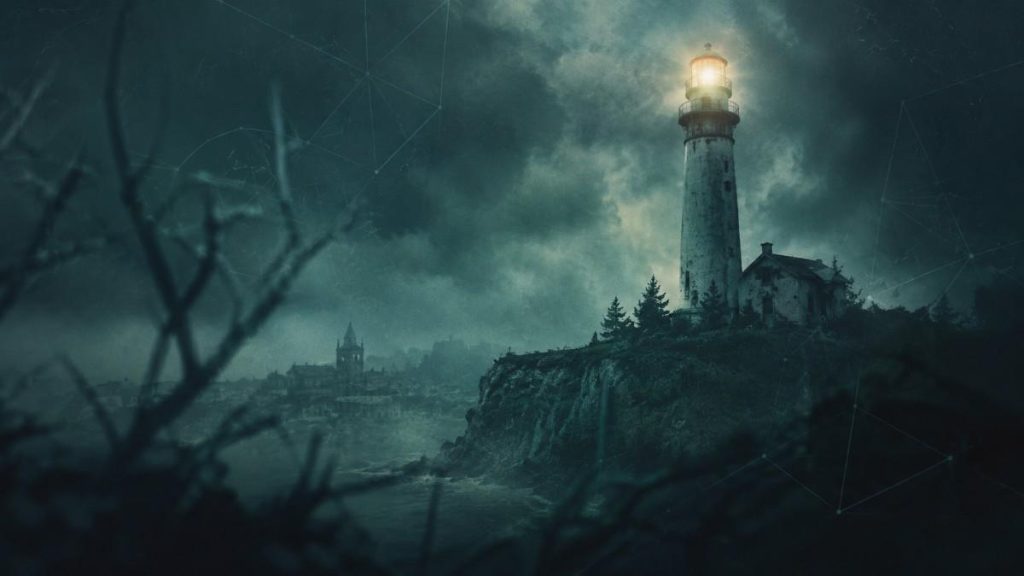
From Lighthouse Theories, Ranked by Showrunner Alignment
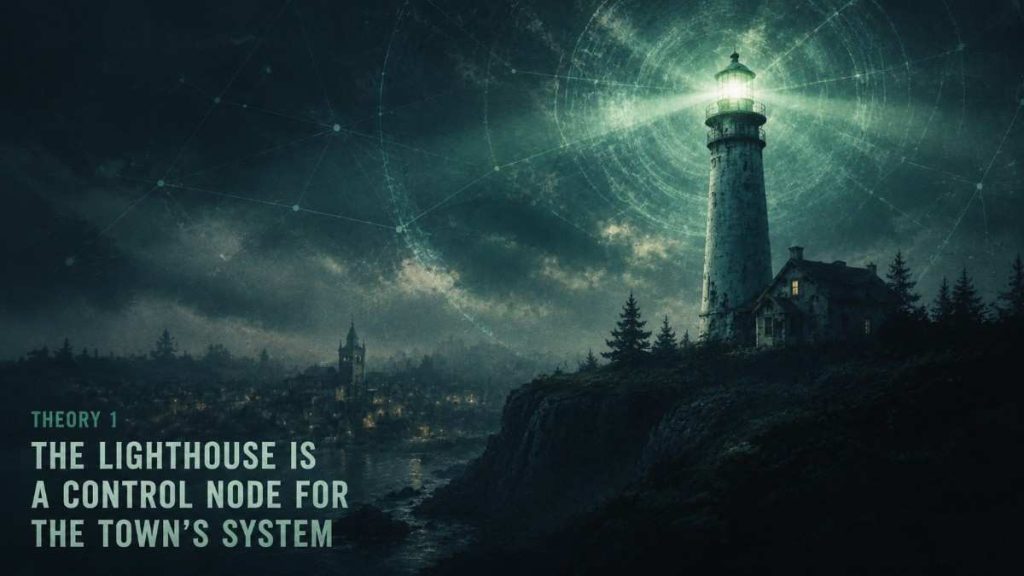
Theory 1: The Lighthouse Is a Control Node for the Town’s System
The theory here is that the lighthouse is not an exit and not a beacon aimed at the outside world. It is a functional component of whatever mechanism keeps the town operating. Think of it less like a lighthouse in the nautical sense and more like a server rack, a transformer station, or a signal tower that maintains the environment’s rules from the inside.
Griffin has described the town repeatedly as a place with “rules” and a logic that can be understood. In a 2023 Collider conversation, he framed the show as being about characters trying to understand a system. A control node fits that framing with uncomfortable precision.
The lighthouse’s appearances across the show are not random. They cluster around moments when the town’s rules are being tested, broken, or revealed. The electrical anomalies, the recurring presence in child drawings, and the connection to the talismans all suggest something functional rather than something purely atmospheric.
The honest counterargument is that no character has physically interacted with the lighthouse in a way that reveals a working mechanism. The theory requires inferring engineering from visual language and thematic repetition. That inference is reasonable, but it is still an inference.
Tier 1. Strongest alignment with Griffin’s stated framing.
Theory 2: The Lighthouse Is a Beacon That Summoned the Residents
This theory proposes that the town did not collect people randomly. Something at the lighthouse actively called specific people toward it, redirecting cars off highways and pulling travelers into an environment they were chosen to enter.
Griffin has confirmed in multiple interviews that the people in the town are there for a reason. He has said explicitly that “not everyone ends up there by accident.” The children who draw the lighthouse before they consciously know what it is are the clearest piece of evidence the show offers here.
Unconscious familiarity with an image you have never seen is a classic narrative signal for fate, for summoning, for a connection that precedes awareness. A summoning beacon theory explains that detail cleanly. It also explains why the lighthouse appears in the subconscious imagery of residents who have no logical reason to picture it.
The gap in this theory is scale and mechanics. How does a lighthouse summon people across multiple decades and different geographic entry points? Griffin has hinted at intentionality but has not described any mechanism for how that works across time and distance.
Tier 1. Griffin’s “not an accident” framing supports this directly and repeatedly.
Theory 3: The Lighthouse Is a Way Out
This is the most straightforward reading of the lighthouse’s narrative role, and it is the one the show’s cinematography seems to tease most overtly. The lighthouse is the exit. Reaching it, or activating it correctly, breaks the loop and allows residents to leave.
Griffin has said the show has a resolution and that characters will find answers. The lighthouse’s visual positioning as something distant, unreachable, and longed for mirrors the structural role of an exit in classic trapped-protagonist narratives. Season 2’s reveal of coordinates and symbols sent fans toward the lighthouse as a destination with renewed energy.
The problem is what Griffin has said about the show’s actual subject. He has described FROM as being about “what people do when they cannot leave,” framing the condition of entrapment as the point rather than as an obstacle to overcome. If the lighthouse is a straightforward exit, that framing loses its teeth.
The show also keeps pulling characters away from the lighthouse rather than toward it. That is a structural choice, and showrunners make those choices for reasons.
Tier 2. Plausible but too simple to be the complete answer, based on Griffin’s framing of the show’s core subject.
Theory 4: The Lighthouse Is Connected to the Boy in White
The Boy in White appears to residents, offers cryptic direction, and seems to exist outside the rules that govern everyone else in the town. This theory connects him directly to the lighthouse, proposing that he either originates from it, controls it, or functions as its representative inside the town’s environment.
Griffin has said the Boy in White is “not what he seems” and that his appearances are not random. If the lighthouse governs the town’s operating system as Theory 1 suggests, then the Boy in White as the system’s communication interface would explain both why he appears to specific people and why his guidance consistently points toward understanding the town’s logic rather than simply escaping it.
That narrative coherence is real and it is one of the reasons this theory has staying power in fan communities. The weakness is that the connection between the Boy in White and the lighthouse is built from visual association and narrative timing rather than explicit confirmation.
Griffin has treated the Boy in White’s origin as one of the show’s central reveals. That could mean the lighthouse connection is exactly right, or it could mean they are separate threads that only appear to intersect.
Tier 2. Circumstantially strong. Dependent on the Boy in White’s origin reveal to confirm or collapse it. For context on another mysterious figure whose connection to the lighthouse may matter, the question of the Man in Yellow belongs in the same conversation.
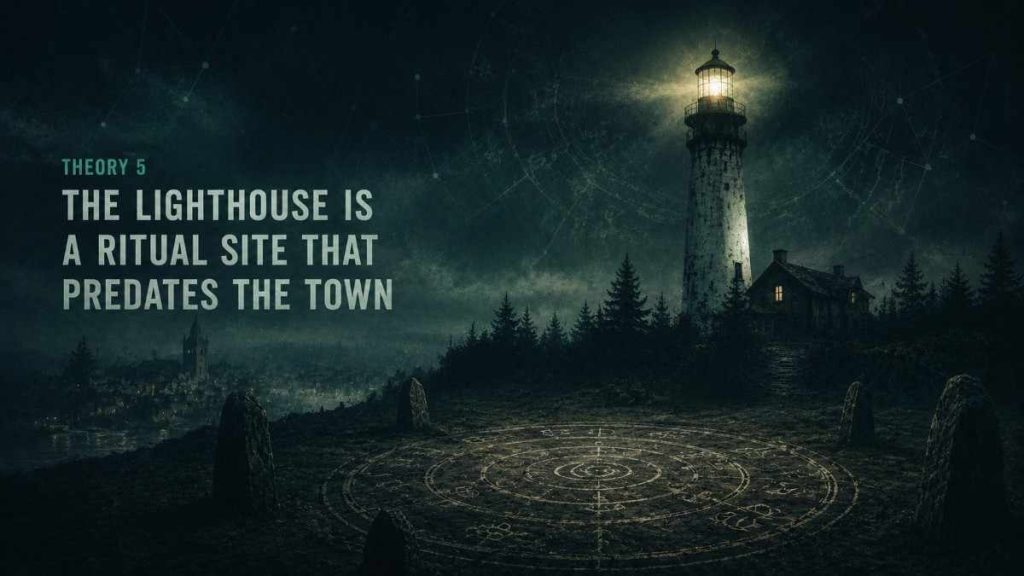
Theory 5: The Lighthouse Is a Ritual Site That Predates the Town
This theory proposes that the lighthouse came first. The town was constructed around it, or grew up around it, as a consequence of whatever the lighthouse is or does. It is a site of original significance in the show’s mythology, not a feature of the environment that the town created.
Griffin has said the show’s mythology has “deep roots” and that the world of FROM predates the story being told. Architectural details in the show hint at structures that appear far older than the residents’ arrival timeline.
If the lighthouse is the original fixed point of a space that rewrites itself around each new wave of arrivals, its age would explain why it surfaces in the subconscious imagery of people who have never seen it. Old things in fictional mythologies tend to carry their history in the people who encounter them, not just in themselves.
The show has not confirmed the lighthouse’s origin date or whether it is structurally distinct from the rest of the environment. The theory is consistent with Griffin’s “deep roots” language, but it extrapolates from tone and atmosphere more than from specific evidence.
Tier 2. Consistent with Griffin’s mythology framing but speculative on the specifics.
Theory 6: The Lighthouse Is a Prison Watchtower
The town is a prison. The lighthouse is the watchtower. Whatever intelligence runs the environment uses the lighthouse to monitor residents, not help them. It does not offer a way out. It enforces the fact that there is no way out.
Griffin has described the town’s rules as consistent and enforced, which implies something is doing the enforcing. The lighthouse’s height and sightline position have not gone unnoticed in fan communities. If something or someone is watching, the lighthouse is the logical place to watch from.
This theory aligns with Griffin’s repeated framing of the town as a system with intelligence behind it rather than a natural phenomenon that residents simply fell into. The weak point is the “who is watching” question. The show has not established a watcher figure who uses the lighthouse practically. The monsters do not seem to use it, and the Boy in White does not seem to operate from it.
The prison metaphor is thematically consistent with the show’s atmosphere, but the mechanics of surveillance have not materialized on screen.
Tier 2. Thematically strong, mechanically unresolved.
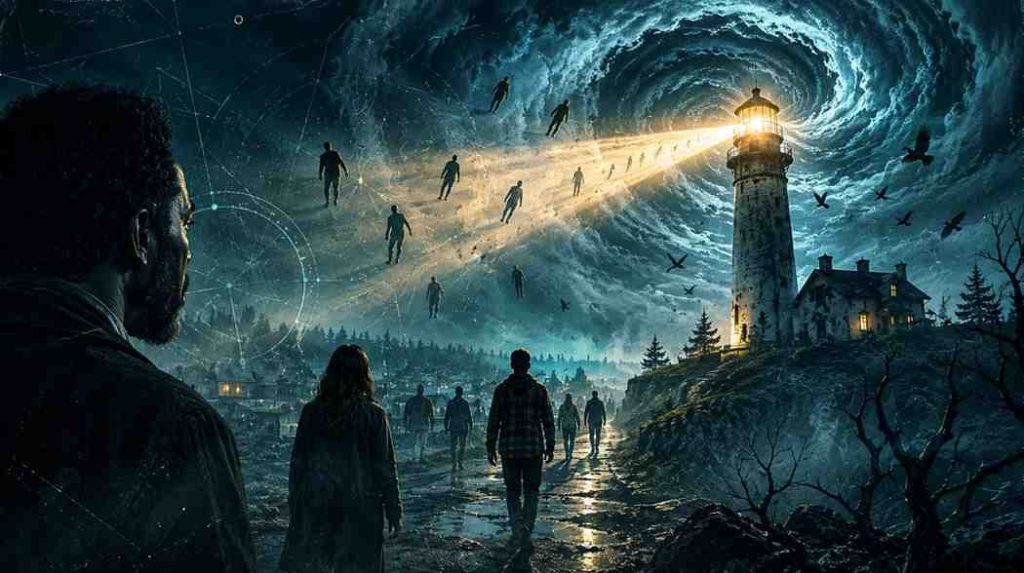
Theory 7: The Lighthouse Is a Purgatory or Afterlife Marker
The town is purgatory, and the lighthouse is either the gate between the living and the dead or a marker measuring residents’ distance from judgment or release. This is one of the most popular theories in the FROM fandom, and it has real literary and folkloric support. Lighthouses have functioned as liminal symbols in narrative traditions for a long time.
The fan case for this theory draws on the town’s loop structure, the strange relationships with death and permanence some characters seem to have, and the religious imagery scattered across the show’s visual language.
Griffin has specifically and repeatedly pushed back on pure afterlife readings. In a panel conversation, he said the show is “not a religious allegory” and that the rules of the town are “not metaphysical in the way people assume.” That is the closest Griffin has come to a direct denial of any major theory.
The purgatory reading also struggles with the mechanical specificity of the talismans, the coordinates, and the electrical phenomena. Those details do not fit cleanly into afterlife frameworks. Purgatory as a concept does not usually have electrical anomalies or GPS coordinates.
Tier 3. The most popular theory in the fandom, and the one Griffin’s interview record pushes back on most directly.
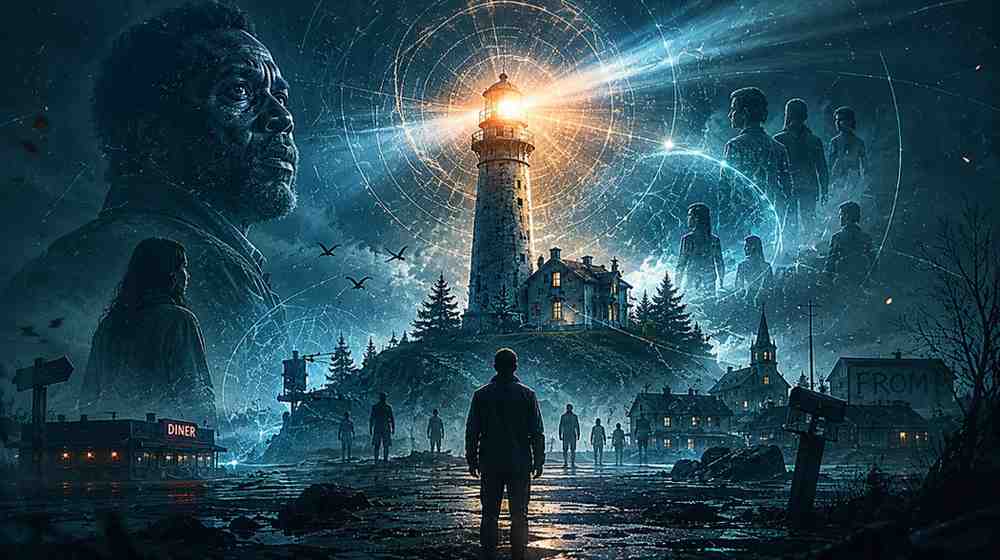
Theory 8: The Lighthouse Is a Simulation Anchor Point
The town is a constructed reality, and the lighthouse is its anchor point. It is where the simulation’s core architecture or power source resides. Reaching it and understanding it would allow residents to rewrite or exit the simulation.
The simulation theory has gained ground because it explains several things the show has not otherwise resolved: the town’s impossible geography, the monsters’ rule-governed behavior, and the recurring electrical phenomena. The lighthouse as the simulation’s operational center has a clean, satisfying structural logic.
Griffin has said the show is “not science fiction in the way people expect” and has resisted the simulation framing in interviews, describing the town as something that “exists” rather than something that is “generated.” He has also said repeatedly that the emotional stakes of the show are central to its resolution.
Simulation theory tends to dissolve emotional stakes. If nothing is real, the grief and fear and love inside the town become decorative. That is not the show Griffin describes when he talks about FROM’s ending.
Tier 3. Intellectually elegant, but Griffin’s framing resists both the genre classification and the emotional logic the theory requires.
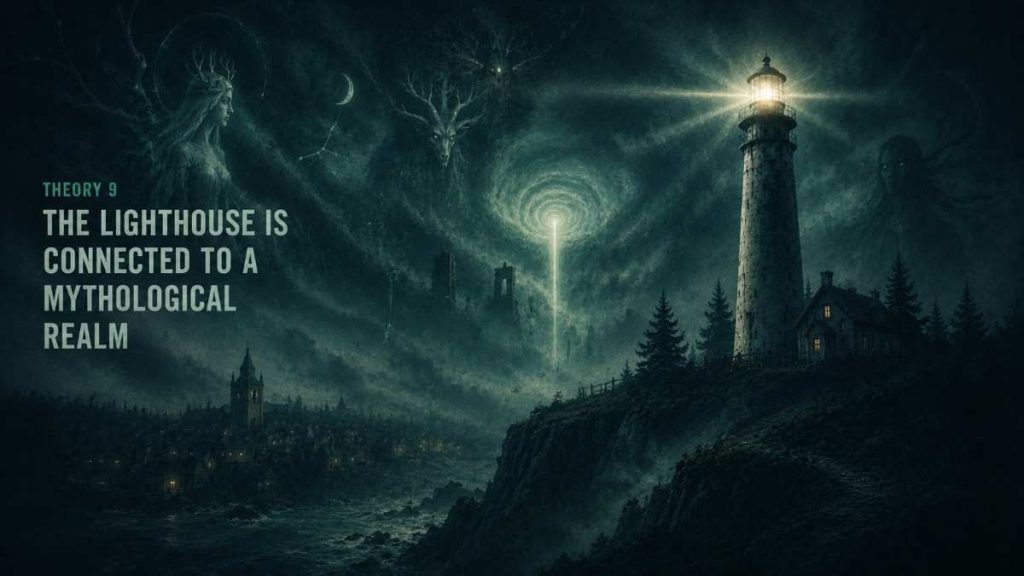
Theory 9: The Lighthouse Is Connected to a Mythological Realm
This theory has circulated in fan communities that connect the show’s imagery to folkloric sources, particularly the idea that the lighthouse marks a passage point to a realm that exists alongside the human world rather than inside it. The Faraway Tree comparison, drawn from Enid Blyton’s children’s series about a tree that connects to different magical worlds, has been used as shorthand for this broader class of theory.
Some fan analysis points to the show’s use of fairy tale imagery, including the specific visual language of the children, the forest, and the creatures, as evidence that Griffin is working in a mythological register with more in common with folklore than with science fiction or theological allegory.
Griffin has spoken positively about the show’s relationship to mythological storytelling in general terms. He has not confirmed any specific folkloric source. The theory is more atmospheric than evidential, and it is less a specific claim about what the lighthouse does and more a claim about the genre context in which it should be read.
That is valuable as framing but not as a standalone theory about the lighthouse’s function.
Tier 3. Useful as a reading lens. Too vague to rank higher as a functional explanation.
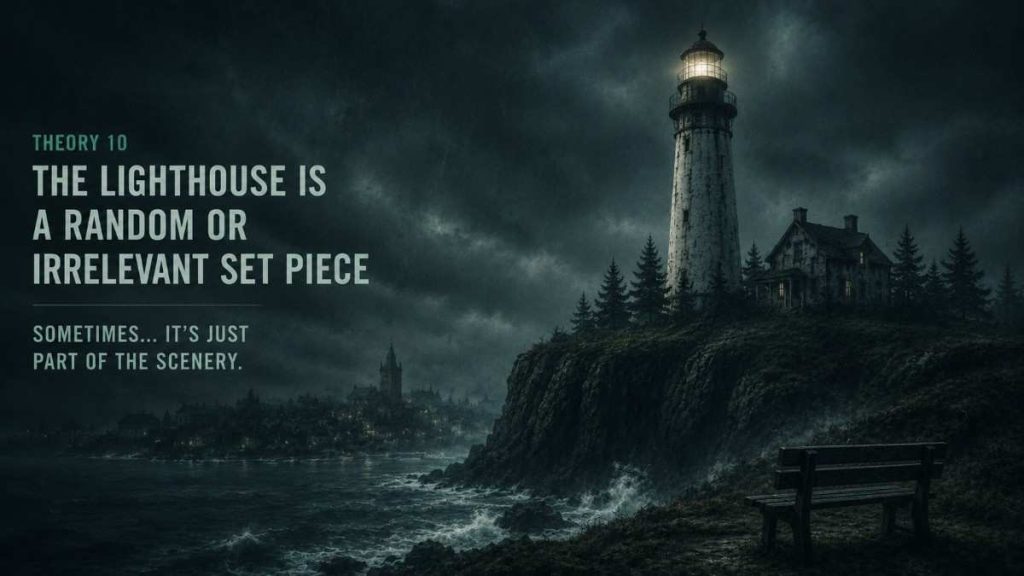
Theory 10: The Lighthouse Is a Random or Irrelevant Set Piece
This theory is less of a fan theory and more of a skeptical position: the lighthouse is visually evocative set dressing that the show uses to build atmosphere and create the impression of mystery without having a concrete answer attached to it. Under this reading, the lighthouse means whatever the show needs it to mean at any given moment, and there is no payoff coming.
This is worth addressing directly because it represents the most common objection to taking FROM theories seriously at all. If the lighthouse is just a mood device, all of this analysis is wasted energy.
Griffin has addressed this class of concern more directly than almost any other topic in his interviews. He has said every detail in the show is intentional and placed for a reason, and he has said this while being asked specifically whether the show has a plan or whether it is making things up as it goes.
He has been consistent on this point across multiple years of interviews, which is harder to fake than a single statement. A showrunner who was bluffing would not keep volunteering that framing across three seasons of press.
Tier 4. Not supported by anything in Griffin’s interview record. This is the one theory the evidence most clearly argues against.
FAQ
What is the lighthouse in FROM and why does it keep appearing?
The lighthouse in FROM is an unconfirmed but clearly significant recurring symbol in the show. It appears in dreams, child drawings, visions, and objects across all three seasons without a direct explanation. Showrunner John Griffin has confirmed that every detail in FROM is intentional and that the world of the show has a definitive mythology with deep roots. The lighthouse’s repeated appearance in the subconscious imagery of residents who have no logical reason to recognize it strongly suggests it plays a functional role in whatever system governs the town, though the specific nature of that role has not been confirmed on screen.
Has John Griffin ever confirmed what the lighthouse means in FROM?
Griffin has not confirmed a specific explanation for the lighthouse. He has confirmed that FROM has a definitive ending already written and that every detail in the show is intentional. He has described the town as a “system with rules” and has said that residents are in the town for a reason. These statements create a framework that favors theories treating the lighthouse as a functional mechanism rather than pure symbolism. Griffin has also pushed back on the purgatory and simulation readings more directly than most fans realize, which narrows the field of plausible explanations.
Is the purgatory theory about FROM confirmed or denied?
The purgatory theory is neither confirmed nor officially denied, but Griffin has come as close to dismissing it as he has with any major FROM theory. In a panel discussion, he said the show is “not a religious allegory” and that the town’s rules are “not metaphysical in the way people assume.” That language is more resistant than a simple no comment. The purgatory reading also struggles to explain the show’s mechanical specificity, including the talismans, coordinates, and electrical phenomena. Those details fit poorly into any pure afterlife framework.
Why do children in FROM draw the lighthouse before they have seen it?
The show presents this as a meaningful detail rather than a coincidence. Griffin has confirmed that the children in FROM carry narrative significance and that residents are in the town for a reason rather than by accident. The most structurally consistent explanation is that the lighthouse has some form of pull or signal that affects people before they consciously recognize it, which would support either the summoning beacon theory or the control node theory. It is also possible the lighthouse exists in a layer of the town’s reality that children perceive more directly than adults.
What is the most credible FROM lighthouse theory based on showrunner hints?
Based on Griffin’s public interview record, the two strongest theories are the control node theory and the summoning beacon theory. Both align with Griffin’s repeated description of the town as a system with rules and with his confirmation that residents are there for a reason. The control node theory fits Griffin’s “system” framing most precisely. The summoning beacon theory fits his “not an accident” framing most directly. Neither has been confirmed on screen, but both are structurally consistent with what Griffin has said over three seasons of interviews.
Does the FROM lighthouse connect to the Boy in White?
Griffin has said the Boy in White is “not what he seems” and that his appearances are not random. A connection between the Boy in White and the lighthouse is circumstantially supported by the show’s visual associations and by the timing of both characters’ appearances relative to moments when the town’s rules are being tested. Griffin has treated the Boy in White’s origin as one of the show’s central reveals. If that reveal confirms the lighthouse as the source or base of the Boy in White’s influence, it would validate one of the mid-tier theories here. If it points elsewhere, it would require reassessing the connection.
Is FROM actually going to explain the lighthouse or will it stay vague forever?
Griffin has been unusually direct about the fact that FROM has a plan. He has described knowing the ending before writing the pilot and has said multiple times across multiple years of press that every detail in the show is intentional and will be accounted for. That is a stronger commitment than most mystery-box showrunners make publicly. The risk of overpromising an explanation is real, and fan communities are right to track whether the show delivers on that promise. Based on the current interview record, the evidence favors the lighthouse getting a real answer rather than a permanent fade to mystery.
What the Ranking Tells You About the Show Itself
The most important insight from this exercise is not which theory is right. It is what the ranking reveals about the kind of show FROM actually is. When you filter out every theory that contradicts Griffin’s stated framing, what you are left with is a cluster of theories that all treat the lighthouse as part of a system with internal logic rather than a symbol open to infinite interpretation.
Griffin has been consistent about this for three years. The town has rules. The residents are there for a reason. Every detail is intentional. Those statements do not describe a show that traffics in vibes. They describe a show with engineering underneath it.
The theories that rank highest are not the most emotionally resonant ones. Purgatory is emotionally resonant. Simulation theory is intellectually elegant. The control node theory and the summoning beacon theory are, by comparison, dry and almost procedural. That is exactly why they rank higher. Griffin is not making a show about feelings dressed up as mystery. He is making a show about a mystery that generates feelings.
The lighthouse is a mechanism first and a metaphor second. The next step is watching Season 4 with a specific frame. When the lighthouse appears, notice what else is happening in the same scene. Notice whether the town’s rules are being tested or broken at that moment. Notice whether characters are receiving or transmitting information they should not have access to. That observational framework, built from Griffin’s own framing rather than fan speculation, will get you closer to the answer than any theory on this list.