
Love Island USA Has Actually Filmed in Hawaii Before, and Left
The show did not start in Fiji and stay forever. Here is the actual location timeline, season by season:
- Season 1 (2019): Fiji
- Season 2 (2021): Fiji
- Season 3 (2022): Kauai, Hawaii
- Season 4 (2022): Casa Amor Villa, Sunstone Manor, California
- Season 5 (2023): Fiji
- Season 6 (2024): Fiji
- Season 7 (2025): Fiji
Season 3 was the Hawaii experiment. The production went to Kauai, filmed the whole season there, and the show then moved to California. By Season 5, it was back in Fiji. And it has stayed there through every season since.
That return, and the sustained presence, is the real story. Productions do not voluntarily absorb the cost and complexity of relocating an entire show unless the current location is failing to deliver something important. A shift of that magnitude involves renegotiating location permits, rebuilding vendor relationships, retraining local crew, and redesigning the entire production footprint. Nobody does that because they feel like a change of scenery.
Season 3 in Hawaii was not publicly reported as a disaster. The show ran. People watched it. But the production team clearly found that something was not working well enough to justify staying. The rest of this piece covers exactly what that something was.
Fiji Has a Tax Rebate Program Specifically for Film Productions
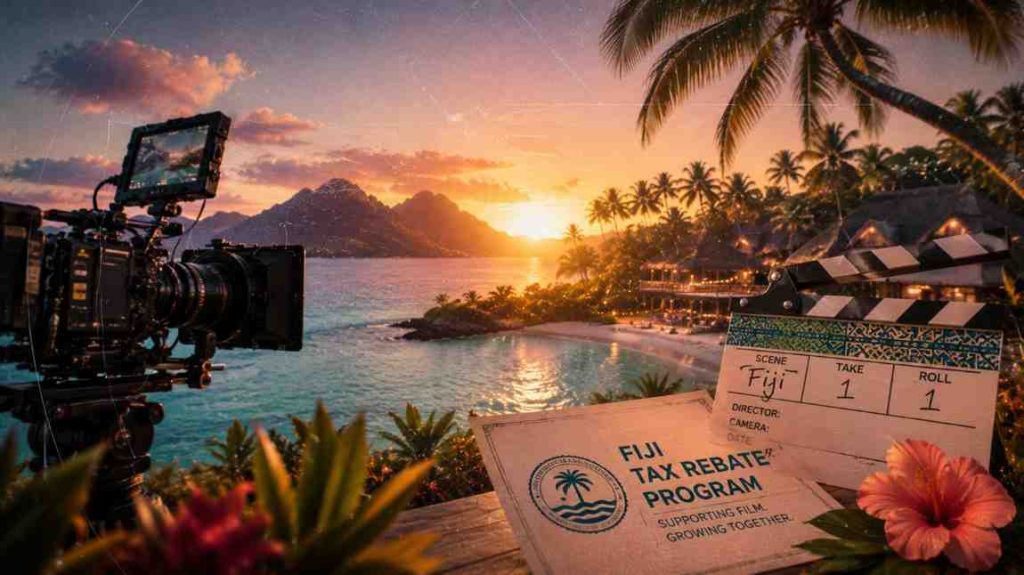
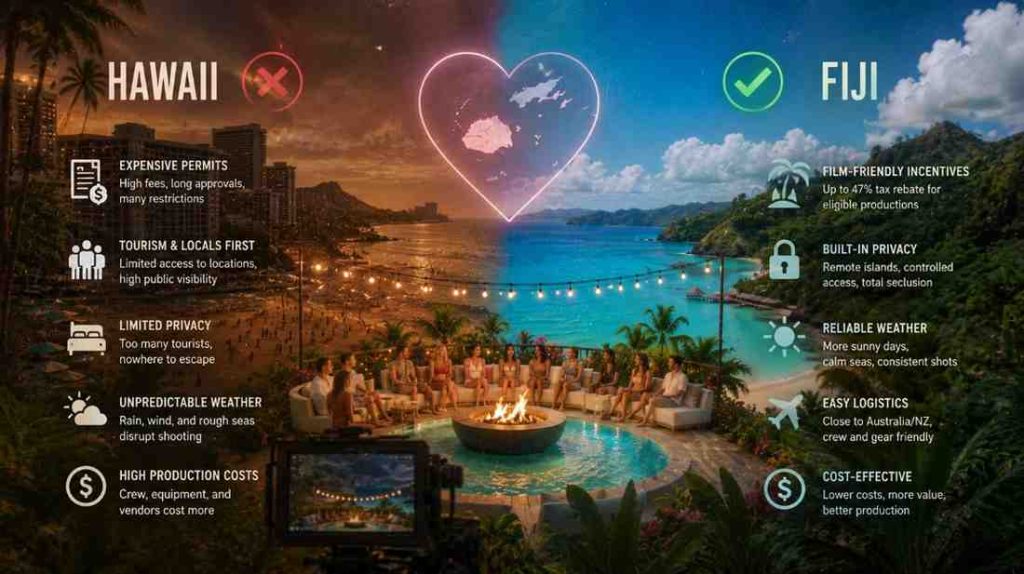
The single biggest financial factor is a program most fans have never heard of: Film Fiji. It operates under the Fiji Audio-Visual Commission, the government body responsible for attracting foreign productions to the islands, and it offers a rebate on qualifying local production expenditure.
The rebate rewards productions that spend money locally. That includes local crew, local accommodation, local vendors, and local services. For a production like Love Island USA, which runs six to eight weeks with a crew of several hundred people, the qualifying local expenditure is enormous. Accommodation, catering, transportation, equipment rentals, and local crew wages all count. The savings compound quickly.
Hawaii has its own film incentive program through the Hawaii Film Office. The structural difference is that Hawaii’s program is designed around film and scripted television. Unscripted reality television has historically had a harder time qualifying cleanly under Hawaii’s credit structure, and the administrative path is more complex with a less predictable payoff.
The cost gap between a remote Fijian island resort and a comparable private property in Kauai or the Big Island is also significant before any rebate is applied. Hawaiian real estate is among the most expensive in the United States. Leasing a private resort for two months of exclusive filming use on a Hawaiian island carries a price tag that no equivalent Fijian location matches. Pile the Film Fiji rebate on top of lower base costs, and the economic case for Fiji becomes very difficult to argue against.
If you want to understand how reality TV shows negotiate location deals and what financial terms actually look like in these agreements, the reality TV contract details world is genuinely surprising.
The 16-Hour Time Difference Is a Production Tool, Not Just a Fun Fact
This is the factor that almost nobody covers, and it is the most operationally important one on the list.
Love Island USA airs episodes within roughly 24 hours of filming, giving the show a near-live feel that is central to its appeal. Peacock’s own promotional material has confirmed that the time difference between Fiji and the US is actively used to make this turnaround possible.
Fiji sits approximately 16 to 17 hours ahead of Eastern Time during US summer. Footage shot during the daytime in Fiji arrives into the US editing pipeline while it is still nighttime in America. Editors in Los Angeles or New York have hours to work on that footage before the next evening’s broadcast window opens. The time difference creates a working gap that makes same-day streaming logistically achievable.
Now consider what happens if the show films in Hawaii instead. Hawaii runs 6 hours behind Eastern Time in summer. Footage shot during the Kauai afternoon hits the US pipeline in the early evening. The editing window effectively disappears. The near-live broadcast format that Peacock built Love Island USA’s streaming strategy around becomes functionally impossible to maintain without an enormous and expensive post-production operation running around the clock.
This is not a minor scheduling inconvenience. It is a structural conflict between the show’s format and the geography of any US territory filming location. California has the same problem. Hawaii has the same problem. Fiji solves it automatically, just by existing on the correct side of the International Date Line.
No other single factor explains the sustained return to Fiji as cleanly as this one does.
Survivor Built the Infrastructure. Love Island Used It.
Bringing a reality TV production into a country that has never hosted one is a months-long project before a single camera rolls. You need to find and train local crew. You need to establish relationships with government permit offices. You need to build supply chains for equipment, catering, and accommodation. None of that exists on day one.
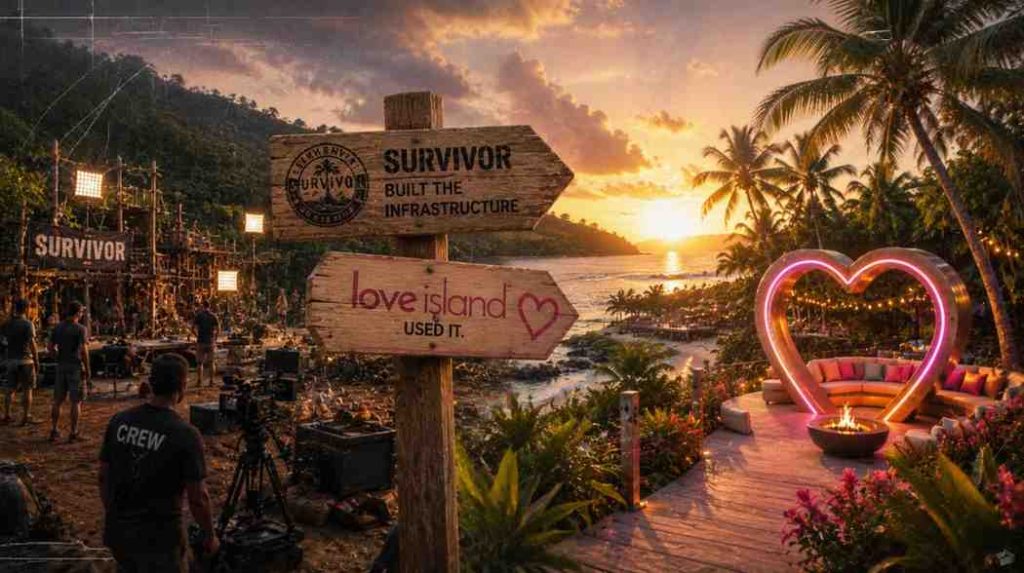
Fiji is not day one for anyone. Survivor has filmed there continuously since Season 33, which was shot in 2016. That is close to a decade of uninterrupted production in the same island nation. A full decade means Fiji now has trained local camera operators, sound technicians, production assistants, and logistics coordinators who have worked on major American reality TV shoots. It means local government officials know what a permit application for this kind of production looks like. It means vendors know the lead times, the crew sizes, the technical requirements.
When Love Island USA arrived in Fiji, it was not pioneering anything. It was plugging into a production ecosystem that Survivor had already spent years building. That is an enormous operational advantage. The groundwork was done.
One additional factor worth noting: Fiji’s remoteness means minimal light pollution. A significant portion of Love Island USA’s most-watched scenes happen outdoors at night, and the visual quality of outdoor night filming in Fiji is noticeably better than what you would get on a semi-urban Hawaiian island with nearby resort development and commercial lighting bleeding into your shots.
Where Exactly in Fiji Is Love Island USA Filmed?
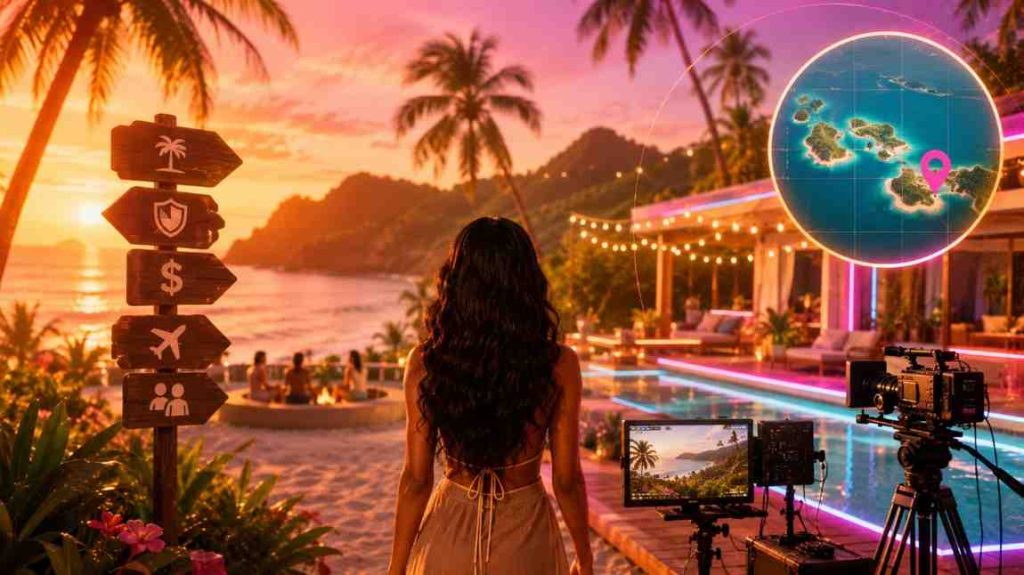
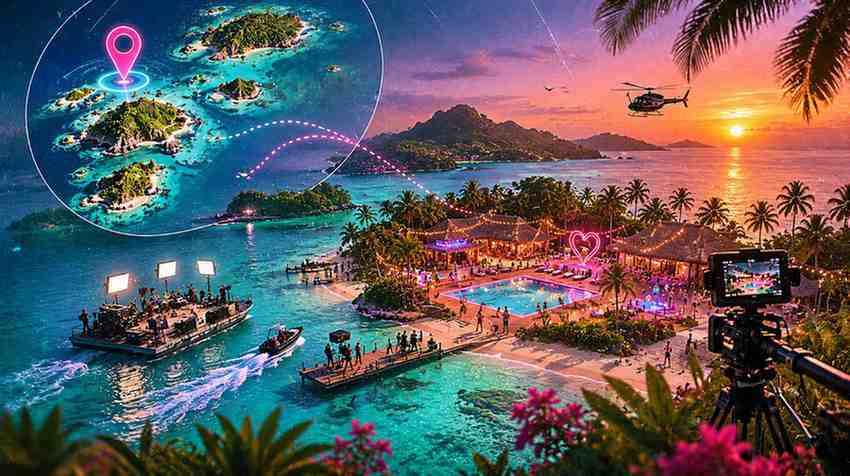
The short answer is the Mamanuca Islands, a group of roughly 20 islands sitting off the western coast of Viti Levu, which is Fiji’s main island.
The Mamanuca Islands Are the Production Base
The Mamanucas are accessible only by boat or small plane from the main island. There are no road connections to the Fijian mainland and no through-traffic. For a production that depends on keeping contestants isolated and preventing spoilers from leaking, this geography is not a nice bonus. It is a core production requirement.
Controlling who approaches a filming location in Kauai or on the Big Island of Hawaii is logistically difficult. Public beach access laws in Hawaii give members of the public legal right to reach most shorelines, regardless of what private development sits behind them. Running a controlled perimeter on a Hawaiian beach property during an active production season is genuinely complicated.
On a Mamanuca island, the ocean is your perimeter. Anyone approaching by boat is visible from a long distance. Anyone arriving by small plane uses a known airstrip. The isolation that makes these islands look beautiful on television is the same isolation that makes them operationally secure.
The Villa, the Resort, and What the SERP Gets Wrong
The establishing shot for the show, the wide aerial footage of a dramatic rocky island that opens many episodes, is associated with Kuata Island in the Yasawa Islands, home of the Barefoot Kuata Island Resort. The Yasawa Islands sit northwest of the Mamanucas. The establishing shot and the filming location are not necessarily the same place, and this distinction trips up a lot of fan coverage.
The Season 7 villa Peacock confirmed for the show features extensive ocean views of the South Pacific, consistent with the Mamanuca footprint the production has used across multiple seasons. The villa configuration itself is a production set built within an operational resort’s footprint for the duration of filming. It is not a permanent structure you can book year-round through a travel site.
Fans frequently ask whether they can visit or rent the Love Island villa. The resorts used as base locations for the production do accept public bookings when not under production contract. You can stay in the general area. You will not be renting the specific configuration of furniture, fire pits, and pool decking that you see on screen. That set gets built for the show and removed when the season wraps.
Why Hawaii Doesn’t Work for a Show Like This
Hawaii is a beautiful place to film television. Many productions have done it successfully. Love Island USA’s specific format, on the other hand, has structural conflicts with what Hawaii can offer.
The Time Difference Problem
The editing window issue covered above is the clearest disqualifier. Hawaii cannot support same-day streaming for a US primetime audience without a post-production operation that would cost significantly more than the location itself saves. No scenery budget makes up for a broken editorial pipeline.
The Public Access Problem
Hawaii’s public beach access laws are among the most protective in the United States. Productions filming on or near Hawaiian beaches regularly encounter legal obligations to maintain public access corridors. Managing that access around an active Love Island USA shoot, where contestant isolation is non-negotiable, creates security and legal complexity that the Mamanuca Islands simply do not have.
The Cost Problem
Local crew wages in Hawaii operate under union structures that increase production labor costs substantially compared to Fiji. The accommodation costs for a crew of several hundred, running for six to eight weeks, on one of Hawaii’s most desirable islands are significantly higher than the equivalent in Fiji. Film Fiji’s rebate program does not have a Hawaiian equivalent that works as cleanly for unscripted formats.
Season 3 filmed in Hawaii and the show quietly moved on. The production did not issue a statement explaining the change. The numbers and the logistics made the decision visible enough on their own.
Why Love Island USA Keeps Coming Back to the Same Place Every Season
Once a production establishes a location that works, the cost of switching is enormous. New permits, new crew relationships, new vendor contracts, new security mapping, new government contacts. Every single piece of operational infrastructure has to be rebuilt from scratch in a new country.
Fiji has inverted that equation. The infrastructure is already there, already calibrated for this kind of production, and already maintained by Survivor’s ongoing presence. Love Island USA is not paying the startup cost anymore. It is paying the ongoing cost, which is a very different number.
There is also a political economy at work that is easy to overlook. Fiji’s tourism sector has become meaningfully connected to Love Island USA’s visibility. When the show airs, searches for Fiji travel destinations spike in sync with premiere dates. The Fijian government has direct economic incentive to keep major American reality TV productions filming there, and that incentive shows up in the terms those productions are offered.
The result is a self-reinforcing cycle. Fiji offers favorable financial terms and existing infrastructure. Productions choose Fiji. Fiji’s production ecosystem grows stronger. Productions find it even harder to justify leaving. Love Island USA is not returning to Fiji every season out of habit. It is returning because the combination of the Film Fiji rebate, the time zone advantage, the Survivor infrastructure, and the Mamanuca Islands’ natural security perimeter is a package that no other location on Earth currently replicates.
If you are curious about how reality TV shows handle the behind-the-scenes decisions that viewers never see, exploring whether The Bachelor is scripted reveals how much production logistics shape what feels spontaneous on screen.
FAQ
Why does Love Island USA film in Fiji instead of somewhere in the US?
Three overlapping factors make Fiji a better production location than any US territory for this specific show format. First, Fiji’s film rebate program through the Fiji Audio-Visual Commission reduces production costs in ways that Hawaii’s and California’s incentive programs do not replicate for unscripted reality television. Second, Fiji sits 16 to 17 hours ahead of Eastern Time, which creates an editing window that makes same-day streaming on Peacock operationally possible. Third, Survivor’s continuous filming presence in Fiji since 2016 built a production infrastructure that Love Island USA could immediately use.
What season of Love Island USA was filmed in Hawaii?
Season 3, which aired in 2022, filmed in Kauai, Hawaii. It was the only season filmed in Hawaii. Season 4 moved to California, and Season 5 returned to Fiji, where the show has remained through Season 7. The production has not publicly explained the departure from Hawaii in detail, but the sustained return to Fiji across multiple subsequent seasons indicates the Hawaii location did not meet the production’s operational requirements long-term.
Where exactly in Fiji is Love Island USA filmed?
The production base is the Mamanuca Islands, a group of roughly 20 islands off the western coast of Viti Levu, Fiji’s main island. The establishing shot viewers see in episodes has been linked to Kuata Island in the Yasawa Islands, home of the Barefoot Kuata Island Resort, but that is the aerial establishing shot rather than the full filming location. The villa itself is built as a temporary production set within a resort footprint in the Mamanuca region for the duration of filming.
Can you visit or stay at the Love Island USA villa in Fiji?
You cannot book the Love Island villa as it appears on television. The villa configuration, including the specific furniture, pool setup, fire pit areas, and decor, is a temporary production set installed within a resort property for filming and removed when the season ends. The resort properties in the Mamanuca area used as production bases do accept public bookings during off-production periods. You can stay in the general region, but the exact set you see on screen is not a permanent rentable space.
Does the 16-hour time difference actually change how Love Island USA is produced?
Yes, in a concrete operational way. Love Island USA airs episodes within roughly 24 hours of filming, creating a near-live feel. Fiji runs approximately 16 to 17 hours ahead of Eastern Time, meaning footage shot during the Fijian day arrives in the US post-production pipeline while it is still nighttime in America. Editors have several hours to cut the episode before primetime. Hawaii runs 6 hours behind Eastern Time in summer, which eliminates that editing window entirely and makes same-day streaming for a US audience logistically incompatible with the show’s format.
Isn’t it just cheaper to film in a place like Mexico or the Caribbean?
Cost alone does not explain the Fiji choice, and cheaper alternatives do exist geographically. What Mexico, the Caribbean, and similar locations cannot replicate is the combination of the time zone advantage, the Film Fiji rebate structure, the pre-existing crew and permit infrastructure from Survivor’s decade of filming, and the natural perimeter security of the remote Mamanuca Islands. Each of those factors matters individually. Together, they create a production environment that alternatives with lower base costs do not actually match once all operational requirements are factored in.
The Location Is the Format
The clearest insight from all of this is that Fiji is not a backdrop Love Island USA uses. It is a production tool the show is built around. The 16-hour time difference is not a side effect of filming in the South Pacific. It is the reason same-day streaming works. The Mamanuca Islands are not just photogenic. They are a controlled perimeter that protects contestant isolation and spoiler security for a show whose drama depends on audiences not knowing what happens next.
Hawaii offered a beautiful island and a recognizable American location. What it could not offer was a functional editing window, an operational production ecosystem, or a financial structure that matched what Fiji puts on the table. Season 3 confirmed that in practice.
Watch where Survivor keeps filming, watch what happens with Film Fiji’s rebate program over the next few years, and you will have a pretty good early signal for where Love Island USA films in Season 8 and beyond. When the economics and the logistics both point the same direction, productions tend to follow.