The Creatures in FROM Follow Rules, and That Is What Makes Them Terrifying
The monsters in FROM are not wild predators acting on instinct. They operate inside a rigid behavioral system with hard limits, and that system is what separates FROM from most horror.
Here is what the show has established across its seasons:
- The creatures only appear at night. Sunrise is not a preference; it is an absolute boundary they do not cross.
- They cannot enter any occupied structure without being invited in. Residents who understand this rule stay alive longer. Residents who forget it do not.
- They knock. They call out names. They smile and gesture and perform friendliness at the door before the night turns lethal.
- They walk with deliberate slowness. They do not run. Fans have noted this repeatedly in community breakdowns, and it is not an oversight by the showrunners. The deliberate pace amplifies dread in a specific way that sprinting would not.
- They stop. When a resident is protected, the creatures do not force their way through. They wait. They smile. They leave.
This is not how animals hunt. A wolf does not follow visiting hours. A predator acting on pure instinct does not politely knock and then stand at a door doing nothing when entry is refused.
The rule-bound behavior of FROM’s creatures means they are constrained by something external to themselves, something that SET the rules and something that enforces them. That realization is the foundation for everything else. Once you see that the creatures operate inside a system, the smile stops being a costume detail. It becomes a question worth asking.
So Why Do FROM Monsters Smile? The Short Answer
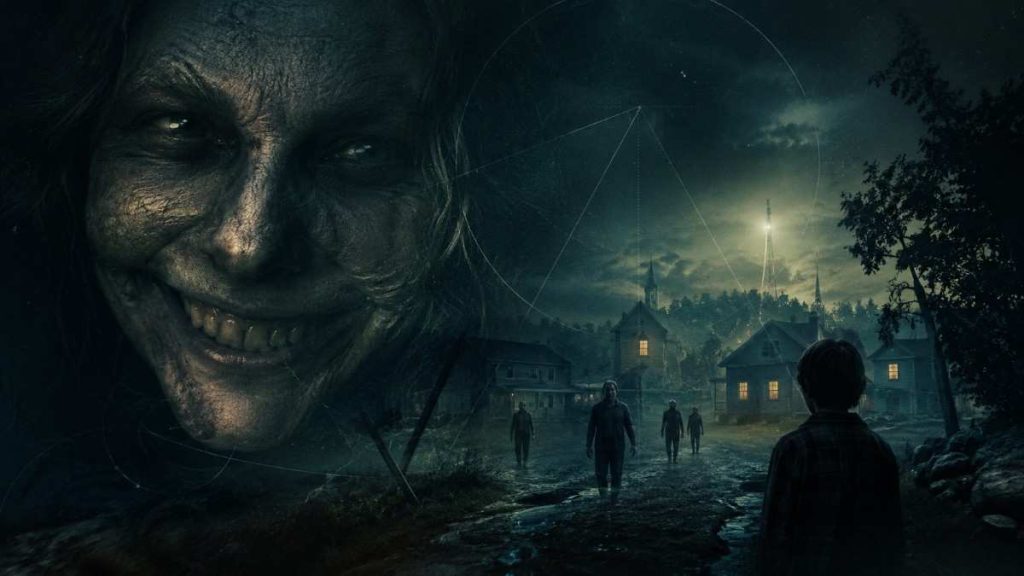
The creatures in FROM smile because the smile is part of how they hunt. It appears at behaviorally consistent moments, during approach, at the door, and in any moment of apparent intimacy or communication with a victim, and it functions as a psychological weapon designed to destabilize rather than warn.
Whether the smile is voluntary, instinctive, or commanded by whatever force controls the Town is the real question. But the EFFECT is consistent across every instance.
A snarling predator triggers fight-or-flight. The human brain is wired for that threat signal. A smiling one does something different. It triggers cognitive dissonance, the instinct to reassess whether the threat is actually real, because everything about the expression says “friendly” while every other context signal says “run.” That split-second reassessment is lethal. It is the pause before the decision, and in FROM, that pause is exactly when people die.
Research into how humans process incongruent expressions consistently shows that a smile in a threatening context registers as more deeply disturbing than an overtly aggressive signal. We evolved to read smiling faces as safe. Anything that weaponizes that wiring against us hits a different, darker register in the brain.
The smile also mimics a specific social gesture. It is not just a random expression. Smiling is something humans do when they are glad to see someone, when they are welcoming someone in, when they want to signal that they mean no harm. The creatures appear to know this. Or, more accurately, whatever DESIGNED them knew this, because the smile does not just happen to be disturbing. It is targeted.
What Is Smiley, and Why Does He Act Different From the Other Creatures?
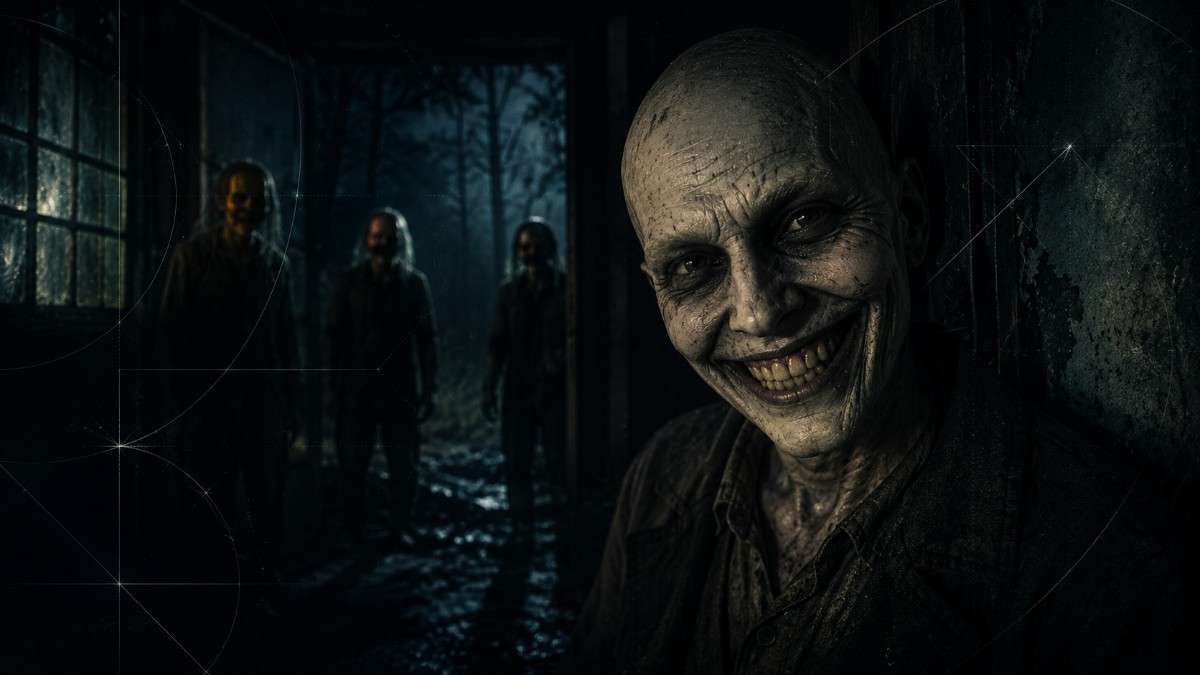
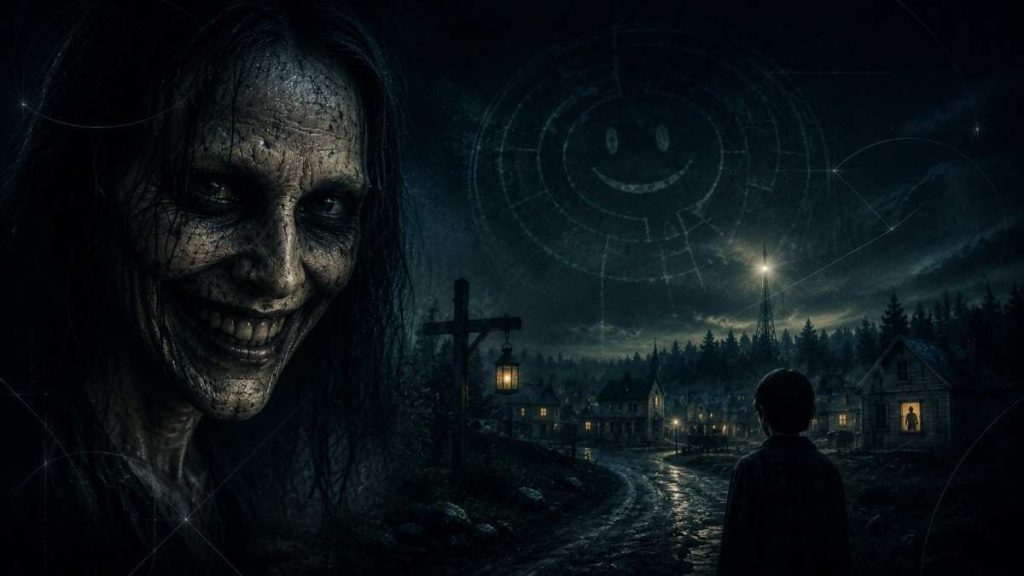
Smiley is a secondary antagonist in FROM who appears across multiple seasons and operates with a level of individual complexity that no other creature in the show matches. The nickname comes from the exaggerated, fixed smile he wears more prominently and more consistently than the rest of the creature population.
Actor Jamie McGuire portrays Smiley, and the show’s writing gives the character specific behavioral traits that set him apart from the general creature pool in ways that matter for the mythology.
What makes Smiley distinct is not just the smile. It is the evidence of individual identity underneath it. Fans have noted that he appears to remember specific locations within Colony House, reacting to the stair railing in a way that suggests familiarity rather than predatory interest. He demonstrates apparent emotional responses to specific situations and specific survivors that go beyond what functional hunting behavior would require. He seems to RECOGNIZE people. Other creatures treat the town’s residents as prey. Smiley sometimes appears to be doing something else entirely, something that looks less like hunting and more like a conversation being conducted without words.
What Did Boyd Do to Smiley?
Boyd’s direct confrontation with Smiley is one of the most discussed creature interactions in the entire show, and for good reason. Boyd’s encounters with Smiley revealed something the show had not made explicit before: the creatures are not all operating at the same level of awareness.
Boyd’s conflict with Smiley demonstrated that Smiley could be tracked, anticipated, and in some sense communicated with, or at least responded to. It revealed that Smiley carries something that functions like a personal grievance, which is not behavior you get from a mindless predator. It also showed that whatever connection Smiley has to the Town runs deeper than the standard creature-Town relationship, raising the question of whether Smiley’s individual prominence is something the Town chose, rather than something that emerged accidentally.
The confrontation did not resolve the origin question. It made it more urgent.
FROM Monster Origin Theories: Are the Creatures Former Humans?
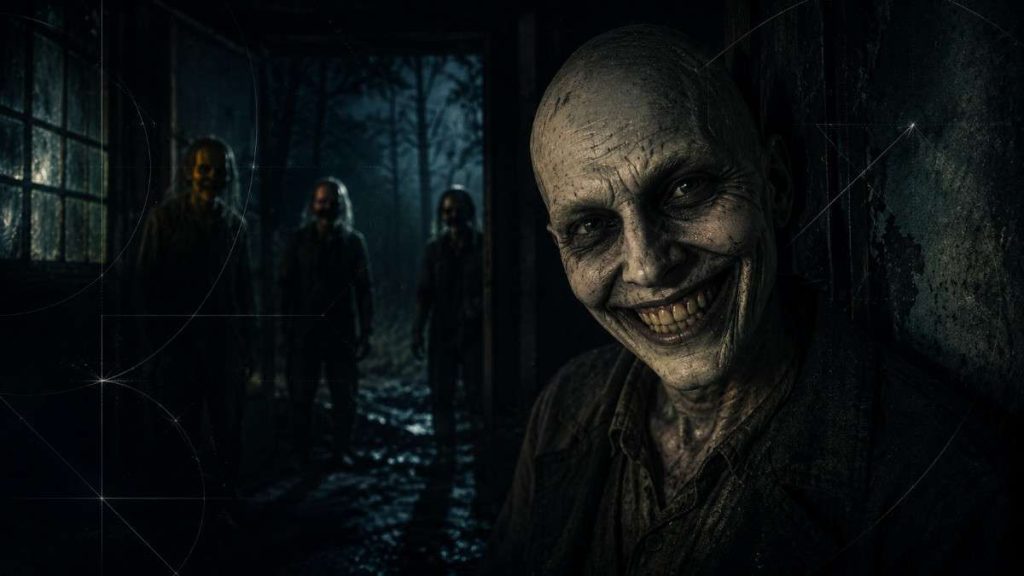
Three major theories compete in the FROM fan community, and they are more compatible with each other than they might first appear.
Theory 1: The Creatures Are Transformed Human Victims
This is the most widely supported theory, and the evidence the show has built into its creature behavior is genuinely compelling.
The creatures mimic distinctly human social behaviors. Knocking. Calling out. Smiling. These are not behaviors a supernatural predator develops from scratch. They are behaviors that suggest the creatures were once beings who used those gestures in their original form, before something stripped away everything except the gestures themselves.
The smile, on this theory, is a remnant. It is what a smile becomes when the person behind it has been hollowed out but the muscle memory of the gesture, or the instinct that once drove it, remains encoded in whatever the creature now is. The wave goodbye is the same conceptual horror. The friendly voice at the door calling your name is the same. The Town’s creatures may be people performing social rituals they can no longer understand, aimed at people who can still feel exactly what those rituals were designed to make them feel.
Fans have theorized, based on behavioral evidence in the show, that Smiley specifically may have lived in Colony House before his transformation. His apparent familiarity with the building’s layout and his fixation on certain residents would support this. If true, it would mean Smiley is smiling at people in the home he used to live in, possibly at people doing what he once did, trying to survive the same place that destroyed him.
The role of the Town’s controlling force connects to this transformation process. Understanding what the Town actually is matters here, because whether the Town corrupts its victims into creatures or whether transformation happens through some other mechanism changes what the smile means.
Theory 2: The Creatures Are Constructs Built by the Town’s Controlling Force
The competing theory argues that the creatures were never human at all. They were created or summoned by whatever entity built the Town, designed from the start to serve a specific function.
The strongest evidence for this theory is the precision of the rules. The “no entry without invitation” constraint does not feel like a side effect of corruption. It feels like a design spec. A wild predator has no reason to respect doorways. A programmed agent operating under instructions from a controlling force would follow the boundary exactly.
On this reading, the smile is not a remnant of humanity. It is a FEATURE, a deliberate choice by the force that built the creatures, included specifically because it maximizes psychological damage to the Town’s prisoners. The smile was put there because whatever controls the Town understands human psychology well enough to weaponize it. It knows that a smiling thing at the door is more corrosive to a survivor’s mental state than a screaming one.
Theory 3: Smiley Is a Specific, Identifiable Person
Season 4 deepened Smiley’s individual backstory in ways that brought a specific identity theory back to the front of fan discussion. The theory, active in Reddit threads and fan wikis, holds that Smiley can be connected to a specific prior resident of the Town.
The Jasper theory, which connects Smiley to a character referenced in earlier seasons, circulates widely in the fan community. The evidence is circumstantial but accumulates: behavioral quirks that align with Jasper’s known personality, the Colony House familiarity, the level of individual awareness Smiley demonstrates.
If Smiley is Jasper, or someone like Jasper, it shifts the entire emotional register of the monster. The most terrifying creature in the show would be a person who went through exactly what the current survivors are going through, failed to escape, and now haunts the people who might succeed where he did not.
Here is the thing none of these three theories acknowledge: they are not mutually exclusive. The Town could create creatures FROM humans, which would mean the creatures are simultaneously former people and Town constructs. Theory 1 and Theory 2 converge instead of competing. Smiley being a specific individual does not disprove the transformation model. It confirms it at the personal level, with a name and a face attached.
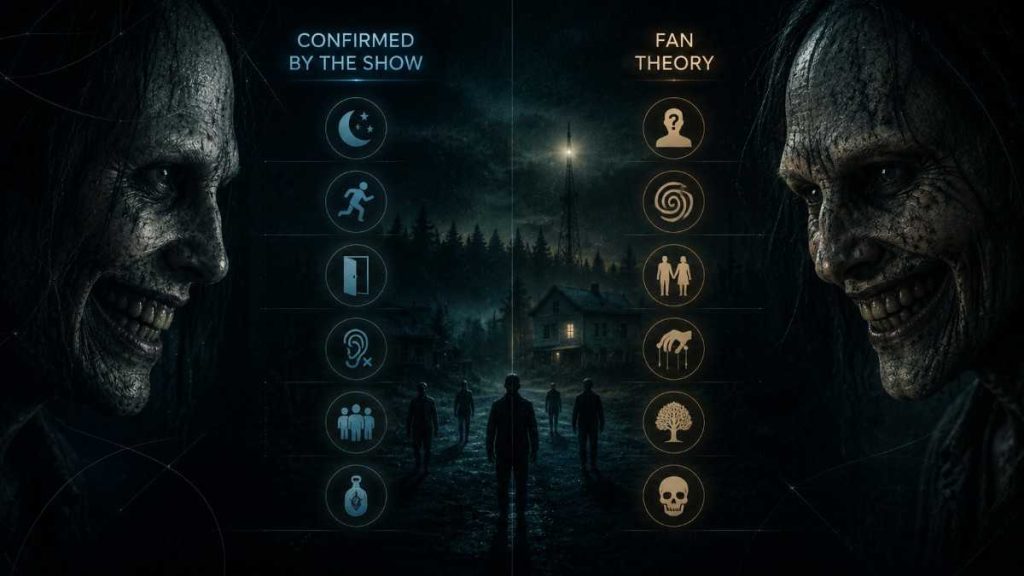
Creature Rules the Show Has Actually Confirmed vs. Fan Theory
This distinction matters more than most FROM explainers acknowledge. There is confirmed show canon, and there is fan inference, and keeping them separate helps you evaluate the theories more honestly.
What the show has actually established through events on screen:
- Creatures cannot enter occupied structures without an invitation. This has been tested and enforced consistently across all seasons.
- The creatures operate only at night. Sunrise ends their activity without exception.
- Talismans repel or slow the creatures. They do not destroy them permanently. The protection is conditional and requires maintenance.
- The creatures display consistent social mimicry: knocking, calling out, smiling, and gesturing in ways that serve the goal of getting a resident to open the door or step outside.
What remains genuinely unconfirmed as of Season 4:
- Whether the creatures retain any awareness of a former identity. Smiley’s behavior SUGGESTS this, but the show has not confirmed it in dialogue or explicit narrative.
- Whether the creatures experience anything analogous to pain or emotion. Their reactions to certain events imply they might, but implication is not confirmation.
- Whether the smile is voluntary, instinctive, or externally commanded. This is possibly the central unanswered question.
- Whether there is a formal hierarchy among the creatures. Smiley’s prominence and behavioral complexity points toward yes, but the mechanics of that hierarchy have not been shown.
The question of Anghkooey’s relationship to the creature system is similarly unresolved. Anghkooey appears to be woven into the FROM lighthouse theories and the show’s broader mythology, but whether Anghkooey is the source of the creatures, a separate entity, or a name for the whole system the creatures operate within remains open.
What the Smile Tells Us About the Town Itself
The smile is not just a creature behavior. It is evidence of intent at the system level.
If the smile is a behavioral rule, something set it. The Town’s controlling force, whatever Anghkooey is, whatever the entity behind the Man in Yellow represents, appears to have designed the creatures specifically to maximize psychological suffering rather than just physical harm. Physical harm alone would be simpler. A creature that just attacked would achieve predation. A creature that knocks, smiles, and calls your name does something more complex and more damaging.
It creates anticipatory terror. Every resident who has survived a night in the Town now associates smiling faces at the door with death. That association does not go away at sunrise. It lives with them through every daylight hour, waiting for the dark to come back.
The smile attacks human social wiring at its most basic level. We are evolutionarily primed to read a smiling face as safe. Every resident of the Town has had that priming turned into a trap. The Man in Yellow’s connection to this control structure, explored in detail at what the Man in Yellow represents, suggests the psychological manipulation runs all the way up the Town’s power structure, not just at the creature level.
The Town does not simply trap people. It appears to study them, understand what breaks them, and build systems specifically calibrated to those breaking points. The smile is one of those calibrations. It was chosen, not evolved.
And if the creatures were once people, if they were once survivors who failed to escape, the forced smile becomes the show’s cruelest design element. It makes the monsters perform the social gesture of warmth and welcome toward people who are doing exactly what they once did. Every smiling creature walking toward a locked door might be a former resident, wearing the expression of friendliness like a scar, aimed at strangers who still have a chance they no longer do.
If you want to see how this mythology pays off on screen, FROM Season 4’s ending sheds more light on where the creature mythology is heading and what the show seems to be building toward.
FROM Creature FAQ
Q: Why can’t the FROM monsters come inside homes?
The creatures cannot enter any occupied dwelling without being explicitly invited in. The show enforces this as an absolute rule across all seasons. The most supported interpretation is that whatever force controls the creatures built this limitation into them as a design choice, not as a weakness they are trying to overcome. By giving survivors a conditional sanctuary, the Town ensures they stay invested in surviving the night rather than giving up, which appears to serve whatever purpose the Town has for its prisoners. It is control architecture, not a creature vulnerability.
Q: What exactly is Smiley in FROM?
Smiley is the most prominent individual creature in FROM, portrayed by actor Jamie McGuire. He is distinguished from other creatures by his exaggerated fixed smile, his apparent memory of specific locations within Colony House, and behavioral complexity that suggests individual identity rather than collective predatory function. He appears to recognize specific survivors and react to situations in ways that go beyond what hunting behavior requires. Whether he was once a specific human resident of the Town is one of the show’s most actively theorized questions heading into its later seasons.
Q: Why do FROM monsters walk slowly instead of running?
The creatures’ deliberate pace is not a physical limitation. It is a psychological weapon. A running predator triggers pure survival instinct and speeds up the encounter. A creature that walks slowly, smiling, and makes no apparent effort to hurry communicates something far more disturbing: it is not worried. It has all the time it needs. That confidence, projected through calm movement and a calm expression, is more corrosive to a survivor’s mental state than a sprint. The show uses this deliberately as part of how the creatures terrorize rather than just kill.
Q: Are the FROM monsters actually former humans?
The show has not confirmed this outright as of Season 4. The transformation theory is the most widely supported fan interpretation, based on the creatures’ use of distinctly human social behaviors like knocking, smiling, and calling out names, behaviors that suggest learned or remembered social gestures rather than instinctive predatory tactics. Smiley’s apparent memory of Colony House and his individual behavioral complexity are the strongest pieces of evidence. The show may be deliberately keeping this ambiguous because confirming it would resolve too much of the mythology too early.
Q: Is there a hierarchy among the creatures in FROM?
The show implies a hierarchy through Smiley’s behavior and prominence without explicitly confirming one. Smiley operates with a level of individual awareness and apparent agency that the standard creature population does not display. If a hierarchy exists, Smiley appears to occupy a different tier than the general creature pool, possibly because of specific qualities he possessed before transformation, or possibly because the Town’s controlling force assigned him a different function. Season 4 suggests the hierarchy question will become more central as the mythology develops.
Q: Is the smile in FROM voluntary or does something force the creatures to do it?
The show has not answered this directly, and it is arguably the most important open question about the creature system. If the smile is voluntary, it means some awareness of the gesture’s effect remains inside the creature. If it is compelled by the Town’s controlling force, it means the entities trapped inside the creatures have no agency over their own expressions, which would be a different kind of horror entirely. The fact that the smile appears at behaviorally consistent, strategically useful moments suggests it is not random, making the “compelled feature” theory more consistent with the evidence.
Q: Does the smile in FROM have anything to do with the Man in Yellow?
The Man in Yellow appears to operate as an intermediary layer in the Town’s control structure, which means his relationship to the creatures is a genuine question rather than a confirmed connection. The creatures and the Man in Yellow both serve the Town’s broader system of psychological control, and the smile fits within that system’s logic. Whether the Man in Yellow specifically has authority over the creatures, or whether both the Man in Yellow and the creatures answer to the same force, has not been confirmed. The convergence of their functions in the Town’s prisoner management system is suggestive, but the show keeps the hierarchy deliberately murky.
The Smile Is Not the Monster’s Choice
Every detail the show gives us about the creatures, the rules they follow, the gestures they perform, the precision of their constraints, points toward the same conclusion. These creatures are not acting freely. They are agents in a system designed by something that understands human psychology at a very specific, very targeted level.
The smile is not disturbing because it is ugly or because it signals something monstrous. It is disturbing because it is right. It looks exactly like what it is mimicking. The Town built something that wears friendliness as a weapon, and it did that because whoever or whatever built the Town knows that the most effective way to break a person is not to take away their safety. It is to take away their ability to read a face and know whether they are safe.
If you want to track where the creature mythology is heading, the mythology’s architecture in Season 4 is where to look next. The show has been building toward specific answers for seasons now, and the creature origin question, with Smiley at its center, appears to be one of the threads it is ready to pull.