

How Much Does It Cost to Make an Episode of Love Island USA?
TL;DR
- Love Island USA’s estimated season budget is approximately $30 million, making it one of the most expensive unscripted formats currently airing in the US.
- Spread across a typical 25 to 35 episode run, the per-episode cost lands somewhere between $857,000 and $1.2 million.
- The three biggest cost drivers are the Fiji filming location, the daily episode production schedule, and a crew that numbers in the hundreds.
- The villa is rented, not owned by production, and an exclusive-use resort lease in Fiji for six-plus weeks is a significant portion of the total spend.
- The $100,000 prize that contestants compete for represents less than 0.34% of what the season costs to make.
Most people assume reality TV is cheap. No scripts, no sets, no actors demanding a trailer with a specific brand of sparkling water. Love Island USA runs on that assumption and quietly spends around $30 million a season anyway. The show looks like people lounging by a pool in Fiji arguing about who has feelings for whom, and it kind of is that, but it takes a genuinely massive operation to make it look that casual.
The number that circulates online is the $30 million season figure, cited by No Film School and attributed to ITV Entertainment, the UK company behind the format. What almost nobody does is stop and actually do the math on what that means per episode, or explain why a show with no sets, no scripts, and no A-list cast costs as much as a mid-tier scripted drama. That is what this article covers. By the end, you will understand exactly why Love Island is expensive, where the money goes, and why the $100,000 prize is genuinely almost a rounding error.

What Is Love Island USA’s Total Production Budget?
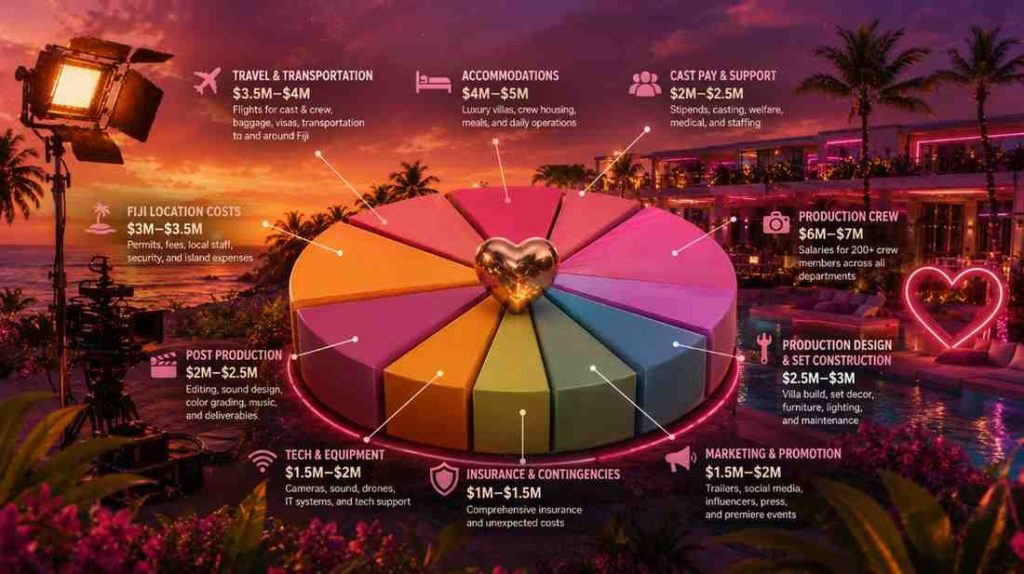
The estimated total production budget for Love Island USA is $30 million per season. That figure comes from No Film School, sourced to ITV Entertainment, the British production company that created the format and licenses it to US broadcasters. Peacock currently airs the US version; CBS held it before that.
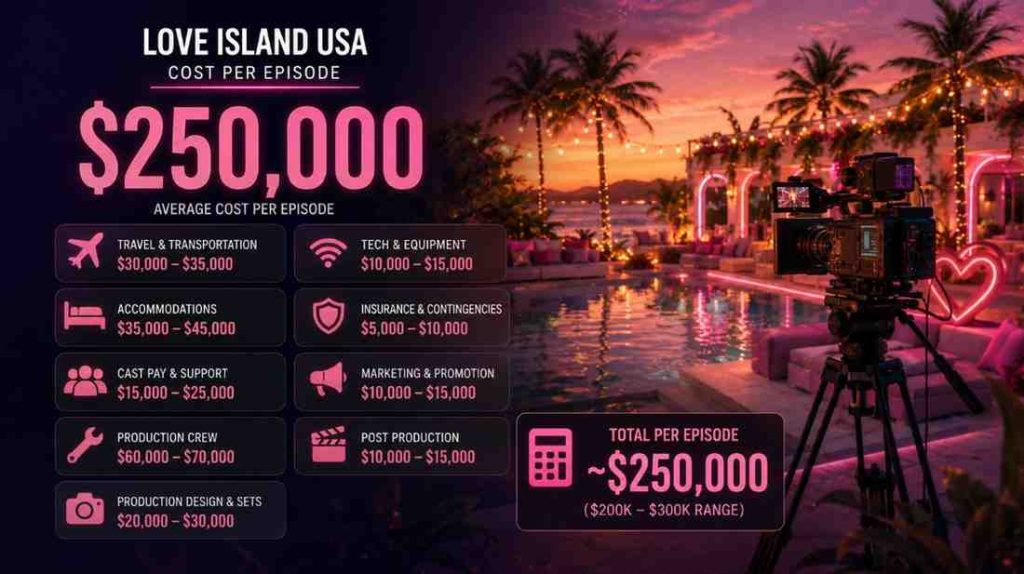
What the $30 million figure needs is some math applied to it. Love Island USA typically produces between 25 and 35 episodes per season depending on the run length. Season 6, which filmed in Fiji, landed around 30 episodes. At that episode count, the per-episode cost sits at roughly $1 million to $1.2 million. That is not cheap. That is more expensive than most scripted cable dramas, and it is many times more than what casual viewers imagine reality TV costs.
The comparison to the UK version is instructive. Love Island UK runs 50-plus episodes per season, which spreads the same category of costs across far more episodes. The US version concentrates a similar scale of spending into fewer episodes, which is part of why the per-episode number looks so high.
How Does That Compare to Other Reality Shows?
Reality TV production costs vary wildly depending on format, location, and how much the show’s structure requires.
- The Bachelor reportedly costs around $43 million per season across roughly 12 episodes, putting its per-episode cost significantly higher than Love Island’s.
- Survivor operates on a comparable model to Love Island: remote international location, large crew, continuous logistics, and an extended shooting schedule. Estimates for Survivor’s season budget run above $40 million.
- The Traitors US, which also airs on Peacock, sits in a similar range to Love Island due to its Scottish castle location and intensive format requirements.
Love Island USA sits firmly in the upper tier of unscripted production costs. The idea that it is a budget show is not accurate. For more on how The Traitors stacks up in terms of production costs for reality competition shows, the numbers follow a similar logic: location and daily operations are the killers.

Why Does Filming in Fiji Cost So Much?
Filming in Fiji costs significantly more than a comparable domestic production because everything that goes into making the show, including equipment, supplies, and most personnel, has to be transported to or sourced near a remote island location. There is no running back to the studio. There is no crew driving home at the end of the day.
Private resort buyouts in Fiji for exclusive-use properties can run anywhere from $10,000 to $50,000 or more per night depending on scale and amenities. Six-plus weeks of exclusive access at the lower end of that range already approaches $4 million. At the upper end, it exceeds $20 million. The real figure for the Love Island villa lease is not publicly confirmed, but the realistic range for an exclusive-use Fijian compound over the filming period is a substantial portion of the total season budget. This is an estimate based on publicly available Fijian resort pricing, not a confirmed production figure.
On top of the base rental, production transforms the property. Camera rigs, lighting infrastructure, set dressing, production offices, and monitoring facilities all get built out from scratch, then dismantled when filming ends. That construction and de-rig cost layers on top of whatever the lease rate is.
Does Production Own the Villa?
No. The villa is a rented property every season. Production leases an existing resort or private compound in Fiji, installs the physical infrastructure required for continuous filming, and hands the property back to its owners when the season wraps. Love Island USA does not retain the villa between seasons.
This means the setup and teardown costs recur every single year. There is no amortization across multiple seasons. Every new season starts from scratch on the location build, which is a recurring cost that domestic shows with owned or long-term leased facilities do not face. The question of why the filming location is Fiji specifically connects to both the aesthetic goals of the show and the isolation requirement, but the financial cost of that choice is real and significant.

The Real Cost Multiplier: Daily Episodes
Daily episode production is the structural choice that separates Love Island USA from almost every other reality show in terms of per-episode cost. Most reality formats shoot their season over several weeks, then edit on a weekly release schedule with days or weeks between what was filmed and what airs. Love Island does not do that.
Love Island USA releases new episodes nearly every day during the season. What audiences watch on a Tuesday was filmed on Monday. That compressed timeline requires a full post-production pipeline operating continuously: editors, story producers reviewing overnight footage, music clearance on a rapid turnaround, graphics, and quality review, all running on a 24-hour cycle.
A single editing team on a weekly show might spend five or six days cutting one 45-minute episode. Love Island’s team does a version of that every single day, which means significantly more editors running in parallel to keep pace. Music licensing alone becomes a non-trivial line item on a daily show. Love Island USA uses a substantial music library throughout each episode, and each track requires its own synchronization license. Multiply that across 30 episodes and the music budget alone is meaningful.
The crew on site does not clock out overnight either. Conversations, arguments, and re-couplings happen at 2am in the villa. All of it needs camera operators and sound recordists present and running. That is not how weekly reality shows operate. The continuous nature of the show is what makes Love Island structurally more expensive than its competitors, even when compared to shows with similar location budgets.

Where Does the Rest of the $30 Million Go?
Once you account for location and the daily production model, the remaining budget covers crew, talent, host fees, post-production infrastructure, and the digital ecosystem the show runs in parallel.
The Crew
Reality TV productions at this scale typically employ between 150 and 300-plus crew members across on-location and post-production roles. On Love Island, that includes multiple field producers and directors, camera operators covering a villa reportedly fitted with dozens of fixed and mobile cameras, sound engineers, lighting technicians, story producers reviewing footage overnight, and editors working in parallel shifts.
Beyond the core production roles, Love Island also carries legal personnel, medical staff, and psychological support workers on location. Mandatory welfare provisions became a more prominent industry standard following controversies around the UK version of the show. Those roles are not optional, and they add to headcount. Crew members working on a remote international location also receive travel coverage, on-location accommodation, per diem rates, and in many cases location bonuses on top of their standard day rates.
The Host
Sarah Hyland hosts Love Island USA starting from Season 6. Host fees for unscripted shows at this profile level typically fall between $1 million and $3 million per season, based on comparable deals in the reality TV space. No confirmed figure for Hyland’s deal has been made public, so this is an industry-range estimate rather than a confirmed number.
Contestant Pay and the Prize Money
Contestants on Love Island USA are not salaried. They receive a daily stipend for their time in the villa, which has been reported in coverage of the show as a modest amount relative to the overall production scale. The headline number audiences focus on is the $100,000 prize, but that figure represents less than 0.34% of the total estimated $30 million season budget.
Most winning couples also choose to split the prize rather than one person keeping it all, meaning the take-home for each person is $50,000 before taxes. The Amaya and Bryan split after their season is a reminder that even winning the prize does not guarantee the outcome the show sets up. The dramatic potential of the split-or-keep decision at the finale is genuinely good television, but in the context of a $30 million production, $100,000 is almost a prop.
Post-Production and the App
Love Island USA operates a companion voting app that allows viewers to influence decisions inside the villa, including eliminations and re-coupling choices. Building and maintaining that app is a technology cost layer that sits entirely outside the on-screen production budget. The app requires backend infrastructure, development resources, moderation, and updates throughout the season.
Social media content, clip packages, and digital-first material also get produced simultaneously with the main show. Those require their own producers and editors beyond the main show team. The show’s digital footprint is not a side project; it is an integrated part of the format, and it costs money to run.
Is Love Island USA Actually Cheap Compared to Scripted TV?
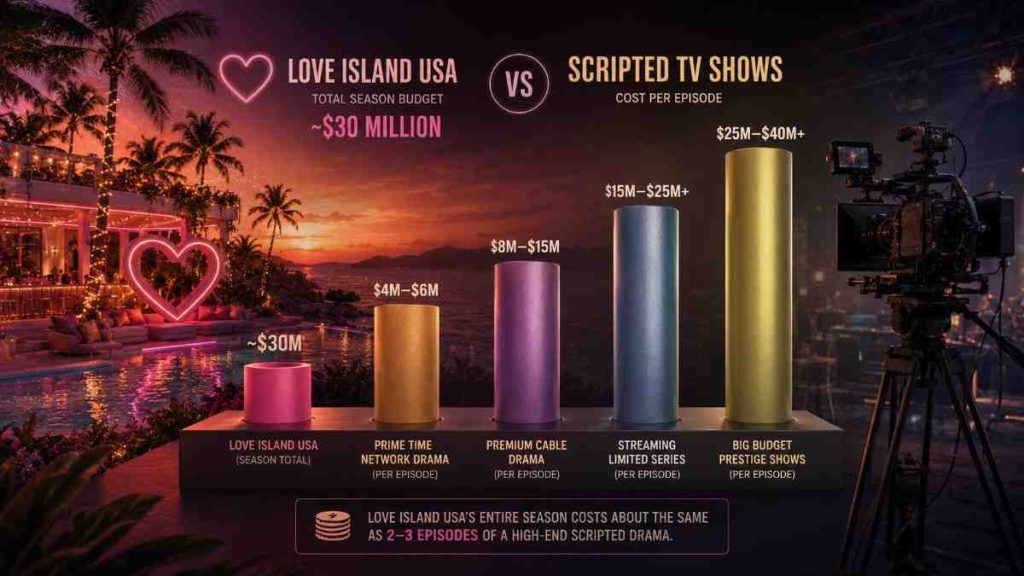
Relative to scripted television, Love Island USA is a bargain. A prestige streaming drama on Netflix or HBO typically costs between $5 million and $15 million per episode. Even a mid-tier network drama runs $3 million to $5 million per episode. Love Island at $1 million to $1.2 million per episode is one-third to one-tenth the cost of a scripted equivalent with a comparable audience.
That cost-to-engagement ratio is the entire business case for why Peacock keeps investing in the format. Season 6 in Fiji became one of the platform’s most-watched originals, generating viewing hours and social media engagement that would cost significantly more to produce in a scripted format. For context on how reality TV pay structures work across the unscripted landscape, the pay scale for Bachelor franchise contestants shows how broadly similar the talent cost model runs across formats.
The $30 million is not waste. It is a calculated production investment in a format that consistently punches above its weight class in audience hours per dollar spent. Peacock is not spending that money despite the cost; it is spending it because the return justifies it.
How Much Does Love Island USA Cost Per Episode, in Plain Numbers?
Here is the complete cost picture in one place for readers who want the summary version.
- Estimated season budget: $30 million (attributed to ITV Entertainment, cited by No Film School)
- Estimated episodes per season: 25 to 35
- Estimated cost per episode: $857,000 to $1.2 million
- Prize money as share of total season budget: less than 0.34%
- Estimated location cost as share of budget: potentially 15% to 25% of total (flagged as estimate based on Fijian resort pricing, not confirmed)
- How it compares: higher per-episode than most scripted cable dramas, lower than prestige streaming drama
All figures are estimates unless otherwise noted. Peacock and ITV Entertainment have not publicly released a line-item budget for any season of Love Island USA.
FAQ
How much does Love Island USA cost to make per season?
The estimated production budget for Love Island USA is approximately $30 million per season, a figure attributed to ITV Entertainment and cited by No Film School. This makes it one of the most expensive unscripted formats currently airing in the United States. The budget covers location costs in Fiji, a crew of 150 to 300-plus people, daily episode post-production, the host fee, contestant stipends, and the digital infrastructure including the companion voting app. No official breakdown has been released by Peacock or ITV Entertainment.
What is Love Island USA’s cost per episode?
Dividing the estimated $30 million season budget across a typical run of 25 to 35 episodes puts the per-episode cost between roughly $857,000 and $1.2 million. That range makes Love Island USA more expensive per episode than most scripted cable dramas, which surprises most viewers who assume reality TV is a low-cost format. The daily episode production schedule is the main structural reason the per-episode number is so high.
Does Love Island production own the villa in Fiji?
No. The villa is a rented property. Production leases an existing resort or private compound in Fiji for the duration of filming, installs camera rigs, lighting, and production infrastructure, then returns the property to its owners when filming ends. This means the setup and teardown costs repeat every season. Exclusive-use resort buyouts in Fiji can range from $10,000 to $50,000 or more per night, making a six-week lease a significant line item in the season budget.
Has anyone kept the full $100,000 prize on Love Island USA?
Yes, though it is uncommon. Most winning couples choose to split the prize at the finale, taking home $50,000 each before taxes. The option to keep or split the money is revealed in the finale episode and is traditionally one of the more dramatic moments of the season. In the broader context of the show, the $100,000 prize represents less than 0.34% of the estimated $30 million season production budget.
Why is Love Island USA so much more expensive than people expect?
The most common objection to the $30 million figure is that the show looks simple: people in a villa, cameras rolling. The real cost comes from three structural factors most viewers never consider. First, the Fiji location means every resource, crew member, and supply has to be transported to or sourced near a remote island for six-plus weeks, with no one going home at the end of the day. Second, the daily episode schedule requires a continuous post-production pipeline running 24 hours a day throughout the season. Third, the crew size, including welfare staff mandated by industry standards, approaches small film production scale.
How does Love Island USA’s budget compare to The Bachelor?
The Bachelor reportedly operates on a season budget of around $43 million, but spreads that across roughly 12 episodes, putting its per-episode cost significantly above Love Island USA’s. Survivor runs at an estimated $40-plus million per season with a comparable remote-location model. Love Island USA sits at the high end of unscripted TV spending, but is not the most expensive reality format in the US when measured by total season budget.
Why does Love Island USA produce episodes daily instead of weekly?
Daily episodes are a core feature of the Love Island format imported from the UK. The near-live turnaround creates urgency for the audience and keeps the show part of the daily conversation during its run. The trade-off is significant: daily release requires a parallel editing operation, rapid music clearance, and overnight story producers reviewing footage, all at a cost structure that weekly reality shows do not carry. It is the format’s most expensive structural choice and the clearest reason per-episode costs run as high as they do.
The Number That Changes How You Watch the Show
The $30 million figure is real, but the per-episode math is what actually reframes the show. At $1 million to $1.2 million per episode, Love Island USA is not cheap reality television. It is mid-budget prestige production wearing flip-flops and a swimsuit. The villa, the logistics, the crew that never sleeps, and a post-production pipeline running 24 hours a day are what that number buys.
The specific action here is simple: the next time someone describes reality TV as cheap filler, the Love Island model is your counterexample. The remoteness, the daily episode model, and the scale of the crew are each expensive on their own. Combined, they produce a show that costs more per episode than most of what airs on cable.
What this probably means going forward is that streaming platforms will keep investing in formats like this, because even at $30 million a season, the cost-to-audience ratio outperforms scripted alternatives by a wide margin. The economics favor the villa over the writer’s room, at least until audiences get tired of both.