
Netflix Does Not Count Viewers the Way You Think It Does
Netflix cares about completion rate, not raw view count. These two numbers can tell completely opposite stories about the same show, and the one Netflix uses internally is not the one it shows the public.
What Netflix Actually Measures (and What It Ignores)
Completion rate is the percentage of people who started a show and watched every episode through to the end. A show with ten episodes where half the audience drops off after episode three can accumulate tens of millions of hours viewed and still have a completion rate that signals failure.
Netflix began publishing limited viewership data in November 2023, releasing a twice-yearly list of hours viewed per title. Before that, there was essentially no public information. Fans spent years arguing about cancellation decisions with almost no actual numbers to reference, which is part of why so many theories filled the vacuum. The hours-viewed metric Netflix now shares publicly is the Top 10 list number, a weekly snapshot of raw consumption. It is not completion rate, and Netflix has been careful never to release completion data publicly.
Industry reporting suggests Netflix’s internal benchmark sits around a 30 percent completion threshold, meaning roughly three out of ten people who start a show need to finish it for the series to register as performing adequately. Netflix has never confirmed this figure officially, but it circulates widely enough in production circles that it shapes how showrunners think about episode structure and pacing.
Why Completion Rate Matters More Than View Count for a Subscription Platform
Netflix makes no money per impression. There are no ads. The revenue model is a flat monthly subscription, which means Netflix’s financial health depends entirely on two things: convincing people to subscribe, and convincing people to stay subscribed.
Completion rate connects to both. A viewer who finishes a show is statistically more likely to remain a subscriber, because finishing means they got value from the experience and expect to get it again. A viewer who starts a show and drops off by episode two learned almost nothing about whether Netflix is worth keeping.
This is where the concept of the marginal subscriber becomes important. A marginal subscriber is someone who signed up for Netflix specifically because of a particular show. They are the most valuable viewer in Netflix’s model, because they represent actual new revenue driven by that title. Someone who already subscribed for other reasons and happens to watch a show contributes no new revenue to that show’s account. When Netflix evaluates whether a show justifies its production cost, it is not counting total viewers. It is estimating how many of those viewers are marginal, and whether those marginal subscribers stay long enough to pay back the cost of acquiring them.
Traditional broadcast television used cost per thousand viewers, abbreviated as CPM, as its primary efficiency metric, because advertising rates were tied directly to audience size. Netflix’s equivalent is closer to cost per completer, weighted toward whether those completers are people who would not have subscribed otherwise. The math is structurally different, which is why shows that would have survived on network TV sometimes get cancelled on Netflix and vice versa.
Why Netflix Cancels Shows After Two Seasons: Where the Math Breaks Down
The two-season cancellation pattern is not a coincidence. Season 2 is where production costs jump, where audience drop-off is most predictable, and where Netflix loses the cost certainty it had during the initial production window. All three of those things happen simultaneously.
The Actor Contract Cliff
When Netflix greenlights a show, the initial cast contracts are typically written to cover two seasons. The rates for both seasons are agreed upon upfront, before anyone knows whether the show will succeed. From the studio’s perspective, this is a calculated risk on talent that is not yet proven.
Once a show becomes a hit, everything changes. Cast members who were unknown commodities when season one was negotiated are now recognizable names. Their agents know it. From season three onward, those actors can demand significantly higher salaries, and they frequently do. The two-season contract structure means Netflix has reasonable cost certainty through season two. Season three is a financial unknown before a single script has been written.
A show that appeared economically viable at pre-negotiated rates can look completely different the moment stars gain full renegotiation leverage. This is not unique to Netflix. It is how the entire industry is structured. But because Netflix does not have the syndication revenue model that once made it worth paying higher rates for a long-running show, the math hits harder on streaming than it did on traditional television.
Why Season 2 Itself Already Costs More Than Season 1
Even within the locked two-season window, season two costs more to produce than season one. Crew day rates increase. The production infrastructure that was built cheaply for a pilot scales up as the show grows. The writers’ room costs more to maintain with experienced staff than it did to assemble from scratch. Guest talent comes at a higher price once a show has a public profile. Archive 81 reportedly cost around 14 million dollars per episode at its production level, meaning any meaningful cost escalation in a second season would have required a substantial completion rate improvement to justify it.
The industry average for a prestige drama is a 20 to 40 percent budget increase between seasons. Apply that to a show that was already expensive and you get a number that needs to be earned back by a proportionally larger audience of completers, many of whom need to be marginal subscribers. Season two audiences are structurally smaller than season one audiences, because not every viewer who finished season one returns immediately for season two. Higher cost, lower initial audience, same completion threshold. That is the cliff.
The Streaming Cancellation Cliff vs. Traditional TV
Network television historically ran shows for years with the explicit goal of reaching syndication. A show needed approximately 100 episodes to be worth selling into reruns, which meant networks had financial incentive to keep shows alive through rough patches. Netflix does not operate on that model at all.
Netflix’s library catalog is largely filled with licensed content from other studios. Its original productions are valued primarily for what they do to subscriber acquisition and retention, not for long-term licensing revenue. For shows cancelled on cliffhangers, this is especially painful for fans to absorb, because the traditional TV logic of “just wait, the story will continue eventually” does not apply. Once a Netflix original fails the renewal math, it is done. There is no syndication backstop and no off-network pickup waiting.
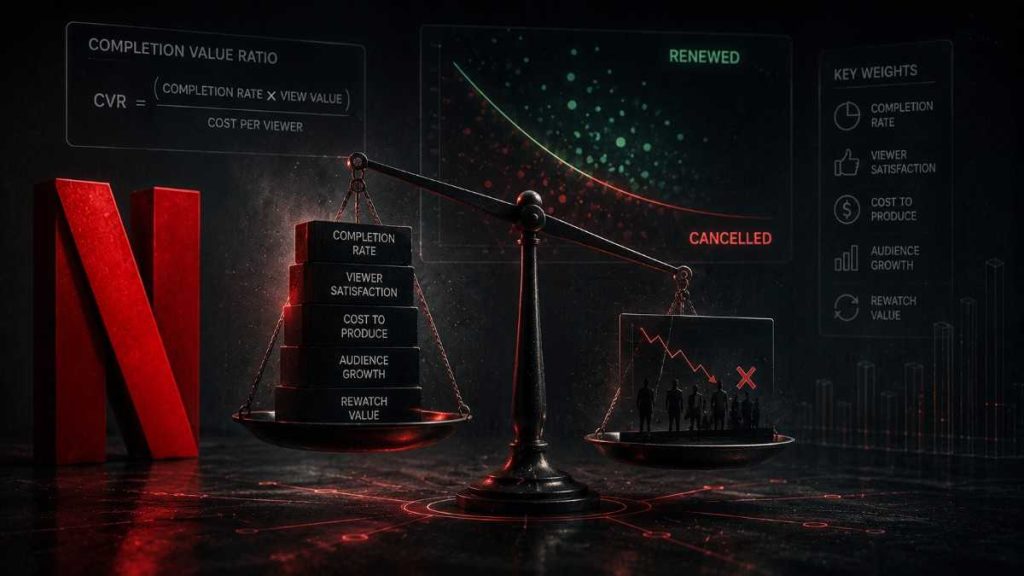
The Completion Value Ratio: A Framework for Understanding Every Netflix Cancellation
No single number captures Netflix’s renewal logic, but there is a way to frame it that makes every cancellation decision legible. Call it the Completion Value Ratio.
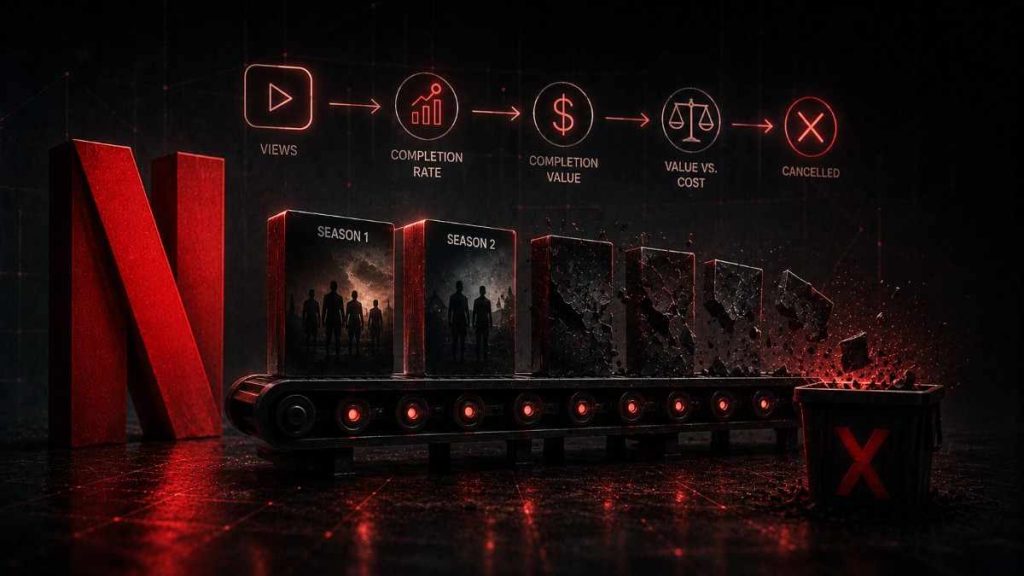
The Completion Value Ratio works like this: take the number of completers who are marginal subscribers, meaning people who subscribed specifically because of the show, and weigh that against the total production cost of the season. A show with a high ratio is bringing in new, committed subscribers who finish the content and stay. A show with a low ratio is expensive, watched mostly by people already subscribed for other reasons, and not finished by enough of its starters to signal strong retention value.
This is not an official Netflix metric with a published formula. It is a conceptual tool for understanding why the same platform renews Stranger Things and cancels Archive 81. The underlying logic is real even if the specific numbers are not publicly available.
What a High Completion Value Ratio Looks Like
Stranger Things is the clearest example of a show with a high ratio. Each new season drove measurable subscriber spikes. The audience was enormous, the completion rate was high, and there was documented evidence that people subscribed specifically to watch new seasons. The production budget is staggering, but the marginal subscriber pull justifies it because the numbers at scale make the ratio work.
Squid Game followed a similar pattern. The show set records for hours viewed in its launch window globally, but more importantly, it drove subscriber growth in markets where Netflix was not yet dominant. That is the marginal subscriber story at its most powerful. New subscribers in new markets, finishing a show, paying monthly fees. Wednesday showed the same pattern, with Netflix referencing subscriber acquisition directly in earnings commentary tied to the show’s debut season.
What a Low Completion Value Ratio Looks Like
Prestige slow-burn science fiction and mystery drama tend to sit at the other end of this ratio. High production cost, a passionate but concentrated fan base, and limited marginal subscriber pull form a specific profile. A show that a deeply loyal pre-existing subscriber watches and loves, but that does not bring new subscribers onto the platform, has a structural ratio problem that no amount of fan passion can correct.
The reason why fan petitions almost never save shows comes down to this directly. A petition with 200,000 signatures measures the intensity of existing fans. Netflix’s renewal decision measures whether the show economically justifies its next production cycle. The OA demonstrated this as clearly as any cancelled show ever has. The synchronized dance protest outside Netflix’s headquarters became one of the most reported fan campaigns in streaming history. Netflix cancelled the show anyway, because the data showing a small, intensely engaged segment rather than broad subscriber-driving viewership did not move. Passion is real. It is just not the variable in the equation Netflix is solving for.
For a deeper look at why that specific show ended the way it did, the breakdown of why The OA was cancelled covers the full story with the same framework applied.
Why a Number One Trending Show Can Still Get Cancelled
A show can sit at number one in Netflix’s weekly Top 10 and still get cancelled. This is the detail that breaks most people’s mental model of how streaming works, and it is worth slowing down to explain exactly why it happens.
Netflix’s public Top 10 list measures hours viewed in a seven-day window. It rewards content that generates heavy short-term consumption, which is not the same thing as completion rate. These are genuinely different metrics measuring different viewer behaviors, and they can diverge sharply.
The binge effect creates a specific distortion for prestige niche content. A show premieres with ten episodes. A broad audience tunes in out of curiosity or because the marketing was effective. They watch two or three episodes, lose interest or get distracted, and stop. Every one of those partial views counts toward the weekly hours total. None of them count toward a healthy completion rate. A show can trend hard at launch, hit number one in multiple countries, and still have early completion data signaling a drop-off pattern that predicts a failing final number.
Archive 81 is the specific example that makes this concrete. The show hit Netflix’s global Top 10 within its first week of release and stayed there for two straight weeks. Critics called it one of the best horror series in recent memory. Netflix cancelled it less than two months after launch. The cancellation timeline is the tell: Netflix’s internal data on completion patterns was already available and already pointing toward a number that did not justify a second season budget at the cost level the show required. The surface number looked fine. The completion math did not.
1899 followed an almost identical arc. The show was one of the most expensive international Netflix productions at the time of its release, created by the team behind Dark with a fully planned three-season story. It charted globally and was cancelled before season two entered production. The creators confirmed publicly that Netflix’s cancellation cited performance data, and that they had no advance warning. The Completion Value Ratio had failed before anyone outside Netflix knew the conversation was even happening.
For more examples of shows that ended mid-story with no resolution, the full list of Netflix shows cancelled on cliffhangers covers the pattern across multiple titles.
Why These Specific Genres Keep Getting Cancelled
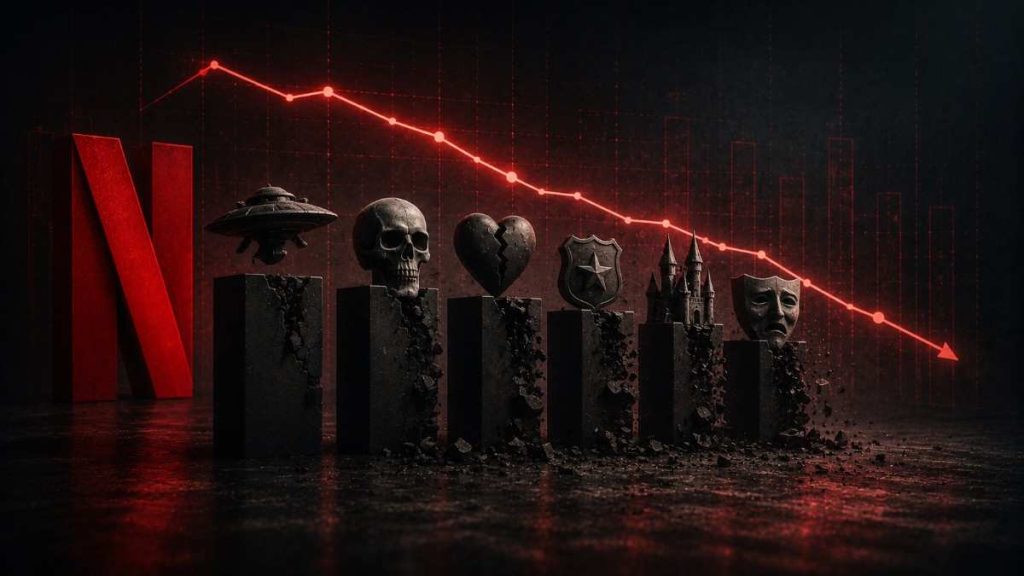
Prestige science fiction and slow-burn mystery drama die on Netflix at a noticeably higher rate than procedural crime, reality competition, or romantic drama. This is not executives having personal taste preferences. It is the genre profile matching the worst possible Completion Value Ratio template almost perfectly.
The Genre Problem Is Really a Cost-Audience Profile Problem
High-concept science fiction and serialized mystery share a specific set of production characteristics. They require elaborate world-building, which means higher per-episode budgets. They depend on serialized storytelling where each episode builds on the last, which means a viewer who misses an episode is more likely to stop entirely rather than jump back in. Casual viewers are structurally less likely to complete the series. That pattern produces exactly the audience shape Netflix’s math penalizes most.
Mindhunter is a useful case study. The show had critical acclaim, a devoted audience, and David Fincher’s name attached. Netflix did not officially cancel it, but Fincher confirmed it was on indefinite hold because the cost of bringing the cast back after a long hiatus had become prohibitive. The show’s audience, while deeply engaged, was not broad enough or marginal enough to justify the production expense of assembling that level of talent again. The practical outcome was cancellation by attrition.
Genre shows with procedural structures, meaning episodes that mostly stand alone even within a larger arc, are significantly more resilient. A viewer who drops off for two weeks and comes back can still finish the series. Completion rates stay higher. The ratio holds. This is why crime procedurals and reality competition formats survive on Netflix at much higher rates than complex serialized narratives, even when the serialized shows generate more critical attention and fan devotion.
Why International Productions Face Extra Pressure
1899, Dark, and other high-profile international Netflix originals face an additional layer of the same math. Subtitled content has a higher drop-off rate among non-native speakers, not because the shows are worse but because the cognitive friction of reading subtitles while following a complex narrative causes more casual viewers to disengage earlier. A show that is brilliant and completion-rate-healthy within its home market can fail the global ratio simply because the subtitled audience drops off faster than the cost model requires them not to.
Netflix’s international strategy has shifted noticeably since 2022 toward content that travels easily across language barriers, meaning lower narrative complexity, faster pacing, and genre choices that reduce friction. That shift is a direct response to completion data, even if Netflix never describes it in those terms publicly.
For the specific numbers behind why Warrior Nun’s audience profile made it a predictable cancellation, the Warrior Nun cancellation breakdown covers that in detail.
The Two-Season Pattern Is a System, Not a Decision
Every element covered in this piece converges at season two. The contract cliff makes season three financially unpredictable. Season two’s higher production cost meets a structurally smaller returning audience. Completion rates on season two are almost always lower than season one because the casual viewers who tried the show do not return for the follow-up. Netflix’s internal data on completion trends is available early enough in a season’s lifecycle that renewal decisions can be made before the full audience picture has even formed.
The result is a system that produces the two-season pattern reliably, without anyone at Netflix sitting in a room deciding to ruin fans’ lives. The decisions are mechanical outputs of a financial model that was built for a different goal than the one traditional television pursued. Netflix is not trying to tell great stories over ten seasons. It is trying to acquire and retain subscribers efficiently. When a show stops doing that, or stops doing it at the cost it requires, the decision follows automatically.
Sense8 is the one case that could be read as a counterexample. Netflix revived the show after a passionate international fan campaign, but the revival was a single wrap-up film, not a full season renewal. That distinction is the system working exactly as described: Netflix gave the audience a low-cost resolution while avoiding the full production expense of a season three. It was a compromise that served Netflix’s interests while appearing to be a fan victory. The math was still in charge.
FAQ
Why does Netflix cancel shows after 2 seasons instead of giving them more time to grow?
The two-season pattern comes from the structure of actor contracts combined with rising production costs. Netflix locks in cast salaries for two seasons upfront at rates negotiated before the show becomes popular. From season three, actors can renegotiate from a position of leverage, making costs unpredictable. Season two already costs 20 to 40 percent more than season one due to crew and infrastructure scaling. When completion rates drop between seasons, as they typically do, higher cost meets lower engagement exactly at the point where contract certainty ends.
Can a show be number one on Netflix and still get cancelled?
Yes, and it happens more often than fans realize. Netflix’s weekly Top 10 measures raw hours viewed in a seven-day window. Completion rate is a separate metric tracking the percentage of starters who finish the series. A show can trend number one by accumulating hours from viewers who start it and stop after two or three episodes. Those partial views boost the Top 10 ranking without improving the completion data Netflix uses for renewal decisions. Archive 81 and 1899 both charted globally before being cancelled within months of their premieres.
Why don’t fan petitions ever save Netflix shows?
Fan petitions measure the intensity of existing subscribers who already love a show. Netflix’s cancellation decisions are based on whether a show justifies its next season’s production cost by acquiring new subscribers who complete the series. These are different questions with different answers. A petition proves devotion inside an existing fan base. It does not change the completion rate data, the marginal subscriber count, or the projected cost of the next season. The OA’s fan campaign was one of the most visible in streaming history and changed nothing about Netflix’s decision.
Why do sci-fi shows get cancelled on Netflix more than other genres?
The genre profile of high-concept science fiction matches the worst-performing Completion Value Ratio template. These shows have high production budgets because of their world-building requirements. They depend on serialized storytelling that causes higher drop-off rates among casual viewers who miss episodes. The audience tends to be passionate but small, concentrated among pre-existing subscribers rather than driving new signups. Lower completion rates combined with higher costs and limited marginal subscriber pull produce a ratio that fails Netflix’s renewal threshold more often than procedural or reality formats.
What is Netflix’s completion rate threshold for renewing a show?
Netflix has never publicly confirmed a specific completion rate target. Industry reporting suggests an internal benchmark of approximately 30 percent, meaning roughly three in ten people who begin a series need to finish it for the show to register as performing adequately in Netflix’s internal metrics. This figure circulates in production and industry circles but remains unverified officially. Netflix began sharing some viewership data publicly in late 2023, but the released figures cover hours viewed rather than completion rates, which Netflix has consistently declined to publish.
Does winning awards or critical acclaim help a Netflix show get renewed?
Awards and critical reception have very limited impact on renewal decisions. Netflix’s renewal logic centers on subscriber acquisition and completion rate, neither of which is directly affected by award nominations. A critically acclaimed show with a small, concentrated audience of existing subscribers can fail the same math as a poorly reviewed show with similar viewing patterns. Mindhunter won awards and had David Fincher attached and was still put on indefinite hold because the audience profile did not justify the production cost of reassembling its cast after a long gap.
Why does Netflix not share its real viewership numbers?
Netflix went almost a decade without releasing meaningful viewership data, and the figures it began publishing in late 2023 are limited to hours viewed per title over reporting windows. Full transparency on completion rates and marginal subscriber data would give competitors, talent agencies, and production studios precise insight into which shows are performing, which would significantly shift negotiating leverage in Netflix’s content deals. Opacity is a strategic business position. The limited data Netflix now releases is calibrated to demonstrate scale without revealing the internal metrics that actually drive renewal decisions.
The Real Reason Your Favorite Show Got Cancelled
The most useful thing you can take from all of this is a shift in what question to ask when a cancellation happens. The question is not “why did they cancel a show people loved?” The question is “what did the completion data look like, and what was the projected cost of the next season?”
Those two numbers together explain almost every Netflix cancellation that has ever felt inexplicable. A show can be brilliant and still fail the ratio. A show can trend globally and still lose the renewal math. The system is not designed to reward quality. It is designed to acquire and retain subscribers at the lowest possible cost per completer, and any show that stops doing that efficiently becomes a sunk cost rather than an investment.
The next time a show you care about gets cancelled, check the genre, check the production budget if it has been reported, and think about whether it was the kind of show that brings new subscribers in or the kind that existing subscribers watch. That second question is the one Netflix already answered before the announcement went public.