
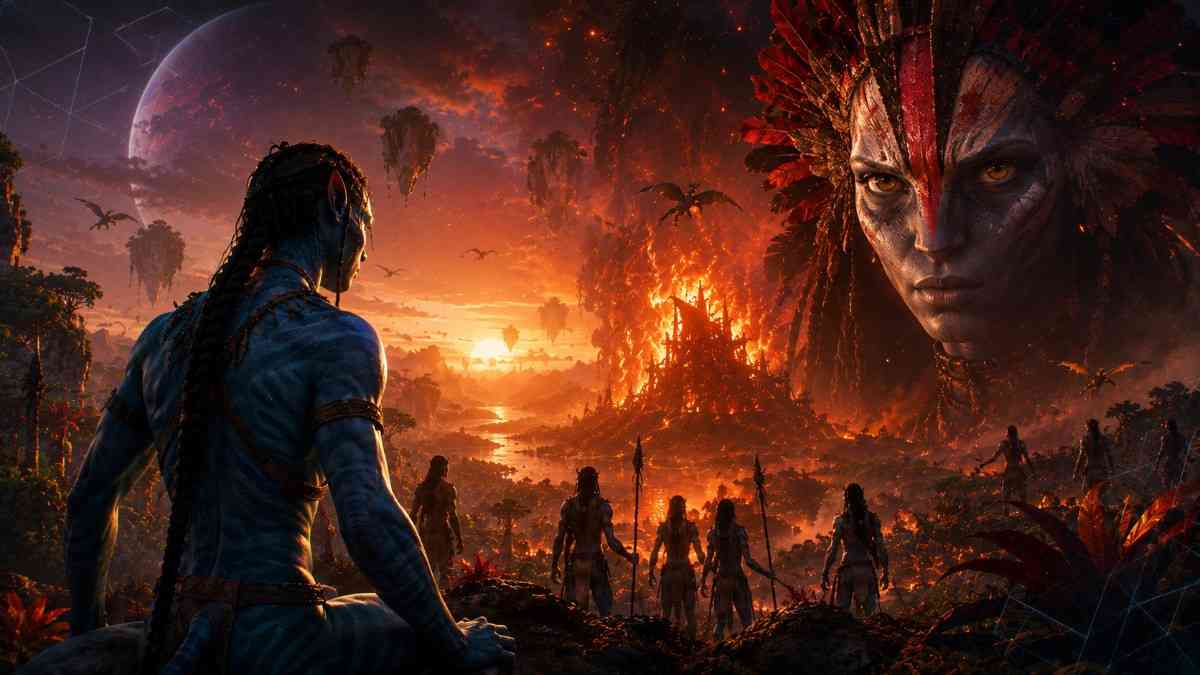
What Is Avatar: Fire and Ash? A 60-Second Answer for First-Timers
Avatar: Fire and Ash is the third installment in James Cameron’s Avatar saga, distributed by 20th Century Studios and released through Disney. It picks up directly after the events of Avatar: The Way of Water and continues the Sully family’s story on Pandora. No plot spoilers here, just the setup: this is a sequel, not a reboot, and it assumes you’ve seen the first two films.
If your memory of the second film is fuzzy, this Way of Water recap covers the events that set up everything happening in Fire and Ash, including how the family ended up living with the reef people and why Neteyam’s death casts such a long shadow over this new movie.
Cameron has planned this as a multi-film arc from the start, not a one-off sequel cash grab. Fire and Ash is the middle chapter of a story that’s meant to stretch across five total films, so some threads here are designed to pay off later, not right away. That structural choice explains why certain subplots in this movie feel deliberately unresolved. Cameron has said in interviews that he is writing toward a finale that is still years out, which means Fire and Ash carries some narrative weight that won’t fully land until Avatar 4 or Avatar 5.
Quick facts: directed by James Cameron, produced and distributed by 20th Century Studios and Disney, runtime of 197 minutes, US theatrical release on December 19, 2025 following a December 1 premiere. The film was shot using the same high frame rate 3D technology Cameron introduced with The Way of Water, and much of the underwater and forest photography relies on the same motion capture pipeline built for the earlier films.
Who’s Who in Avatar: Fire and Ash: Returning Characters and New Faces
The core Sully family cast is back, alongside a new antagonist tribe that didn’t exist in the first two movies. Here’s the full lineup.
| Character | Actor | Role/Status |
|---|---|---|
| Jake Sully | Sam Worthington | Returning |
| Neytiri | Zoe Saldaña | Returning |
| Dr. Grace Augustine (avatar form) | Sigourney Weaver | Returning |
| Colonel Miles Quaritch | Stephen Lang | Returning |
| Kate Winslet’s character | Kate Winslet | Returning |
| Varang | New cast addition | New, antagonist leader of the Ash People/Mangkwan |
Each returning actor is doing more work here than a simple cameo. Weaver, who played Grace Augustine as a human scientist in the first film, continues her role in avatar form connected to Kiri’s storyline. Winslet’s character, introduced in The Way of Water as a member of the Metkayina reef clan, gets expanded screen time in this installment as the family’s alliances widen beyond their original tribe.
The Sully Family, One Year After Neteyam’s Death
Grief is doing a lot of the heavy lifting in this film’s first act. Jake and Neytiri are still processing the loss of their son Neteyam, and that unresolved pain is a big part of why the family ends up on the trip that kicks off the movie’s central conflict. Their surviving children, including Kiri and Spider, each carry a version of that grief differently, and the film spends real time on how it reshapes the family’s dynamic rather than treating the loss as a one-scene plot device.
If you want the full picture of what happens to Quaritch’s exact fate in the film, Quaritch’s fate explained covers it in detail, including how his arc intersects with the human recombinant soldiers introduced earlier in the franchise.
Varang and the Ash People (Or Is It the Mangkwan?): Clearing Up the Name Confusion
Varang leads a Na’vi tribe that goes by two different names across the internet, and both are technically correct. “Ash People” is the more casual, fan-facing name that shows up on IMDb and in community discussion threads. “Mangkwan” appears to be the more formal or in-universe name used in reference materials like Wikipedia’s film infobox.
Think of it like the difference between calling someone “the Rock” and calling him Dwayne Johnson. Same person, different register. Neither source is wrong, they’re just speaking to different audiences, and no single source bothers to explain that both names point at the same group. Now you know, so the next Reddit argument about it should be a quick one.
The Ash People live in a volcanic region of Pandora that hasn’t been shown on screen before, which is part of why the tribe reads as more aggressive than the reef-dwelling Metkayina from the second film or the forest-based Omaticaya from the first. Their culture is built around fire, ash, and volcanic terrain, which is where both the tribe’s name and the film’s title come from. Varang’s motivations aren’t purely villainous either. Her hostility toward the Sully family is framed as a response to resource pressure and territorial threat, not simple cartoon evil, which is consistent with how Cameron has written most of the franchise’s antagonists.
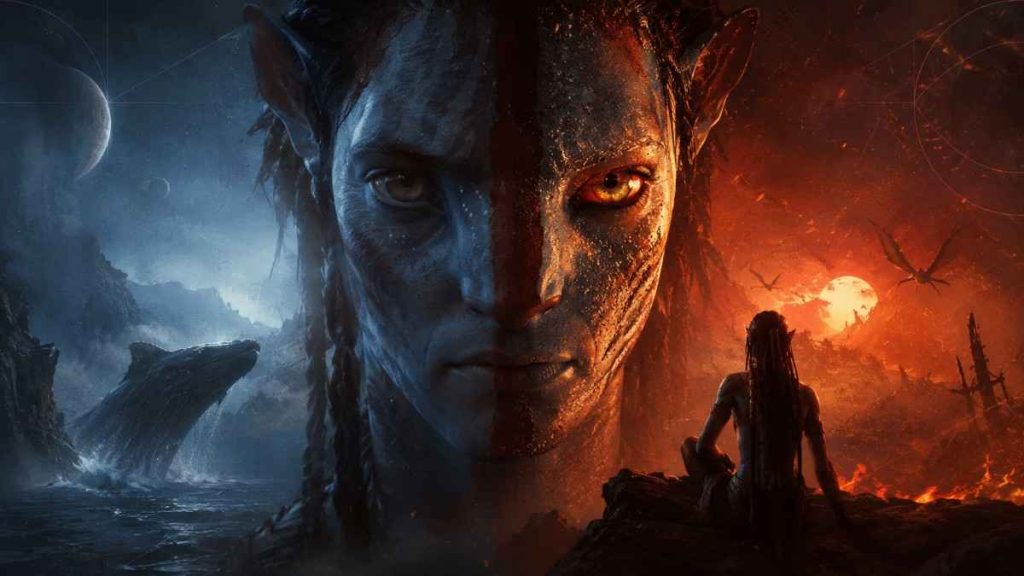
Avatar Fire and Ash Explained: The Plot Without Spoilers
No spoilers past this point in this section. The film centers on a merchant convoy journey the Sully family takes while still grieving Neteyam, a trip that puts them directly in the path of Varang’s Ash People. What starts as a supply run turns into an ambush, and the stakes escalate from there into a wider conflict that threatens the fragile peace on Pandora.
The convoy plot gives Cameron a reason to move the Sully family through several regions of Pandora that haven’t appeared in earlier films, which is part of why the runtime runs long. Along the way, the family reconnects with allies introduced in The Way of Water and picks up new tensions with human forces still operating on the planet. Kiri’s connection to Eywa, the planet’s collective consciousness, becomes a bigger part of the story here than it was in the previous film, though the full extent of that connection is spoiler territory.
That’s the setup. Everything after this point gets into resolution details, so if you’d rather experience the back half cold, skip to the streaming and box office sections below.
Avatar Fire and Ash Ending Explained: Full Spoiler Breakdown
SPOILER WARNING: this section reveals plot resolution details, including the ending.
The final act brings Quaritch and Jake into an uneasy, temporary alliance against a shared threat, which is a genuinely wild sentence to type given their history across three movies. Kiri’s connection to Eywa becomes a major plot engine, tying her abilities directly to the film’s climax. Spider, meanwhile, gets a development that fans had been asking about for two movies straight: he can now breathe on Pandora without mechanical assistance, thanks to a mycelial connection that changes his relationship to the planet entirely.
The Sully family also escapes capture by the Mangkwan, setting up where the story goes in the next chapter. Varang survives the film’s climax, which most fans read as a clear signal that her conflict with the Sully family is not finished, and that Avatar 4 will pick up some version of this rivalry rather than starting fresh with an entirely new threat.
The post-credits material is light compared to something like a Marvel film, but it does tease the geographic direction the saga is heading next, with visual hints pointing toward regions of Pandora not yet explored on screen. For the complete ending and post-credits scene, including exactly how each thread resolves, this full ending breakdown covers every beat shot by shot.
When and Where to Watch Avatar: Fire and Ash (Theaters, Disney+, Rent)
Avatar: Fire and Ash is streaming on Disney+ right now, after wrapping its theatrical run. If your local theater still has a showing listed, that’s a holdover screening rather than the primary way to catch it at this point.
| Format | Availability | Notes |
|---|---|---|
| Theatrical | Limited holdover screenings | Wide release ran from December 19, 2025 |
| Disney+ | Streaming now | Included with a standard Disney+ subscription |
| Digital rental/purchase | Check your usual digital storefront | Typically follows the same window as other Disney theatrical releases |
If you’re specifically hunting for a rental option outside Disney+, availability can shift by region and by week, so a quick check of your preferred digital storefront is your fastest path to a confirmed answer. Viewers who want the full high frame rate 3D experience the film was designed for should note that most home setups, including Disney+ streaming, do not replicate the theatrical 3D presentation, since that format depends on specific projection hardware most home theaters don’t have.

Avatar Fire and Ash Box Office and Critical Reception, By the Numbers
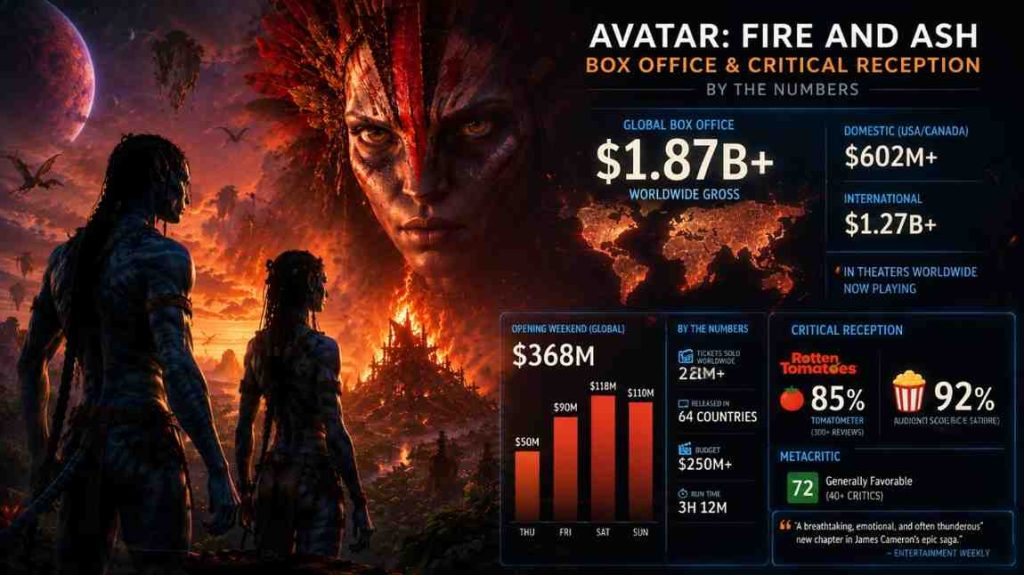
Avatar: Fire and Ash made roughly $1.49 billion worldwide against a reported production budget of $350 to $400 million. That makes it a clear commercial hit by ordinary Hollywood standards and, at the same time, the lowest-grossing film in the Avatar series to date.
| Metric | Figure |
|---|---|
| Reported production budget | $350 million to $400 million |
| Worldwide gross | Approximately $1.49 billion |
| Franchise rank by gross | Lowest of the three Avatar films released so far |
Both things are true at once, and that’s really the whole story of this movie’s box office run. A $1.49 billion global haul would be the envy of almost every other film released this year, but inside the Avatar franchise specifically, it’s underperforming relative to Avatar and The Way of Water, both of which crossed $2 billion worldwide.
Several factors likely contributed to the softer number relative to earlier entries. The theatrical window for major franchise films has shortened industry-wide since 2022, which means less time for word-of-mouth to build box office momentum the way it did for the first two Avatar films. China’s box office, which contributed heavily to the first film’s total, has also become a smaller factor for Hollywood blockbusters generally in recent years, and Fire and Ash’s China performance reportedly lagged behind the earlier films.
Critics at outlets like IGN and IndieWire generally praised the visual craft while raising the same complaint that trailed The Way of Water: the runtime and script pacing drag in places. The film picked up recognition in visual effects categories at the 98th Academy Awards and the 79th BAFTAs, and it landed on year-end top-ten lists from both the American Film Institute and the National Board of Review. Audience reception has skewed more positive than critical reception, with several outlets noting that the emotional material around Neteyam’s death landed better with general audiences than with critics focused on pacing.
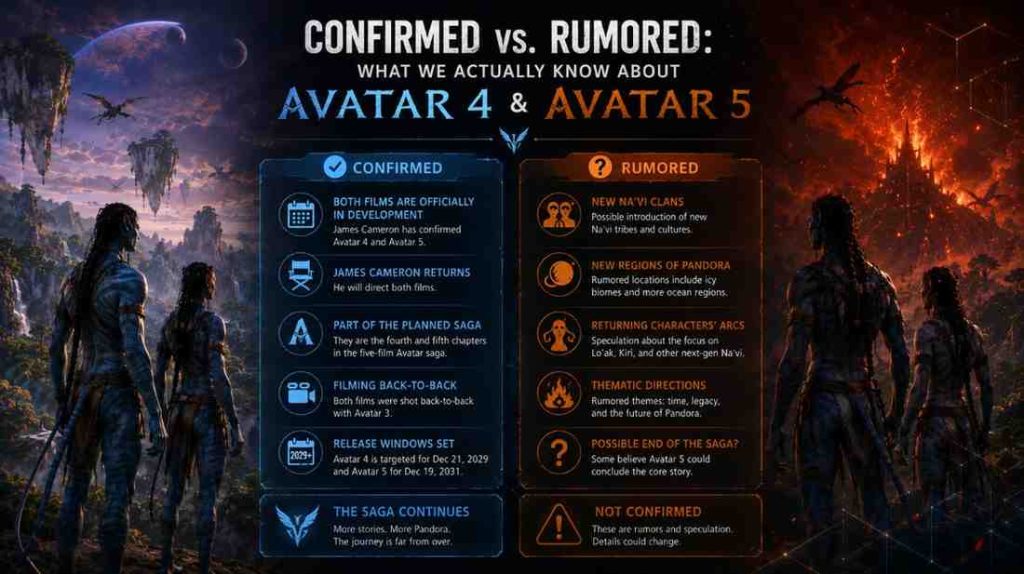
Confirmed vs. Rumored: What We Actually Know About Avatar 4 and Avatar 5
Avatar 4 is reportedly targeting a 2029 release, with Avatar 5 pointed at 2031, but neither date is locked in yet. Those are reported production targets, not officially confirmed release dates, and the Avatar franchise has a well-documented habit of moving its own release windows before.
| Claim | Status | Notes |
|---|---|---|
| Avatar 4 targeting 2029 | Reported | Not a locked release date |
| Avatar 5 targeting 2031 | Reported | Not a locked release date |
| Five-film saga overall plan | Confirmed by Cameron’s stated intent | Fire and Ash is the third of five planned films |
This franchise has shifted its own timeline more than once already, so treat 2029 and 2031 as working targets rather than dates to circle on a calendar. Avatar 2 was originally targeted for a much earlier release before ultimately arriving in December 2022, more than a decade after the original film, largely because Cameron and his team were waiting for underwater motion capture technology to reach a usable state.
That same pattern of technology-driven delay could apply to Avatar 4 and Avatar 5, especially if Cameron pursues new visual techniques not yet used in the series. Cast members have suggested in press interviews that some material for Avatar 4 has already been shot alongside Fire and Ash, using the same production windows, which is the same approach Cameron used to film the second and third movies together. If that reporting holds up, it could shorten the usual gap between installments compared to the six-year wait between The Way of Water and Fire and Ash.
If you want everything reported so far about other big franchises with 2026 movies on the calendar, this 2026 franchise roundup covers the wider landscape of what’s actually locked versus what’s still a rumor.
FAQ: Fast Answers to Avatar Fire and Ash Questions
Is Avatar: Fire and Ash streaming on Disney+?
Yes. Avatar: Fire and Ash is available to stream on Disney+ now, after completing its theatrical run that began with a December 1, 2025 premiere and a wide US release on December 19, 2025. A standard Disney+ subscription is all you need to watch it, and no separate rental fee is currently required.
Is Avatar 3 a hit or a flop?
It’s a hit by normal box office standards and an underperformer only by the Avatar franchise’s own extremely high bar. The film grossed roughly $1.49 billion worldwide against a $350 to $400 million budget, which is a strong result for almost any movie ever made. It simply ranks as the lowest-grossing entry among the three Avatar films released so far.
Who is Varang in Avatar: Fire and Ash?
Varang is the new antagonist leading a Na’vi tribe introduced in this film, referred to as either the Ash People or the Mangkwan depending on the source. She drives the central conflict that pulls the grieving Sully family into an ambush and a wider fight for control on Pandora. Both tribe names refer to the same group, just from different sourcing conventions.
How long is Avatar: Fire and Ash?
The film runs 197 minutes, which is a little over three and a quarter hours. That’s in line with the runtime of The Way of Water and consistent with Cameron’s general approach to pacing across the Avatar series. Plan your snack breaks accordingly.
Is there an Avatar 4 confirmed?
Avatar 4 is part of Cameron’s confirmed five-film plan for the saga, but its release date is not locked. It’s reportedly targeting 2029, though that timeline is a reported production target rather than an official release date. The franchise has moved its own release windows before, so treat 2029 as a working estimate.
The Bottom Line
Avatar: Fire and Ash earns its place as a genuine box office success and, in the same breath, the softest performer in a franchise that set an almost impossible bar for itself with Avatar and The Way of Water. Both facts belong in the same sentence, and neither one cancels the other out.
If you’re deciding whether to watch it, the answer is simple: it’s streaming on Disney+ right now, the story picks up cleanly from The Way of Water, and the naming confusion around the Ash People and the Mangkwan is nothing more than two sources describing the same tribe. Watch the spoiler-free plot section above if you want to go in mostly cold, or jump straight to the ending breakdown if you’re the type who reads the last page of a mystery novel first.
Avatar 4 and Avatar 5 are still years out, and neither date is set in stone yet. That gives you plenty of time to catch up on Fire and Ash, revisit the earlier films, and get ready for whatever Varang and the Ash People bring to the next chapter of Pandora’s story.