“Scripted” Is the Wrong Word. Here’s What’s Actually Happening.
Nobody on The Bachelor reads lines off a page. There is no script in the traditional sense, the way there’s a script for a sitcom or a movie. Contestants are not handed dialogue. That part is true.
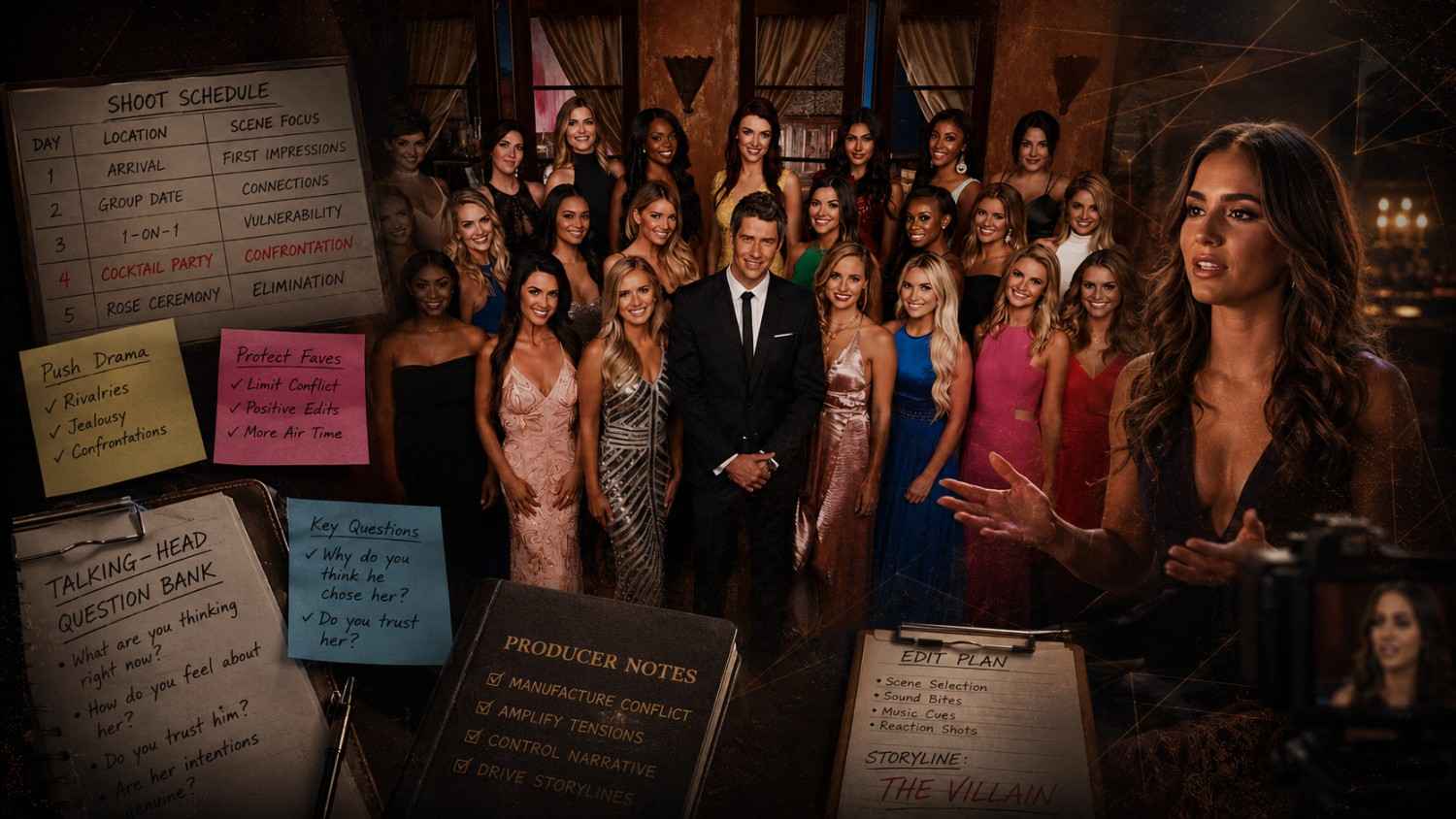
What exists instead is something more interesting and more troubling: a production environment engineered to lower inhibitions, heighten emotional states, and produce footage that supports a story producers have already decided to tell. The show is not written before filming. The story is shaped during and after, using real people’s real emotional reactions as raw material.
This distinction matters because it changes how you watch. The tears you see are not performed. The heartbreak is not acted. The specific conditions that produced those tears and that heartbreak were designed.
The primary sources that document this are a 2024 Vice interview with a former producer who described “100% manipulation” on set, public statements from Sarah Gertrude Shapiro (who produced The Bachelor before creating UnReal), Nick Thompson’s CBC interview about his experience on Love Is Blind (a franchise with overlapping production tactics), and journalist Emily Nussbaum’s research across more than 300 reality TV industry figures. These are the people who were in the rooms. Their accounts are specific, consistent, and largely corroborated by each other.
To answer the most common version of this question directly: no, The Bachelor is not scripted in any part that involves contestants reading pre-written dialogue. It is manipulated at the level of environment, timing, editing, and interrogation technique. Those are four very different mechanisms, and each one deserves its own explanation.
The Physical Tactics: How Producers Compromise Contestants Before Cameras Even Roll
The manipulation starts before anyone asks a single question. It starts with what producers do to contestants’ bodies.
Tactic 1: Sleep Deprivation
Filming days on The Bachelor regularly run 16 to 20 hours. This is not a scheduling accident. Former cast members and producers have described a consistent pattern: the most emotionally significant conversations, the confessionals that end up in the edit, and the confrontations between contestants are deliberately timed for late in those filming days, when exhaustion is at its peak.
Sleep deprivation measurably degrades emotional regulation. A person who has been awake for 18 hours cries more easily, reacts more intensely, and has significantly lower resistance to emotionally loaded questions than a person who slept normally. This is documented in sleep research, and it is not a coincidence that producers schedule difficult moments for the hours when this effect is strongest.
Nick Thompson, who appeared on Love Is Blind (a Netflix reality franchise that shares production DNA with the Bachelor franchise), described the filming schedule in a CBC interview as a key mechanism of psychological pressure. His account lines up with what former Bachelor cast members have described in their own interviews. The exhaustion is not incidental. It is the context producers need.
Tactic 2: Alcohol as a Production Tool
The Vice interview from 2024, in which a former producer described the show’s manipulation as operating at “100%,” was explicit about alcohol. Drinks are not simply available on set. They are maintained as a consistent presence during emotionally significant production events: rose ceremonies, cocktail parties, group dates.
Producers keep glasses filled during these events. Nobody forces anyone to drink. The environment makes NOT drinking the unusual social choice, which is a meaningful distinction because it means the pressure to drink is social and ambient rather than direct, and therefore harder to name or resist.
The stated purpose, according to producer testimony, is lowered inhibitions and increased emotional volatility. More emotional volatility means more usable footage. More usable footage means more editorial control over the story being told.
Tactic 3: Food, Water, and Sunlight Restriction
Nick Thompson reported losing around 15 pounds during two weeks of filming on Love Is Blind. That is not a weight loss program. That is a physiological state that compounds everything else happening on set.
Some reality formats deliberately limit contestants’ exposure to natural light, which removes their ability to intuitively track time. When you cannot tell how long you have been awake, or how long you have been in a particular emotional state, the urgency of what is happening in front of you feels more immediate and more consuming than it would otherwise. A person who is hungry, dehydrated, and sleep-deprived is physiologically primed for emotional instability. That instability is what the production cameras are waiting for.
The Confessional Room: Where “Real” Moments Get Constructed
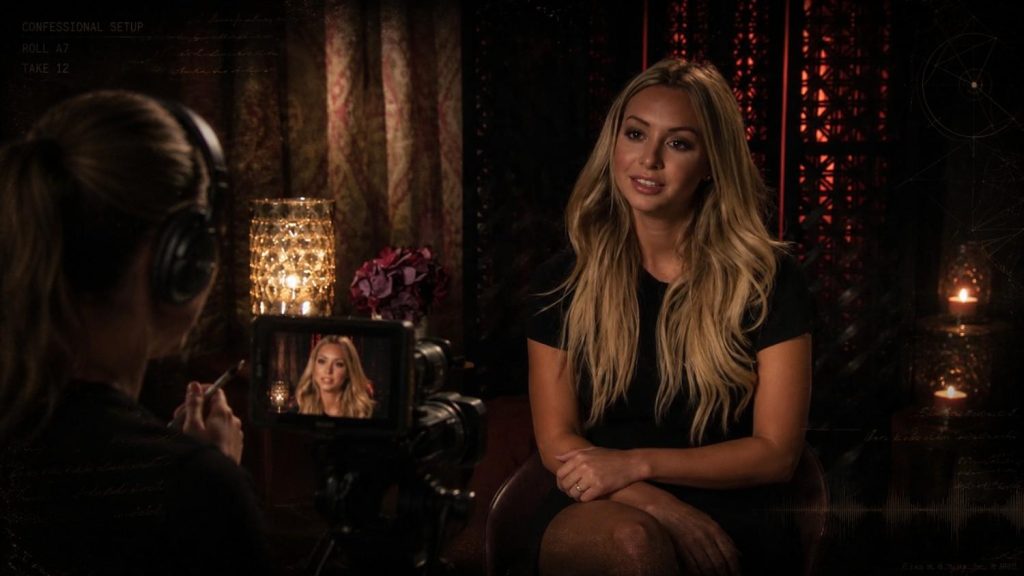
Viewers tend to trust confessional footage more than other parts of the show. It feels unfiltered. Someone sitting alone, talking directly to camera, no other contestants around. That’s the real person saying what they actually think, right?
The confessional room is the most engineered space in the entire production.
Tactic 4: Leading Questions and Confessional Guidance
Producers do not write scripts for confessionals. What they do is considerably more effective: they ask variations of the same emotionally loaded question, repeatedly, until the contestant arrives at the emotional state the edit requires.
The technique exploits a well-documented psychological effect: repeated questioning about self-worth causes the person being questioned to genuinely reconsider what they believed. Not perform doubt. Actually feel it. A producer asking “do you think you deserve to be here?” in five different forms over the course of an hour is not just extracting an answer. They are restructuring the contestant’s own confidence in real time.
Producers know which wound to press because they have a map. Pre-production interviews run for hours before filming begins. Contestants disclose their insecurities, their past relationships, their fears. That information does not stay in the pre-production room. It travels with the producer into every confessional session.
Tactic 5: Frankenbiting
Frankenbiting is a post-production editing technique in which separate audio or video clips from different confessional sessions are spliced together to create a statement the contestant never actually made as a single utterance.
Here is how it works in practice. A contestant says “I really like him” during a confessional on Day 4. Two days later, in a completely separate session about a different situation, she says “I’m not sure this is right for me.” An editor combines them: “I really like him… I’m not sure this is right for me.” The result, as it appears on screen, implies present-tense ambivalence during a specific moment. The reality is two separate emotional states, separated by 48 hours and different contexts, sewn together into a single statement.
This technique is invisible to viewers because confessionals are filmed against static, neutral backgrounds. There are no windows showing the time of day, no other people to anchor the timeline, no visual cues that would reveal the splicing. Journalist Emily Nussbaum, who spent years researching reality TV production across hundreds of industry sources, identified frankenbiting as standard editorial practice, not an exceptional technique used by rogue producers.
How the Bachelor Villain Gets Made Before Filming Even Ends
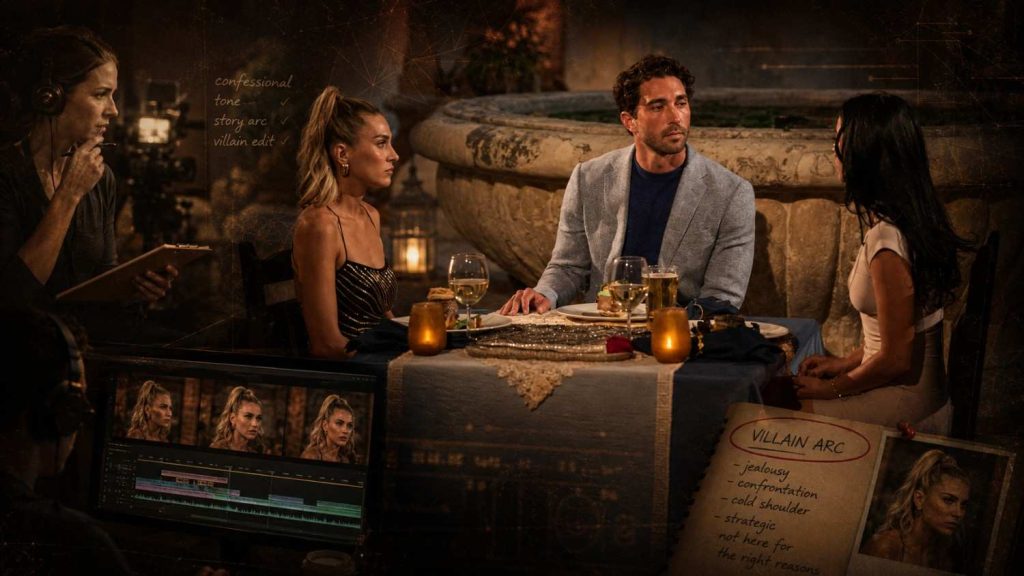
The villain on any given season of The Bachelor did not emerge organically from the footage. The villain was identified, and then the footage was organized around that identification.
Tactic 6: The Early Villain Decision and Manufactured Conflict
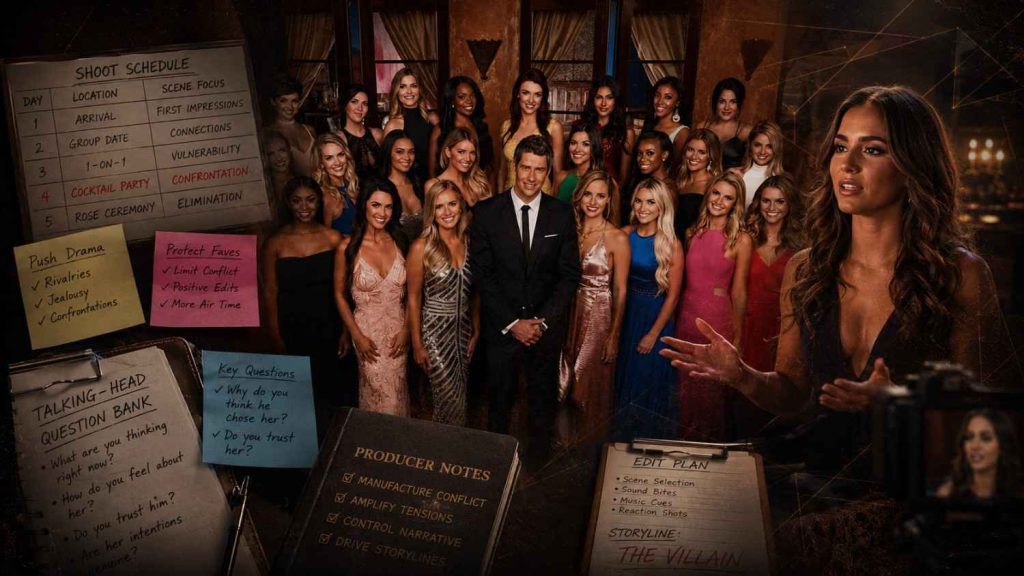
Producers identify a villain candidate within the first week of filming, often within the first few days. Once that decision is made, the narrative frame is locked. Every subsequent piece of footage featuring that person gets evaluated against a single question: does this support the villain read?
Ambiguous moments get cut to emphasize the negative interpretation. Sympathetic moments get left on the floor. The person at home watching sees 40 minutes of footage representing 40 hours of a real human being’s behavior. The 40 hours contained contradictions, kindness, confusion, and complexity. The 40 minutes contains a character arc that was decided before it was filmed.
Former cast members have described watching their own edit and feeling like they were watching a stranger. The things they said were real. The selection of which things to show, and how to frame them, was entirely in someone else’s hands.
Tactic 7: Strategic Isolation and Preventing Note Comparison
Contestants in the Bachelor mansion are not free to discuss their individual experiences with each other openly. Producers actively keep potential allies in separate spaces during high-tension periods, which prevents something that would be immediately clarifying: contestants comparing notes.
If three women could sit down together and compare what the Bachelor said to each of them on the same night, they might quickly discover he used the same language with all three, made the same implicit promises, and navigated each conversation in nearly identical ways. That discovery would dissolve a significant portion of the show’s romantic tension. Isolation is what preserves it.
Schedule Manipulation and the Loaded Talking-Head Question
The physical and narrative tactics work together with two more specific tools: the way questions are constructed and the way the production calendar is weaponized.
Tactic 8: Loaded Talking-Head Questions
A neutral confessional question would be something like “how did that feel?” Producers running Bachelor confessionals do not ask neutral questions. The questions carry embedded assumptions that the contestant’s answer must engage with, regardless of whether those assumptions reflect reality.
“Do you think she actually respects you?” is not a neutral inquiry. It assumes disrespect as a starting point and asks the contestant to either confirm or defend against it. In a state of exhaustion, emotional flooding, and social isolation, the brain tends to take the premise seriously and search for evidence to evaluate it.
Tactic 9: The Scheduled Chaos
Spontaneity on The Bachelor is not spontaneous. Former cast members have described being woken in the early hours of the morning for sudden “urgent” conversations with producers or unexpected filming moments. What feels to the contestant like an unpredictable, destabilizing situation is, on the production side, a planned sequence.
Exhaustion is the optimal context for emotionally raw footage, and the production schedule is built to deliver contestants to that context at specific moments. The chaos has a calendar. The breakdown is booked.
The Bachelor Specifically: Why the Mansion Is a Manipulation Device
Everything described above applies across reality TV broadly. The Bachelor has several franchise-specific features that concentrate these effects.
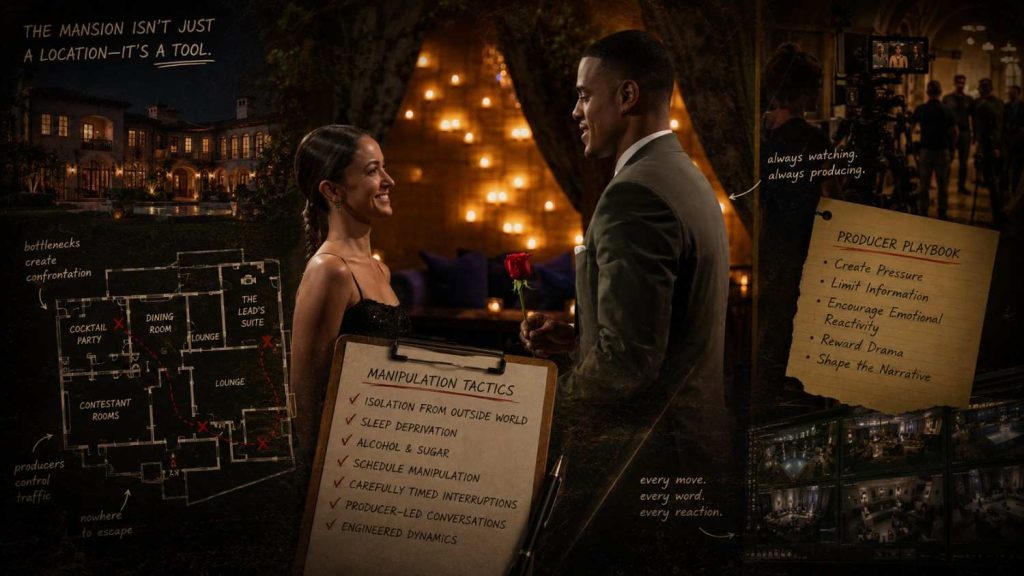
The mansion has cameras in virtually every room. There is no genuinely private space where contestants can decompress outside of production view. The constant awareness of being filmed changes behavior in ways that producers can then shape through editing.
Contractual arrangements prevent cast members from leaving the mansion grounds alone. Physical movement is controlled. This means the only social world available to contestants is the one the producers have constructed inside the property, which they manage and monitor entirely.
The compressed romantic timeline is perhaps the most elegant manipulation of all. Contestants are asked to arrive at marriage-level emotional conclusions over the course of roughly six weeks. They are surrounded by other people competing for the same person. They are sleep-deprived, isolated, and denied the ordinary social resources humans use to process intense feelings. The urgency they feel is real to them. It is real because the environment has been specifically constructed to make it feel real.
For context on how these structural pressures have created growing scrutiny of the franchise, the Bachelorette cancellation questions piece covers the institutional fallout.
Sarah Gertrude Shapiro, UnReal, and the Producer Who Couldn’t Stay
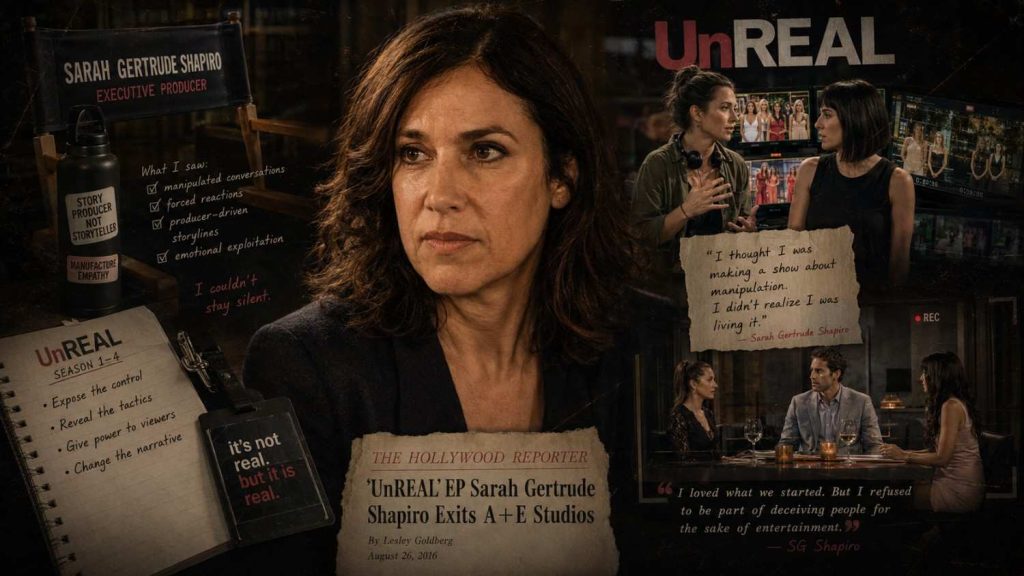
Sarah Gertrude Shapiro is the most credible insider voice on Bachelor production tactics for a specific reason: she documented what she participated in at enough length and detail to turn it into a multi-season scripted television drama.
Shapiro worked as a producer on The Bachelor. She left. In 2015, she co-created UnReal, a scripted Lifetime drama set behind the scenes of a Bachelor-style competition show. The series depicted producer manipulation of contestants in explicit, specific detail: the emotional extraction techniques, the villain construction, the alcohol, the isolation, the leading questions. Critics praised it for its accuracy. Former Bachelor producers who spoke to journalists after the show’s premiere confirmed that the specific tactics UnReal depicted matched real production practice.
Shapiro has stated in multiple interviews that creating UnReal was, in part, a way of processing what she had done professionally. Her argument is not that the tactics worked because contestants were weak or gullible. Her argument is that the tactics worked because they were calibrated to exploit normal human psychology, and that the same techniques would compromise most people placed in the same conditions.
Why the Emotions Are Real Even When the Conditions Are Engineered
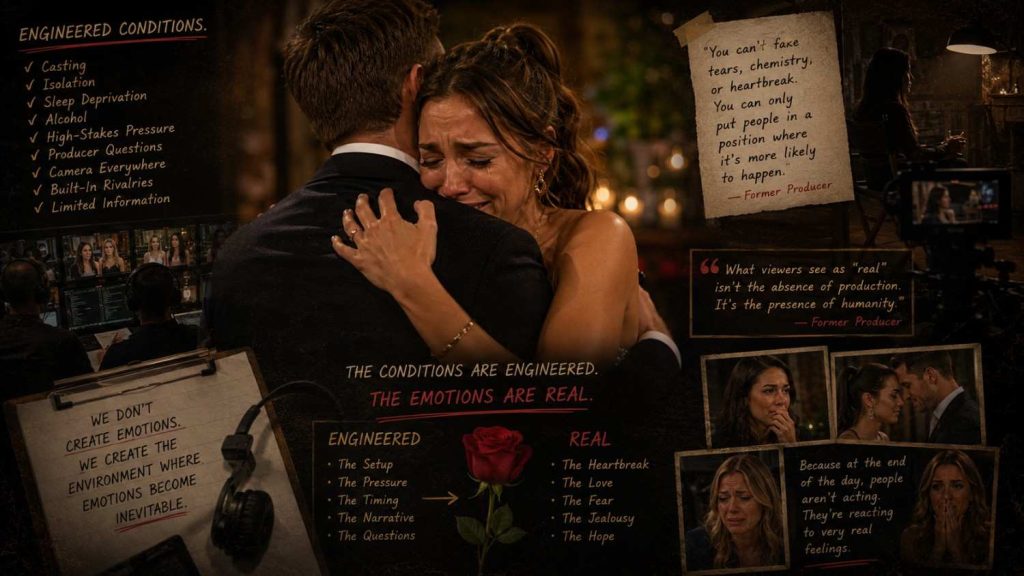
Contestants on The Bachelor genuinely fall in love. They genuinely feel betrayed. They genuinely break down and cannot stop crying. None of that is performance. The emotional experience happening inside them is not manufactured.
What is manufactured is the environment that produces those emotions: the sleep restriction, the alcohol access, the isolation, the compressed timeline, the leading questions, the absence of outside social anchors. The conditions were engineered. The feelings those conditions produced are entirely authentic.
This is not a contradiction. It is the mechanism. If you put most people in an environment that removes their sleep, limits their food, eliminates their social support network, supplies constant alcohol, asks them repeatedly whether they deserve to be loved, and compresses a relationship decision that would normally take years into six weeks, those people will have an intense emotional experience. Not because they are television personalities or emotionally porous. Because they are human.
Former cast members who have spoken out, including several who advocated for better mental health support during production through the UCAN Foundation’s work in the reality TV space, have consistently made this distinction. They are not saying their feelings were fake. They are saying their feelings were produced by conditions they did not fully understand while they were inside them.
What’s Changing (Slowly)
The pushback on Bachelor-style production practices has been building, but it is not moving fast.
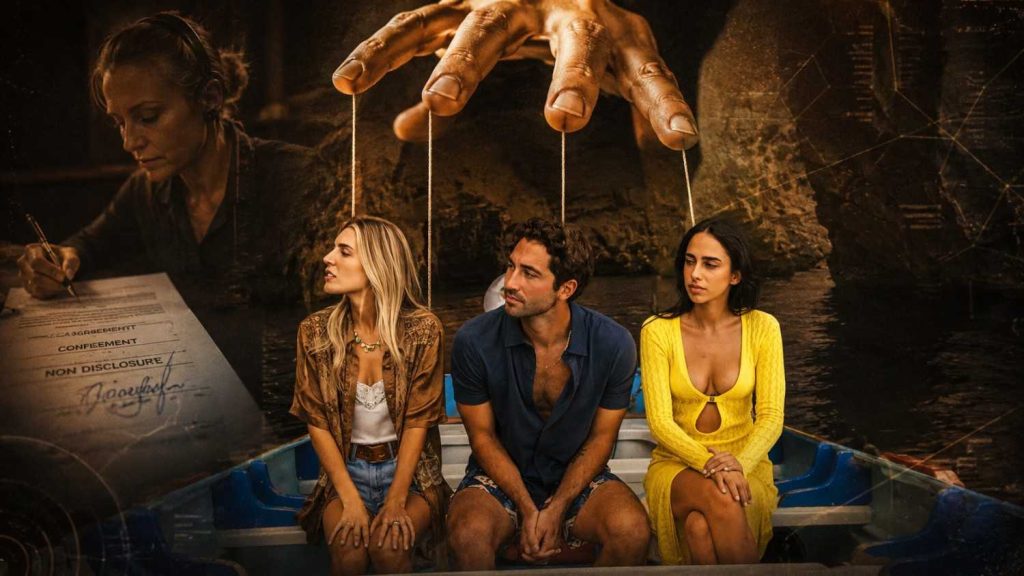
Mental health advocates and former cast members have pushed production companies to provide post-filming psychological support, with mixed results. The UCAN Foundation has specifically advocated for reality TV contestants, arguing that people who go through intense production environments deserve professional support afterward, not just a non-disclosure agreement.
Labor classification questions have circulated in the industry for years. The question of whether reality TV contestants should qualify for labor protections as workers, rather than being classified as participants in a competition, has been raised at the regulatory level, though no significant change has resulted yet.
The franchise’s why The Bachelorette was cancelled situation reflects some of this pressure. Declining ratings combined with increased public awareness of production practices have created an environment where the franchise can no longer operate with the same opacity it once did.
UnReal probably accelerated this. When a former insider turns the production playbook into a critically acclaimed television show, it becomes harder for networks to claim that the behind-the-scenes tactics are either unknown or benign.
FAQ
Is The Bachelor actually scripted, or do contestants improvise everything?
The Bachelor is not scripted in any traditional sense. No contestant reads pre-written dialogue. What happens is a structured production environment that uses sleep deprivation, controlled alcohol access, social isolation, and targeted confessional questioning to produce emotionally intense footage. The words contestants say are their own. The conditions designed to produce those words were built by producers.
What is frankenbiting and does The Bachelor actually do it?
Frankenbiting is a post-production editing technique that splices audio or video clips from separate confessional sessions to create a statement the contestant never made as a single utterance. A line from Day 4 and a line from Day 6 get stitched together to imply a single emotional moment. Journalist Emily Nussbaum’s research across hundreds of reality TV industry sources identified it as standard production practice, not a rare exception.
Who is Sarah Gertrude Shapiro and why does her account matter?
Sarah Gertrude Shapiro worked as a producer on The Bachelor before leaving the industry. She then co-created UnReal, a scripted Lifetime drama that depicted the behind-the-scenes manipulation tactics of a Bachelor-style production in specific detail. Multiple former Bachelor producers confirmed the show’s accuracy after it premiered in 2015. Her account is credible because she was inside the production, left on ethical grounds, and documented the experience in enough detail to sustain a multi-season television series.
Do Bachelor producers decide who wins the show?
The evidence suggests producers heavily influence who stays and for how long through the editing process and the information they give to the lead, but there is no confirmed documentation that a final outcome is pre-selected and enforced. What is documented is that producers shape the emotional environment around the lead, control what information the lead has access to about each contestant, and can influence the lead’s perceptions through strategic framing of other people’s behavior.
Why do Bachelor contestants seem so emotional compared to real life?
Because they are in conditions specifically designed to maximize emotional intensity. A filming day running 16 to 20 hours, a consistent alcohol supply, social isolation from friends and family, restricted food, and repeated leading questions about personal insecurities will produce emotional volatility in most people regardless of their baseline temperament.
Is it possible to genuinely fall in love on The Bachelor despite the manipulation?
Yes. The feelings contestants experience are real, even if the conditions that produced them were engineered. Sleep deprivation, social isolation, and compressed timelines create genuine emotional intensity. That intensity can attach itself to a real person and produce something that functions like love, at least temporarily. Whether relationships formed under those conditions are durable outside of them is a separate question.
What is the strongest argument that The Bachelor’s manipulation is ethically wrong?
The strongest argument is informed consent. Contestants sign up knowing the show involves competition and editing. They do not sign up with accurate knowledge of how sleep deprivation, alcohol management, and targeted psychological questioning will be used on them. The manipulation works specifically because people do not recognize it while it is happening. The gap between what contestants believe they are agreeing to and what they actually experience is where the ethical case sits.
The Uncomfortable Takeaway
The most clarifying thing anyone has said about The Bachelor came from someone who left the industry and made a whole television show about what she saw. Sarah Gertrude Shapiro’s argument was not that reality TV is populated with unusually vulnerable people. It was that these techniques would work on most people, because they were designed around how human beings actually function under pressure.
That reframe is what changes how you watch. If you started with “I can’t believe those people fall apart like that on TV,” you should end with something closer to “I understand now what kind of environment produces that falling apart.” The specific answer to what you should do with that understanding is simple: watch the show if you enjoy it, but watch it knowing that the story you’re seeing was assembled from real feelings produced by an engineered environment. The tears were real. The system that caused them was not accidental.
The franchise is facing more scrutiny than it ever has, and former insiders are talking more openly than they used to. For now, the nine tactics in this piece are the working vocabulary for anyone who wants to describe accurately what “reality TV manipulation” actually means.