

How We Confirmed Each Status (Court Records, Not Rumors)
Every status referenced in this piece traces back to a primary source: a state Department of Corrections inmate locator, an active court docket, or verified reporting from outlets that covered the trial directly. That is a deliberately higher bar than the average “where are they now” roundup.
Most competing lists lean on secondhand aggregation. A tabloid says a name is “still locked up,” a Pinterest board repeats it, and six months later that claim is stale and nobody updates it. Court dockets and inmate locators do not have that problem, because they update the moment something legally changes.
That gap between “reported once” and “verified now” is where most true crime misinformation actually lives. A status that was accurate at the time of the trial coverage can be six updates out of date by the time it resurfaces on social media. Nobody flags the drift because nobody is checking the docket again.
If you take one thing from this section, take this: a person’s current legal status is never a fixed fact. It is a snapshot of a public record on a specific date. That is why our dedicated case files always note when they were last checked against the primary source.

Killers Where Are They Now: The Full 2026 Status Breakdown
The 15 cases below are ordered by search volume and how unresolved the legal proceedings currently are, since those are the names readers are most likely to be confused about right now. Convicted status refers to the underlying verdict in each case, which is public record. Current appeal, parole, or sentencing activity is tracked separately in each linked case file.
| Name | The Case | Full Status Check |
|---|---|---|
| Alex Murdaugh | Convicted of murdering his wife and son amid a sprawling South Carolina financial fraud scandal | Dedicated Bamfuzzle case file |
| Chad Daybell | Convicted in Idaho in connection with the deaths of his first wife and his new wife’s two children | Dedicated Bamfuzzle case file |
| Jodi Arias | Convicted of killing her ex-boyfriend Travis Alexander in Arizona | Dedicated Bamfuzzle case file |
| Letecia Stauch | Accused in Colorado in the death of her stepson | Dedicated Bamfuzzle case file |
| Ruby Franke | Convicted in Utah on child abuse charges tied to her family vlogging channel | Dedicated Bamfuzzle case file |
| Kouri Richins | Accused of poisoning her husband in Utah after publishing a children’s book about grief | Dedicated Bamfuzzle case file |
| Donna Adelson | Charged in connection with the murder of law professor Dan Markel in Florida | Dedicated Bamfuzzle case file |
| Nicholas Godejohn | Convicted of murdering Dee Dee Blanchard, the mother of Gypsy Rose Blanchard | Dedicated Bamfuzzle case file |
| Dalia Dippolito | Convicted of soliciting an undercover officer to kill her husband in Florida | Dedicated Bamfuzzle case file |
| Samuel Bateman | Charged in Arizona in a federal case involving multiple minors | Dedicated Bamfuzzle case file |
| Sarah Boone | Accused of killing her boyfriend during a game of hide and seek in Florida | Dedicated Bamfuzzle case file |
| Shanda Vander Ark | Convicted in a Michigan child abuse case | Dedicated Bamfuzzle case file |
| Summer Shiflet | Connected to the Vander Ark case in Michigan | Dedicated Bamfuzzle case file |
| Jennifer Pan | Convicted in Canada of arranging the murder of her mother | Dedicated Bamfuzzle case file |
| Kaitlin Armstrong | Convicted of killing professional cyclist Moriah Wilson in Texas | Dedicated Bamfuzzle case file |
Jodi Arias is a good example of why this table cannot just say “convicted” and move on. Her case has generated years of ongoing parole speculation. Her parole odds breakdown lays out exactly what the Arizona court record actually says versus what true crime forums have assumed for years.
Notice how many of these cases involve a conviction that is genuinely settled, alongside a handful, like Letecia Stauch or Samuel Bateman, where the legal process itself was still active at last check. That split is exactly why a single “alive or in prison” label fails these readers.
Sentence length matters here too. A case with a mandatory minimum of 25 years behaves very differently in the news cycle than a case with a life sentence and no parole eligibility. The first will resurface every time a parole hearing gets scheduled, whether or not release is likely.
Which of These Killers Were Actually Released?
Some names on this list get asked about specifically because a rumor is circulating that they walked free. The honest answer is that release status depends entirely on the legal mechanism involved. That mechanism varies wildly case to case.
Three things can move someone from “convicted” to “released” long before a life sentence technically ends. A parole board can grant release after a mandatory minimum is served. An appellate court can overturn a conviction outright, sending the case back for retrial or dismissal.
A resentencing law, the kind several states passed for defendants who were minors at the time of their crime, can also shorten an existing sentence. None of these mechanisms are automatic. Each requires its own filing, hearing, and ruling before anything actually changes on the ground.
None of that means every headline claiming a release is accurate. His ongoing appeal in the Murdaugh case is a clear example of how a legal process can generate constant news coverage without anyone actually walking out of a facility. The mechanism moving is not the same as the outcome changing, and that distinction is where most confusion starts.

The One Thing That Confuses People About “Where Are They Now” Cases
A case reappearing in the news does not mean a new crime happened. It almost always means one specific legal step moved forward: an appellate ruling, a new filing, a scheduled hearing, or a resentencing motion working its way through the docket.
Appeals in particular can run far longer than most readers expect. A conviction from years ago can still generate headlines today simply because the appellate process has multiple stages, and each stage can take a year or more to resolve. That is normal, not a sign that something new or suspicious happened.
This is also why a case file worth trusting will date its status update. A status from 2023 and a status from 2026 can be completely different facts about the same person. Treating them as interchangeable is how misinformation spreads in true crime spaces.
Search interest itself is a poor proxy for legal activity. A name can spike on social media because of an unrelated documentary release, a podcast episode, or an anniversary of the crime, none of which change the actual docket. Checking the date on a status update is the only way to know if a spike in attention lines up with a real legal development.

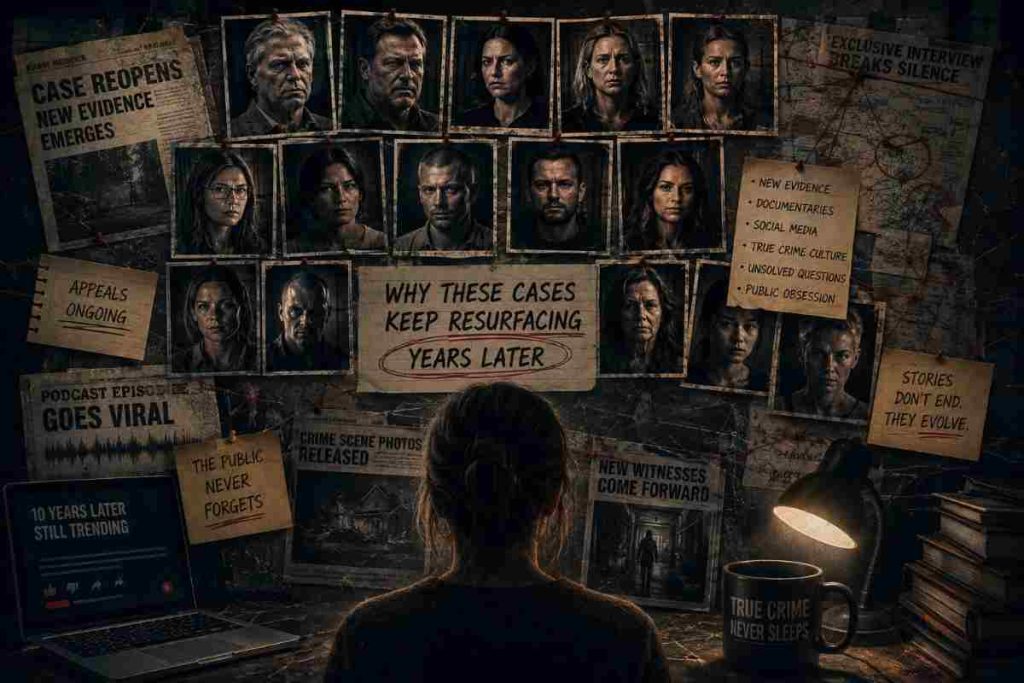
Why These Cases Keep Resurfacing Years Later
True crime content has a long tail that most other entertainment topics do not. A reality show cast member fades from search interest within a season or two. A convicted killer’s case can generate search volume for a decade, because the legal process itself keeps generating new events.
Streaming platforms compound this. A documentary or dramatized series can introduce a case to an entirely new audience years after the original trial ended, and that audience searches “where are they now” without any context on how much legal activity happened in between. That is part of why cases like Jodi Arias or Nicholas Godejohn keep circulating long after their trials wrapped.
Anniversaries function the same way. A ten year anniversary of a verdict, a milestone in an appeal, or a scheduled parole hearing date can all trigger a fresh wave of search interest, even when nothing about the underlying facts of the case has changed.
Confirmed Facts vs. Online Speculation: How to Tell the Difference
Court filings and official Department of Corrections records are confirmed facts. Everything else, including TikTok theories, unverified “insider” tips, and old screenshots recirculating out of context, is speculation until a primary source backs it up.
A simple filter works for almost any true crime claim you see online. Ask whether the claim cites a specific document, docket number, or official record. Ask whether the source is the original reporting outlet or someone quoting a screenshot of that reporting three steps removed.
Ask whether the date attached to the claim is actually current. A claim that was accurate in 2021 is not automatically accurate in 2026, especially in a case with active appeals or a scheduled parole hearing since then.
If you have ever hit a wall trying to answer a specific question about one of these cases because the search results were fragmented, vague, or flat out contradictory, our true crime tracker is built specifically to cut through that noise across active 2026 cases.
Which Killer’s Story Should You Read First?
Pick based on what you actually want out of the read, not just name recognition. Readers chasing courtroom drama tend to get the most out of the Murdaugh or Daybell cases, since both involve financial and family entanglements that unfolded in public over months of testimony.
Readers more interested in psychology than procedure usually gravitate toward Jennifer Pan or Nicholas Godejohn, both of which involve family dynamics that go well beyond the crime itself. If you want a case that is still actively developing rather than fully settled, check whichever entry above is mid-appeal, since that is where new, citable developments are most likely to land next.
If you are curious specifically about motive rather than legal outcome, Kaitlin Armstrong’s motive breakdown covers the relationship background that made her case a national story in the first place. It walks through the timeline that connects her to Moriah Wilson without getting lost in the manhunt coverage that dominated most headlines at the time.

Frequently Asked Questions
Which of these 15 killers are still in prison as of 2026?
Status varies by case and changes as appeals and parole hearings move forward, so there is no single answer that stays accurate for long. The reliable way to check is a state Department of Corrections inmate locator, which each case’s dedicated Bamfuzzle file links to directly. Several names on this list, including Nicholas Godejohn and Jennifer Pan, remain incarcerated under long sentences, while others have active legal proceedings still deciding their outcome.
Has anyone on this list been released early, and why?
Early release typically comes from one of three mechanisms: a granted parole hearing, an overturned conviction sent back for retrial, or a resentencing law applied retroactively. None of these outcomes are automatic, and each requires a specific legal filing and ruling. Check each case’s dedicated file for the confirmed, dated status rather than assuming a release based on a headline or social media post.
Why do some of these true crime cases still show up in the news years after conviction?
They show up because an appeal, resentencing motion, or scheduled hearing is moving through the courts, not because a new crime occurred. Appellate processes routinely take years to resolve, with multiple filing and ruling stages along the way. A case resurfacing in headlines is a sign of legal activity, not evidence that the original facts of the crime have changed.
How can I check a killer’s real prison status myself instead of trusting a forum post?
Search the relevant state’s Department of Corrections inmate locator directly, using the person’s full legal name. Most states offer this as a free public search tool. For federal cases, the Federal Bureau of Prisons maintains a similar inmate locator. Cross reference any claim against the actual court docket for the case, which will show filings, rulings, and hearing dates in chronological order.
Are the Manson Family members still alive or in prison?
Several original Manson Family members have died since their convictions, including Charles Manson himself in 2017. Others have had parole proceedings over the decades with mixed outcomes, and status varies by individual rather than applying uniformly to the group. Confirm any specific name’s current status through California’s official parole board records rather than relying on older reporting that may not reflect recent hearings.
The real value of a list like this is not the names themselves. It is knowing that a conviction is a starting point for a legal record, not the end of one. The confusion around “is this person still in prison” almost always traces back to a single appeal, resentencing motion, or parole hearing working through the system.
Next time a name from this list resurfaces in your feed, do not take the caption’s word for it. Pull up the dedicated case file, check the date on the status, and trace it back to the actual court record before you repeat it to anyone else.
True crime coverage moves fast and gets sloppy in exactly the gap between “convicted” and “currently.” Closing that gap with sourced, dated facts is the only thing that actually separates a useful roundup from another recycled forum thread.