Reality TV Contract Details: The $50,000 Quit Penalty
The $50,000 figure is real, and it’s in the contract as a pre-set financial penalty for leaving production without producer permission. This isn’t a number a judge decides later, it’s written in before filming starts.
What Thompson Said in His CBC Interview
In October 2025, Nick Thompson spoke with CBC’s Day 6 and described a liquidated damages clause requiring cast members to pay $50,000 if they left filming without producer approval. “Liquidated damages” is legal language for a penalty amount that both parties agree to upfront, before any dispute happens. The idea is that it would be hard to calculate the actual cost of someone quitting mid-production, so the contract names a fixed number instead.
The key word in Thompson’s description is “approval.” The penalty doesn’t just trigger if you quit entirely, it triggers if you leave without a producer signing off on it first. That’s a meaningful distinction. The producers control what counts as approved. You don’t.
Kinetic Content has not publicly responded to Thompson’s characterization of this clause.
What This Looks Like in Practice
Cast members are typically in a controlled filming environment for weeks, with limited contact with the outside world. Phones are often restricted. Family members can’t call. By the time someone feels the urge to leave, they’re already deep inside a production bubble with a $50,000 number sitting in a document they signed before they got there.
The $50,000 figure functions less as a realistic lawsuit threat and more as a psychological anchor. The question isn’t “will they actually sue me?” The question is “can I afford to find out?” That’s exactly what the clause is designed to produce. A contestant doing the math on walking off a set at 3 a.m. after a rough day isn’t thinking about litigation strategy, they’re thinking about that number.
People Also Ask: “Can you quit a reality TV show?” Technically yes. The contract makes it financially painful to do so without producer sign-off, and the producers decide what sign-off means.

Why “Contractor” Classification Costs Cast Members Everything
Being classified as an independent contractor rather than an employee isn’t a technicality. It’s the mechanism that removes almost every labor protection that would otherwise apply.
What the Classification Takes Away
Under independent contractor status, cast members have no legal right to overtime pay, no mandatory meal break protections, and no workers’ compensation coverage. Most state labor codes don’t apply to them. This matters enormously in a production environment where 16- and 20-hour filming days are routine.
If a standard employee worked a 20-hour day without breaks, there would be legal consequences for the employer. For a reality TV cast member classified as a contractor, there’s no equivalent protection. They’re not legally “working” in the sense that labor law recognizes.
The NLRB’s 2024 Finding Against Kinetic Content
The National Labor Relations Board ruled in 2024 that Kinetic Content had mislabeled cast members as “participants” rather than employees. This is one of the first federal-level findings of its kind specifically applied to a reality TV production company.
The ruling doesn’t automatically reclassify every reality TV cast member in America. What it does is create a documented federal finding that the contractor/participant framing, at least as Kinetic Content applied it, didn’t hold up to scrutiny. That’s precedent.
The Stephen Richardson Class Action (September 2025)
The most structurally significant challenge to Kinetic Content’s classification practices was filed in September 2025. Stephen Richardson’s class action doesn’t target a single incident, it argues that the independent-contractor classification was applied systematically across Kinetic Content productions as a way to avoid labor obligations. Per Primetimer’s reporting on the filing, the suit challenges the entire structural framework, not just one season or one cast member’s experience.
A class action is different from an individual lawsuit in an important way: if it succeeds, it creates an outcome that applies to the whole class.

What the Filming Consent Clause Actually Covers
The filming consent clause is probably the broadest thing in the contract.
The Scope of the Consent
Cast members consent to being filmed and audio-recorded in essentially any context during production. That includes private conversations, moments on their own time, and situations that weren’t specifically described to them before they signed. The language covers footage used in ways that weren’t anticipated, because production teams can’t always anticipate what will make it into a final cut, or what the show will become years later.
The consent doesn’t expire when filming wraps. Producers can use footage in perpetuity, including in future seasons, promotional materials, recap specials, and programming that has nothing to do with the original show the cast member thought they were appearing on.
Editing Rights and the Misrepresentation Problem
Contracts give producers the right to edit footage in any way they choose. That includes changing the sequence of events, cutting conversations to alter their meaning, and combining audio or visual elements from different moments to create a new impression. An anonymous producer interviewed by Vice described the editing process as a production decision, not a factual record.
This is legal because the cast member consented to it. A contestant who feels the final edit made them look like a villain has almost no legal standing to challenge it. If you want to understand how editing shapes viewer perception, the most hated contestants are often the clearest example.

The NDA That Doesn’t End When Filming Does
The non-disclosure agreement built into these contracts is what makes everything else invisible.
What the NDA Covers
Cast members are typically prohibited from discussing specific filming conditions, production decisions, and contractual terms after the show wraps. That means no talking publicly about how many hours they were filmed, how scenes were constructed, what they were asked to say or do, or what the contract itself contains.
The NDA is the reason conditions like those Thompson described were relatively invisible for years. Not because nothing was happening because the people who experienced it were legally bound not to say so.
Why the NDA Problem Is Circular
Cast members can’t describe their conditions publicly, so the conditions don’t become common knowledge, so new cast members sign the same contract without accurate information about what they’re agreeing to. The information asymmetry is baked in.
Thompson’s ability to speak publicly in October 2025 came after legal proceedings had already made some contract terms part of the public record. Once information surfaces through litigation, the NDA’s reach becomes harder to enforce around those specific facts. But that’s the exception, not the rule.

No Residuals: Why Streaming Forever Doesn’t Mean Getting Paid Forever
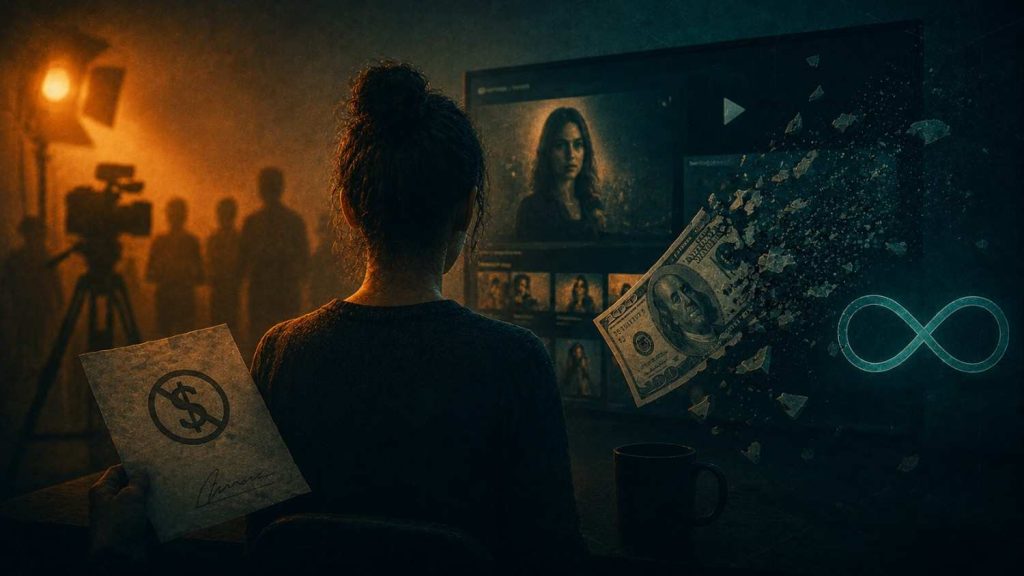
A Love Is Blind season that premiered four years ago is still on Netflix. The cast members from that season received their original payment. That’s it.
How the Revenue Gap Works
Cast members receive a flat fee or weekly stipend during filming and nothing after that, regardless of how long the show streams. A scripted actor who appears in a show that streams for four years receives residual payments during that entire period under SAG-AFTRA agreements. A reality TV contestant receives nothing beyond the original deal.
Thompson has publicly argued that cast members should receive a share of streaming revenue. The argument mirrors the logic that drove the 2023 SAG-AFTRA strike. Reality TV cast members were explicitly excluded from that strike’s scope and from the agreements it produced.
If cast members are reclassified as employees rather than contractors, the residuals question becomes legally different. The economics behind franchise cancellations show how labor cost structure shapes network decisions about unscripted programming.
What Courts Have Actually Decided
The $1.4 Million Netflix Settlement (2023)
Netflix settled for $1.4 million in 2023, covering 144 former cast and crew members from Love Is Blind and other Kinetic Content productions. Neither Netflix nor Kinetic Content admitted wrongdoing. Averaged across 144 claimants, that works out to roughly $9,700 per person — less than a fifth of a single $50,000 quit penalty.
Individual Cases Still Pending
Tran Dang filed suit in 2023, including allegations of sexual assault during production. Renee Poche filed a separate case against Kinetic Content in 2024. Both remain pending. The pattern — Dang (2023), Poche (2024), Richardson class action (September 2025) — documents a sequence of legal challenges to the same production company’s practices within a short window.

Bachelor Franchise Contracts: What’s Different
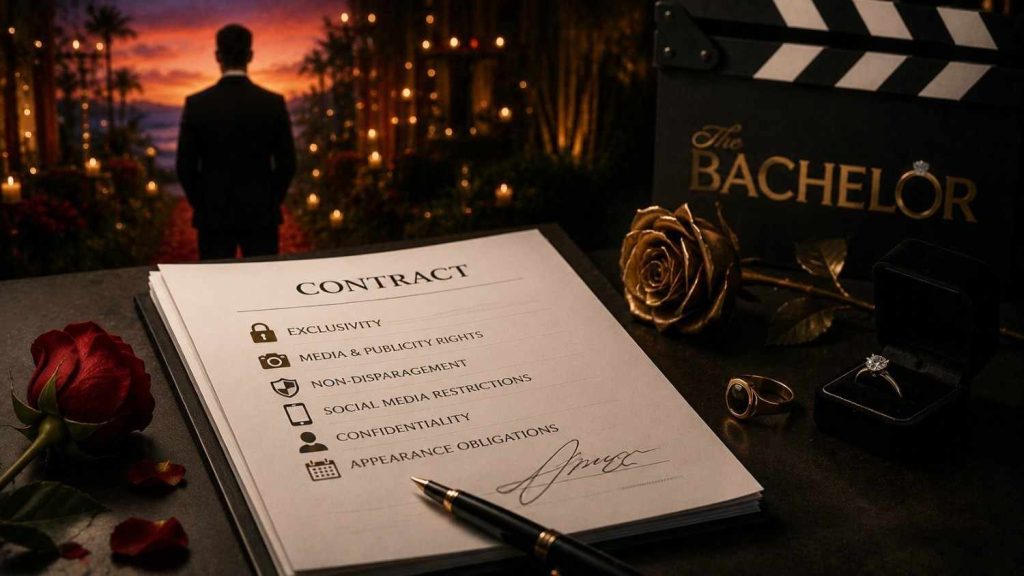
The Bachelor franchise runs on the same structural logic: independent-contractor classification, broad filming consent, and NDA provisions that survive production. Bachelor contracts are reportedly more restrictive on social media, both during and after filming. NDA periods in Bachelor contracts are reported to run longer than the Kinetic Content standard. Neither franchise pays residuals. Both use perpetual likeness rights language.
For context on how the franchise’s production model has shifted, questions around the Bachelorette cancellation get into the changing economics of unscripted programming.
What’s Starting to Change
The NLRB’s 2024 ruling against Kinetic Content is the clearest federal signal that the independent-contractor classification used in reality TV is not invulnerable. The UCAN Foundation — the Unscripted Cast Assistance Network, now offers free legal review of reality TV contracts for prospective cast members. It didn’t exist five years ago.
No legislation specifically addressing reality TV labor classification has passed as of 2025. What’s happening instead is a slower process: litigation by litigation, ruling by ruling, the contractor framework is being pressure-tested in court.
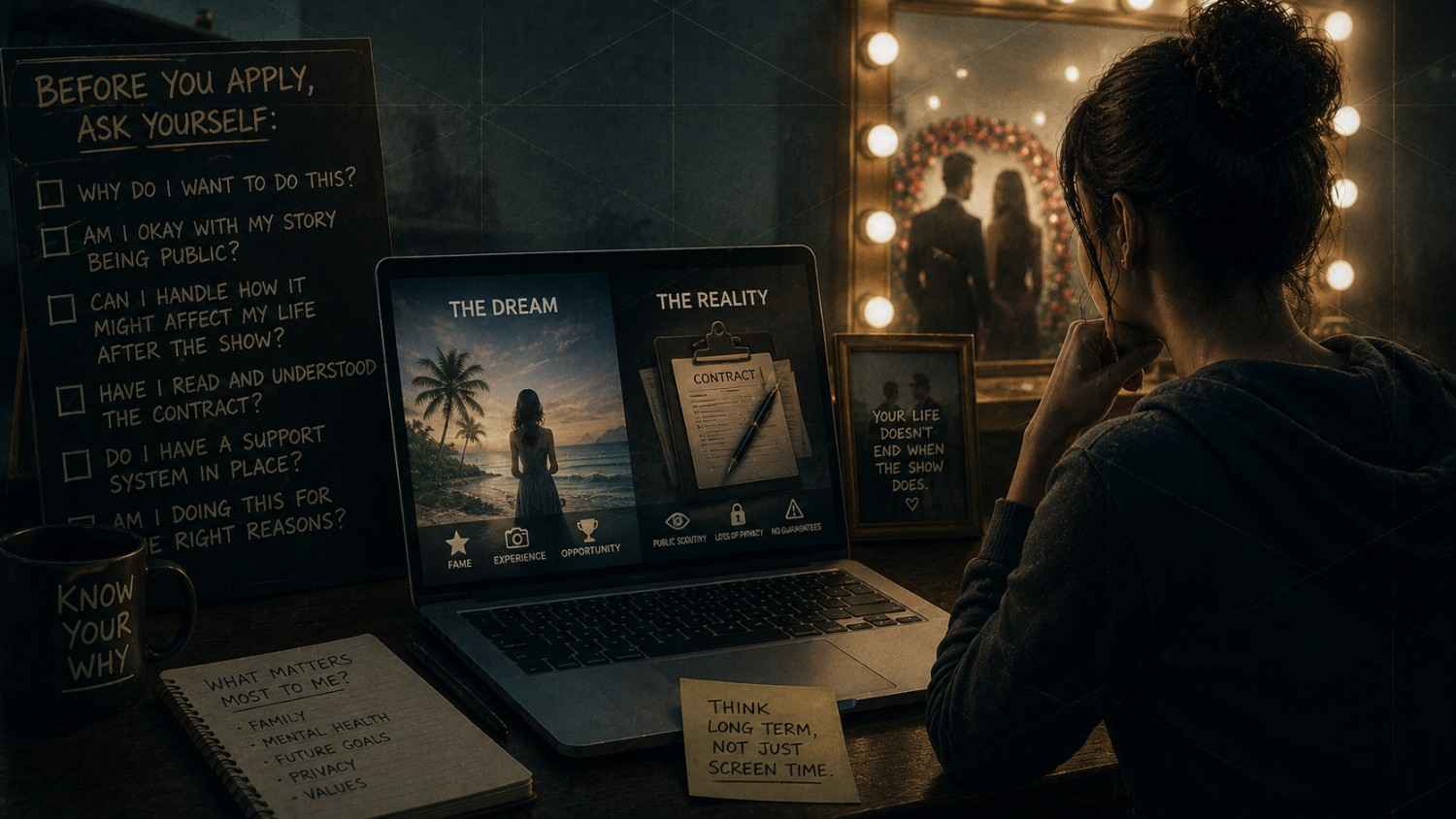
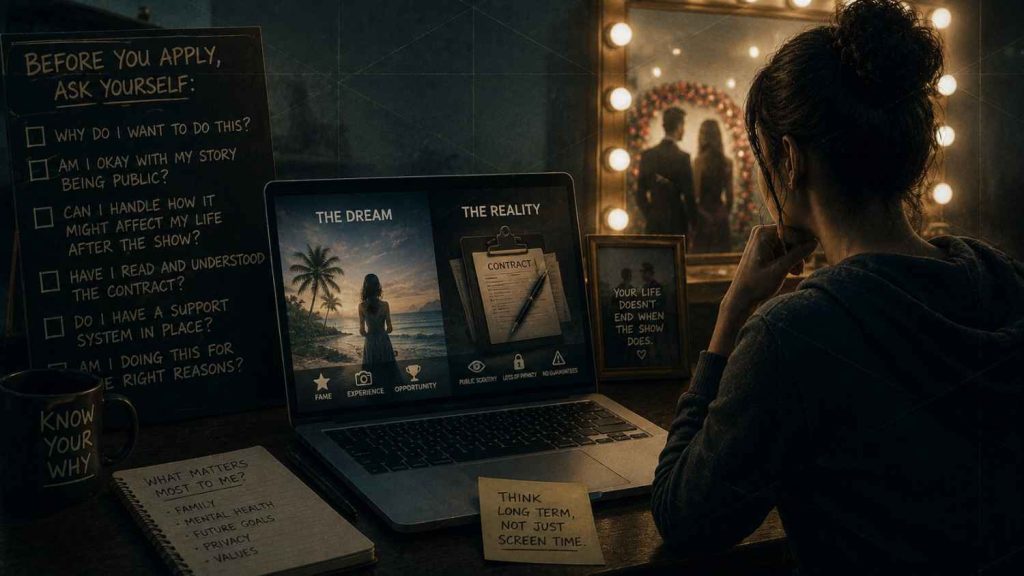
What to Do If You’re Thinking About Applying
The contract will be roughly 30 pages. Budget real time to read it before signing.
Specific Clauses to Look For
- Liquidated damages / early departure penalties: What is the dollar amount? What triggers it? Who decides whether your departure was “approved”?
- Employment classification: Does it call you a “participant,” “contestant,” or “independent contractor”? Anything other than “employee” means you’re outside standard labor law protections.
- Filming consent scope: Does it cover footage use in perpetuity? Does it cover unrelated productions?
- Editing rights: Can producers alter, rearrange, or combine footage without your approval?
- NDA terms: How long does it last? What are you prohibited from discussing? Are there carve-outs for legal proceedings?
- Residuals and downstream revenue: Is there any provision for payment if the show continues generating revenue?
Before You Sign Anything
Contact the UCAN Foundation for a free legal review before signing. A lawyer who reviews reality TV contracts regularly will spot the specific clauses that matter in ways that a general read-through won’t.
Talk to former cast members if you can find them, not about spoilers, but about filming conditions, hours, and what happened when someone wanted to leave. You won’t always get full answers, but you’ll get signal.
Go in understanding that the contract is written to protect the production, not you. Knowing that before you sign puts you in a different position than most people who’ve sat where you’re sitting.
FAQ
Is the $50,000 quit penalty in Love Is Blind contracts actually real?
Yes, according to Nick Thompson’s October 2025 interview with CBC’s Day 6. He described a liquidated damages clause requiring cast members to pay $50,000 if they leave production without producer approval. Kinetic Content has not publicly disputed Thompson’s description. The $50,000 figure functions as a financial deterrent, not just a theoretical legal threat.
Do reality TV cast members have any labor protections at all?
Very few, under current law. The independent-contractor classification removes most standard protections: overtime pay, mandatory meal breaks, workers’ compensation, and state labor code protections generally don’t apply. The NLRB’s 2024 ruling found that Kinetic Content’s use of this classification was improper, but that ruling applies specifically to Kinetic Content. The Stephen Richardson class action, filed September 2025, is the most significant current challenge to this framework.
Can a reality TV show legally edit you to look like a villain even if that’s not what happened?
Yes, in most cases. Contracts give producers broad editing rights, including the right to rearrange footage, cut conversations to change their meaning, and combine material from different moments. Cast members consent to this before filming starts, which makes it very difficult to challenge legally after the fact.
How long does a reality TV NDA last?
It varies by production and contract, but NDAs in reality TV participant agreements typically survive past the filming period and often past the show’s original air date. Bachelor franchise NDAs are reported to run longer than most. Former cast members who speak publicly about contract specifics usually do so after legal proceedings have made some of that information part of the public record.
What was the Love Is Blind Netflix settlement actually about?
The $1.4 million settlement in 2023 resolved claims from 144 former cast and crew members involving labor conditions during filming, including the independent-contractor classification. Netflix and Kinetic Content did not admit wrongdoing. Averaged across 144 claimants, the settlement worked out to roughly $9,700 per person.
Do reality TV contestants ever get residuals from streaming?
No. Standard reality TV participant agreements include no residuals provision. Cast members receive a flat fee or stipend during filming and nothing after that, regardless of how long the show streams. Reality TV cast was explicitly excluded from the streaming residuals improvements SAG-AFTRA won in 2023.
What’s the difference between the Love Is Blind lawsuits and the Stephen Richardson class action?
The earlier individual cases — Tran Dang (2023) and Renee Poche (2024) — tested specific allegations about individual experiences. The Richardson class action, filed September 2025, argues that the independent-contractor classification was applied systematically across Kinetic Content productions. If certified, its outcome would apply to the entire class, not just one individual.
What is the UCAN Foundation and can they actually help?
The UCAN Foundation — Unscripted Cast Assistance Network — provides free legal review of reality TV contracts to prospective cast members before they sign. It was created by former reality TV cast members and advocates. If you’re considering signing a reality TV participant agreement, contacting UCAN before you sign is the most concrete and immediately available option.
The Bottom Line
Every clause in a reality TV participant agreement was written by lawyers working for the production company. Not for the talent. Not for the cast. For the company. The $50,000 quit penalty exists because leaving costs them money. The contractor classification exists because employee status costs them more. The broad editing consent exists because creative control is what makes the product profitable.
The litigation pattern around Kinetic Content, the NLRB ruling, the individual suits, the $1.4 million settlement, the Richardson class action, has made more of this visible than it’s ever been. Former cast members are talking. Courts are ruling. Federal agencies are weighing in. The framework isn’t collapsing, but it’s being tested in ways it hasn’t been before.
If you’re thinking about applying to a reality TV show, apply with actual information. Read the contract. Use UCAN’s free legal review. Talk to former cast members. Know what the $50,000 clause means before you’re sitting on a set at midnight deciding whether you can afford to walk out. The show will be fine either way. Make sure you will be too.