The Problem With “Just Watch Poirot”
Picking an Agatha Christie adaptation sounds simple until you actually try. There are dozens of options spread across BBC, ITV, BritBox, and streaming platforms. Some run for 13 series. Some are three-episode miniseries. Some star actors you recognize from completely different genres playing characters who barely resemble the originals.
Every ranked list you find either tells you Suchet’s Poirot is the best (helpful, but not specific enough) or buries the actually great one-off adaptations under a pile of nostalgia-driven BBC rankings. What most people miss is that these adaptations are not trying to do the same thing.
A show designed to air 70 episodes over 25 years is built differently than a three-part prestige miniseries produced for a modern streaming audience. Comparing them on the same scale without acknowledging that difference is how you end up recommending Joan Hickson’s Marple to someone who wants Knives Out-level tension, and then watching them bounce off it in the first 20 minutes.
This ranking covers eight TV adaptations specifically, not theatrical films, and judges each one by four consistent criteria: faithfulness to source material, lead performance quality, production value, and rewatchability.
How This Ranking Works
These four criteria are not weighted equally for every entry, but every entry is judged by all four.
Faithfulness to source material measures how closely the adaptation follows Christie’s original plot structure, character intent, and narrative resolution. This does not automatically make a more faithful adaptation better television. It means you know what you’re getting.
Lead performance quality measures whether the central detective or ensemble cast carries the weight of Christie’s character construction. Christie wrote highly specific people. Actors who understand that specificity produce fundamentally different results than actors who are simply cast to be interesting.
Production value covers period accuracy, cinematography, score, and atmosphere. This matters more for Christie than for most source material because her novels are deeply rooted in a specific English social world. Getting that world wrong visually undermines everything else.
Rewatchability is the real test for mystery content. Once you know who did it and why, does the show still hold up? Great adaptations do, because the pleasure shifts from suspense to performance and craft.
One clarifying note before the list: “best” is not the same as “most faithful.” Several entries here rank high precisely because they work brilliantly as television even when they take liberties with Christie’s originals.
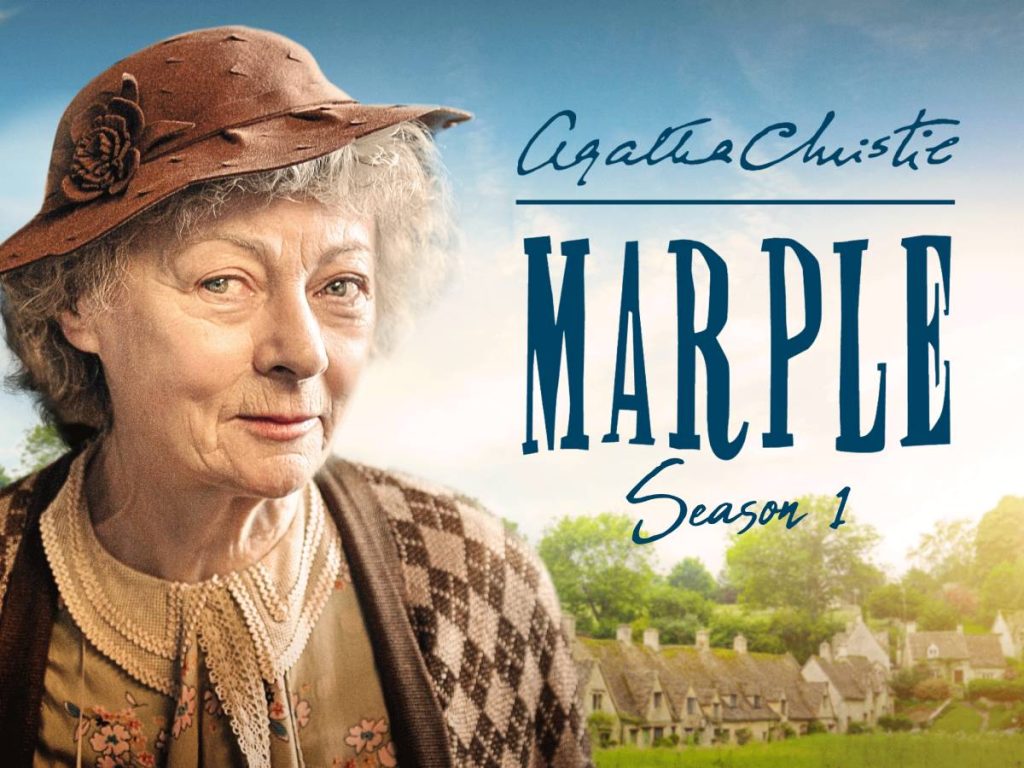
#8: Agatha Christie’s Marple (ITV, 2004-2013): Big Cast, Uneven Results
The ITV Marple series is a glossy, well-cast production that consistently undermines itself by inserting Miss Marple into Christie plots that were never hers.
Geraldine McEwan vs. Julia McKenzie
Two actresses shared the role across the series’ run. Geraldine McEwan played Marple in Series 1 through 3, bringing an eccentric, slightly comic energy that felt more theatrical than bookish. Julia McKenzie took over for Series 4 through 6, offering a warmer, quieter interpretation, though the scripts by that point had become so loose with the source material that even a strong performance couldn’t compensate.
The casting was not the problem. The problem was structural. The production team ran out of genuine Marple novels and started adapting other Christie works by inserting Marple into them. Ordeal by Innocence, Why Didn’t They Ask Evans?, and The Sittaford Mystery are not Marple stories. Marple was dropped into them anyway, which left fans of those books frustrated and new viewers confused about what they were actually watching.
The guest casts across the run are legitimately impressive. Charles Dance, Ian Richardson, and Emilia Fox all appear across various episodes. The period production is handsome and comfortable to watch. The series runs to a steady 7.4 on IMDb, which reflects exactly what it is: competent, enjoyable mystery television that stops short of being essential.
Who this is for: Viewers who want a relaxed, well-produced period mystery experience and don’t have strong feelings about staying inside the source material.
#7: Why Didn’t They Ask Evans? (BritBox/ITV, 2022): Style Over Substance
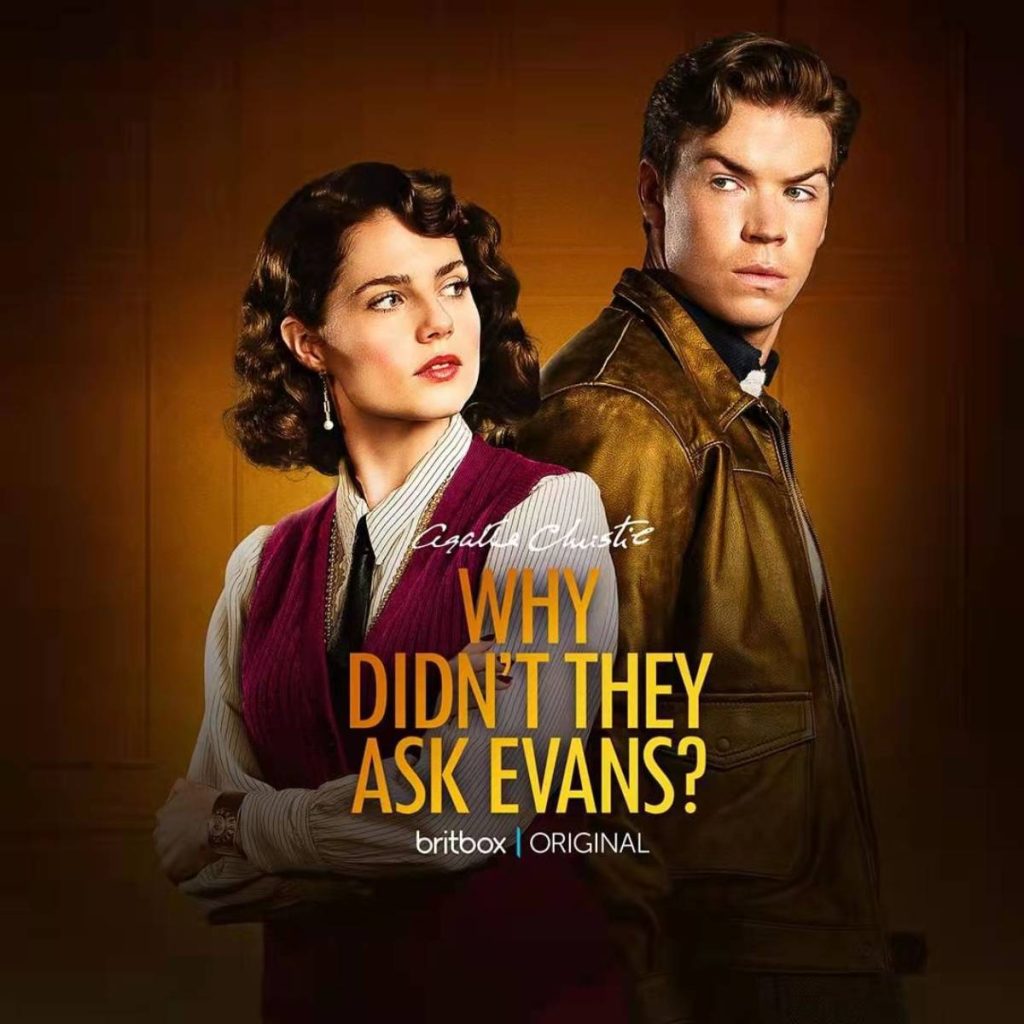
Hugh Laurie’s adaptation of one of Christie’s most beloved standalone novels is inventive, lightly comic, and so consciously stylish that it occasionally forgets to be suspenseful.
The three-part miniseries stars Will Poulter and Lucy Boynton as Bobby Jones and Frankie Derwent, the amateur detective duo at the center of Christie’s original 1934 novel. Laurie wrote and directed all three episodes, and his fingerprints are all over the tone. This is a caper as much as a mystery. The visuals are playful, the performances lean into charm over dread, and the whole thing moves with a lightness that sits closer to Wes Anderson territory than to traditional Christie.
Fan reception landed in two clear camps. Viewers who came for the Christie novel felt the adaptation traded too much of the book’s genuine tension for stylistic flourishes. Viewers who came for Laurie, Poulter, and Boynton found it a thoroughly enjoyable watch. The original novel is widely considered one of Christie’s most satisfying standalones, with a mystery architecture that rewards close attention. The underlying engine of suspense gets a little lost in the presentation.
Who this is for: Viewers who want something fun and visually inventive, and who aren’t arriving with strong prior attachment to the source novel.
#6: Partners in Crime (BBC, 2015): A Promising Experiment That Loses Its Footing
The BBC’s Tommy and Tuppence adaptation is ambitious in concept and underdisciplined in execution, a show that wanted to be a Cold War spy thriller and a Christie mystery at the same time and fully committed to neither.
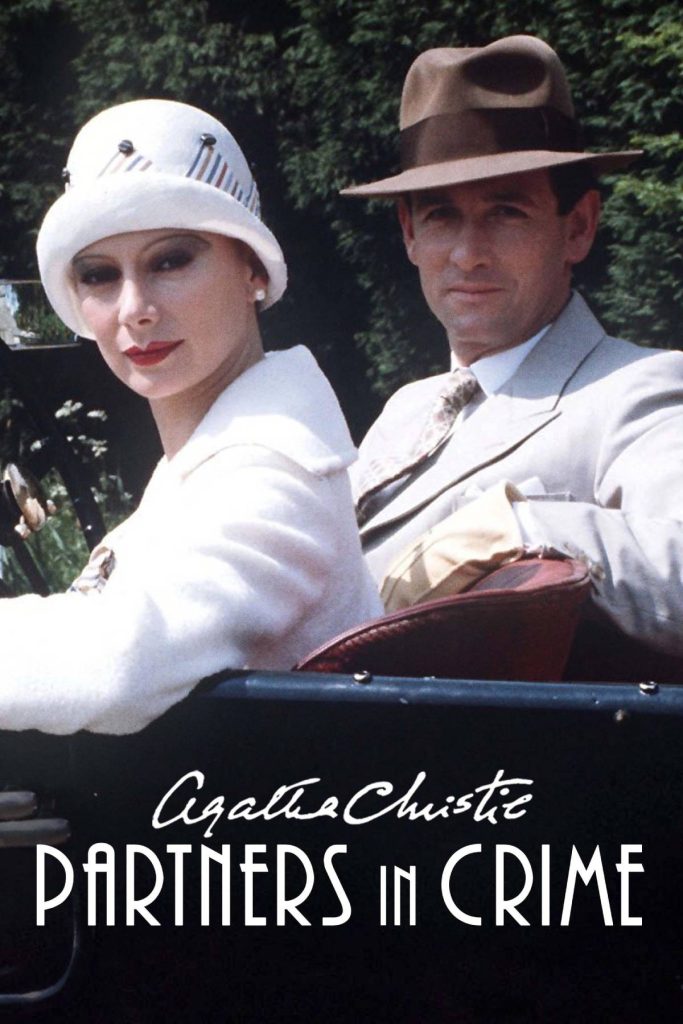
Based on Christie’s Tommy and Tuppence Beresford stories, the series stars David Walliams and Jessica Raine as the married detective duo. The modernization strategy is clever on paper: rather than updating the setting to present day, the show is set in the early 1950s, threading Cold War espionage through Christie’s lighter adventure-mystery plots. Walliams and Raine have real chemistry, and the production design captures early postwar Britain with reasonable care.
The problem is that the Cold War material swallows the mystery structure whole. By the second episode of the series, you’re watching a spy thriller that happens to feature characters with Christie’s names, rather than a Christie adaptation that happens to involve spies. Two series were commissioned. Only one was made.
Who this is for: Viewers curious about the Tommy and Tuppence stories who want to see an ambitious swing, even one that doesn’t fully connect.
#5: The ABC Murders (BBC, 2018): The Dark Reinterpretation That Divides Fans
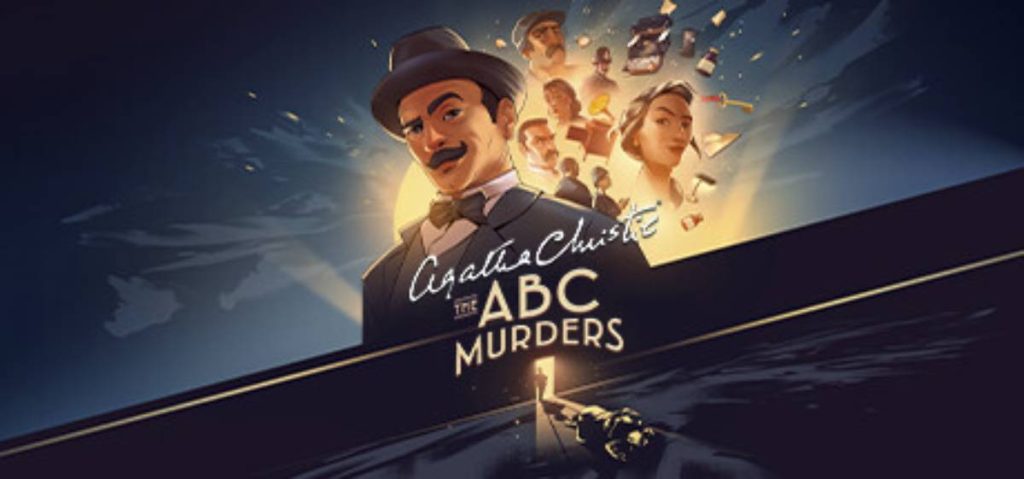
John Malkovich’s Poirot is not the Poirot you know, and whether that is a problem or a strength depends entirely on what you came to watch.
Is The ABC Murders faithful to the book?
The mystery structure is largely intact. The three-episode format handles the serial-killer premise with efficiency, and the plot mechanics of Christie’s original 1936 novel are preserved well enough that readers will recognize the key beats. What the BBC adaptation changes is everything surrounding the plot: tone, characterization, and political subtext.
Malkovich’s Poirot is a man in visible decline. He is older, heavier, more isolated, and far more melancholic than any previous screen incarnation. The 1930s England he moves through is one inching toward fascism, and the show makes that atmosphere explicit. Audiences who came to the show without prior loyalty to David Suchet’s interpretation generally found it compelling. Christie purists largely rejected it, on the grounds that the Poirot they were watching bore so little resemblance to the character Christie created.
Both positions are defensible. The show sits at 7.4 on IMDb, which is exactly the score of a production that executes its own vision well while splitting its intended audience down the middle.
Who this is for: Viewers who like dark, atmospheric crime dramas and don’t arrive with strong feelings about how Poirot is supposed to look, sound, or behave.
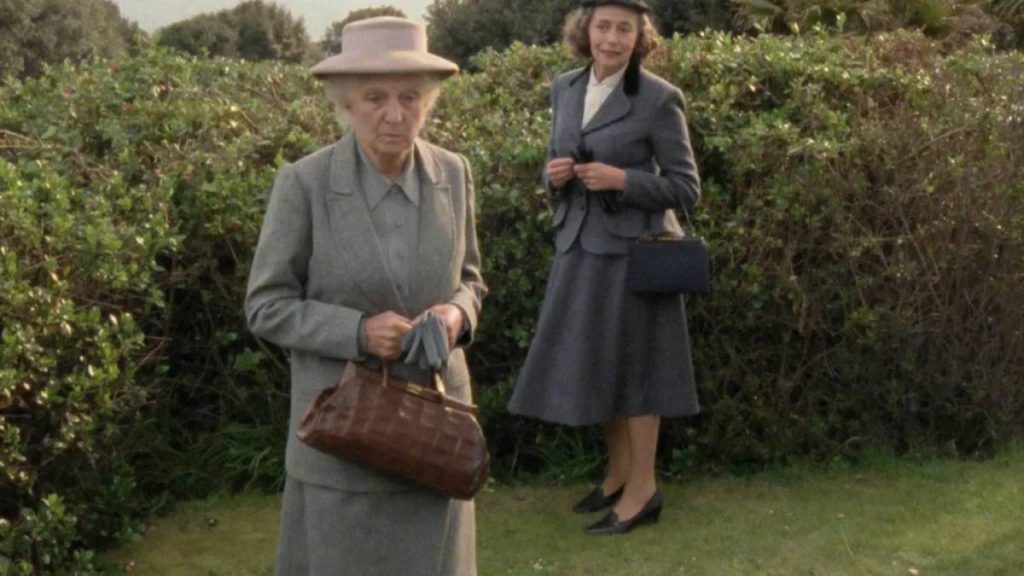
#4: Miss Marple with Joan Hickson (BBC, 1984-1992): The Most Faithful Marple Ever Put on Screen
Joan Hickson’s Miss Marple is the definitive screen version of the character, not because of production scale or modern polish, but because it is the one that actually matches what Christie wrote.
Why Joan Hickson Is Considered the Definitive Miss Marple
The backstory here is extraordinary. In the 1940s, decades before the BBC series was made, Christie saw Joan Hickson in a stage production and wrote her a personal note saying she hoped Hickson would one day play Miss Marple. Hickson finally got the role in 1984, at the age of 78.
The BBC series ran across 12 feature-length episodes, covering most of the major Marple novels without importing plots from other Christie works. Hickson’s interpretation matches Christie’s own descriptions precisely: gentle in manner, precise in observation, never theatrical. She does not perform deduction. She notices things, quietly, and then tells you what they mean.
The production is modest by contemporary standards. The pacing is slower than modern audiences expect from mystery television. For anyone who has read the books, however, the experience of watching Hickson is one of complete recognition.
Who this is for: Christie readers who want the most accurate screen Marple, and viewers who prefer patient, character-driven mystery over glossy production.
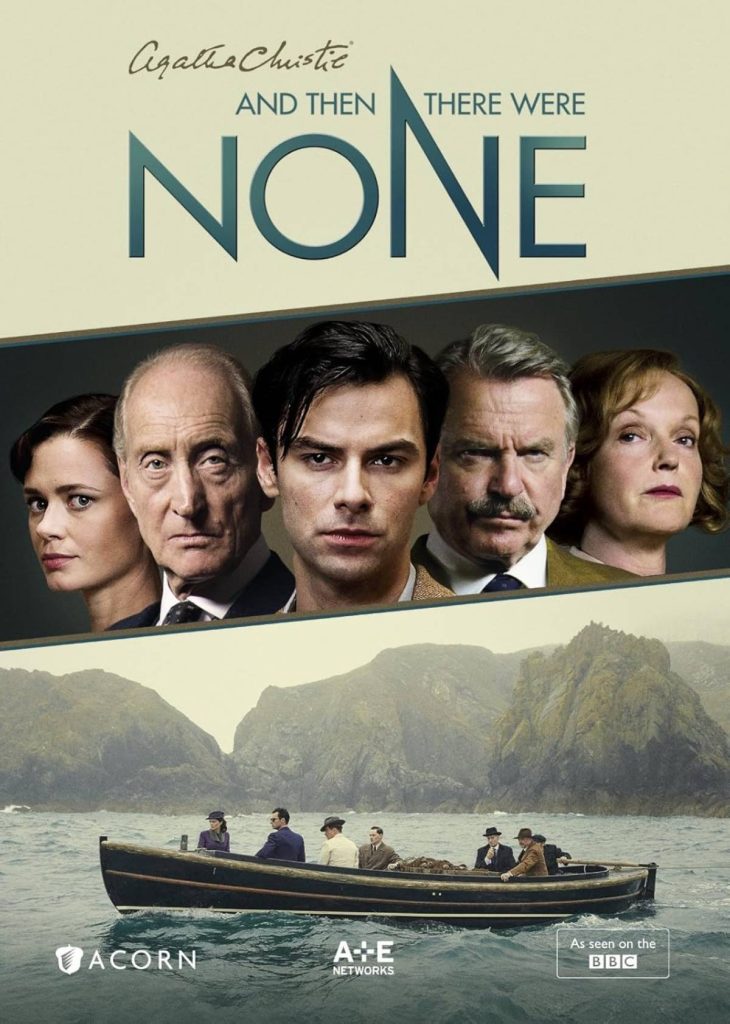
#3: And Then There Were None (BBC, 2015): The Best Single-Story Christie Adaptation
The 2015 BBC miniseries is the adaptation that proved Christie’s work could survive a modern, psychologically intense treatment without losing the structural precision that made the source material great.
What Makes the 2015 And Then There Were None Different
Christie’s novel is her best-selling work, with global sales that place it among the top-selling mystery novels ever written. It has been adapted for film and television multiple times across eight decades. The 2015 BBC version, adapted by Sarah Phelps and starring Aidan Turner, Charles Dance, Sam Neill, and Maeve Dermody, is the one that finally got the balance right.
The changes from the book are real and worth knowing in advance. The tone is darker and more psychologically intense than the original. The violence is more explicit. The ending diverges from the novel’s resolution, a choice that infuriated portions of the Christie fanbase and satisfied a different portion equally.
What the adaptation gets entirely right is atmosphere. The island is oppressive in a way that no previous version achieved. The ensemble cast brings enough individual weight to make each character’s death genuinely affecting. This adaptation also set the template for the BBC’s subsequent Christie productions, including Witness for the Prosecution and Ordeal by Innocence.
Who this is for: Newcomers to Christie who want a self-contained, cinematic entry point, and thriller fans who might not otherwise seek out classic mystery television.
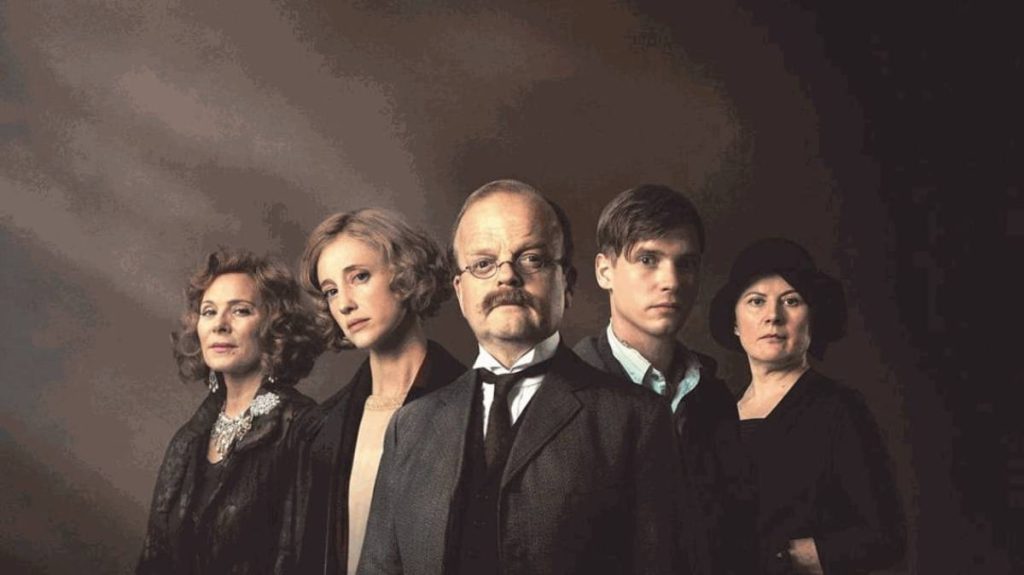
#2: Witness for the Prosecution (BBC, 2016): The Most Underrated Christie Adaptation
Toby Jones’s performance as Leonard Vole is the finest individual acting achievement in any Christie TV adaptation, and the fact that this miniseries rarely appears near the top of ranked lists says more about its low profile than its quality.
The two-part adaptation, also written by Sarah Phelps, is based on Christie’s celebrated 1925 short story, later expanded into a stage play that ran for years in London’s West End. The story is a courtroom mystery in structure. A young man is accused of murdering a wealthy older woman. His wife’s testimony will decide whether he lives or dies.
Jones plays Leonard Vole as meek, opaque, and somehow deeply unsettling despite projecting no obvious menace. You cannot read him. Christie built the story to make that impossibility work as a plot mechanism, and Jones delivers it with a precision that makes the experience genuinely uncomfortable. Andrea Riseborough as Romaine matches Jones beat for beat, and Kim Cattrall as the sharp-witted solicitor rounds out a three-lead structure that functions more like a chamber drama than a conventional mystery.
The production design is exceptional. The 1920s London courtroom scenes are cold, precise, and beautifully lit in a way that feels more European art film than Sunday-evening British television.
Who this is for: Viewers who want psychological tension over detective-formula comfort, and anyone who responds to strong ensemble performance above all else.
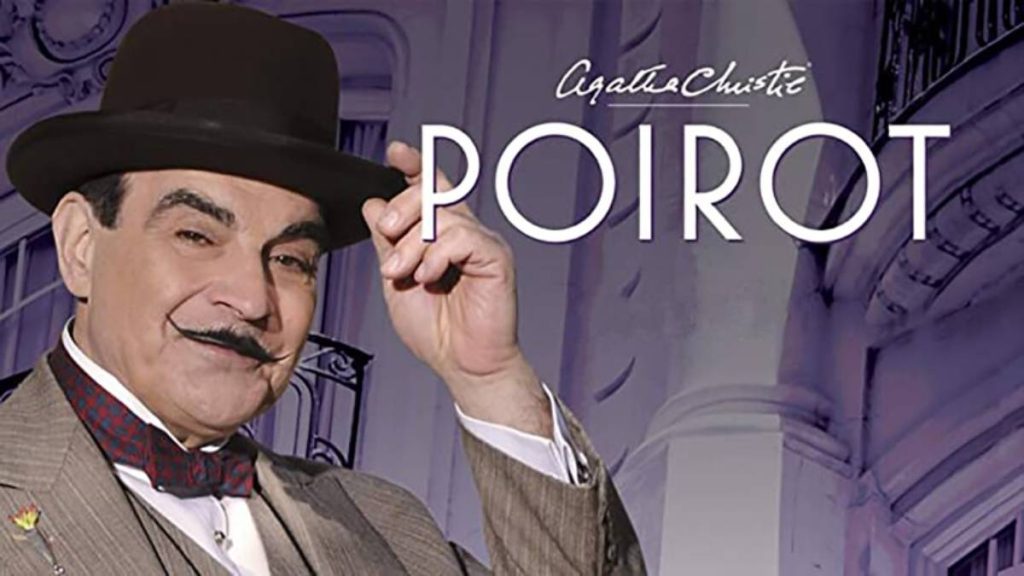
#1: Agatha Christie’s Poirot with David Suchet (ITV, 1989-2013): The Standard Everything Else Gets Measured Against
David Suchet spent 25 years playing one character across 70 episodes, and the result is the most complete, most consistent, and most carefully constructed Christie adaptation in television history.
Why David Suchet’s Poirot Is Considered Definitive
Suchet has described the process of building Poirot from the ground up, reading every Christie novel in which the character appeared, cataloguing every physical description, personality trait, and behavioral tic, and building a performance from that research outward. The physical choices alone are precise: the egg-shaped head, the fastidious grooming, the way Poirot holds his body as if any disorder in his environment were a personal affront. None of that is accidental.
The series ran from 1989 to 2013 across 13 series, covering all 33 Poirot novels and all of the major short story collections. That comprehensiveness matters. Most long-running detective series drift over time as cast members change or production quality shifts. Poirot drifts in the opposite direction: it becomes more assured, more emotionally complex, and more willing to engage with the darker moral architecture of Christie’s later novels.
The Later Series and What They Got Right
The early seasons are light, charming, and extremely faithful to Christie’s shorter works. The later seasons, covering longer novels like Evil Under the Sun, Death on the Nile, and Curtain: Poirot’s Last Case, take on a weight that the lighter early episodes don’t attempt. The final episode, Curtain, adapted from the novel Christie wrote during World War II and sealed in a vault until publication in 1975, is one of the most emotionally affecting endings in British television.
The consistency of Suchet’s performance across that span is the most impressive single achievement in Christie adaptation. Supporting cast members come and go. Producers change. The visual style of British television changes around the show across three decades. Suchet’s Poirot remains identifiable, specific, and fully inhabited throughout.
No other adaptation covers this much Christie material at this level of quality. That is why this series is the standard. Not nostalgia. Not default critical consensus. Genuine scope, genuine commitment, and a lead performance built to last.
Who this is for: Anyone who wants to go deep on Christie’s detective fiction. Start with Season 1, expect the first few series to be lighter in tone, and stay for the long game.
FAQ
Which Agatha Christie adaptation should I watch first?
Start with And Then There Were None (BBC, 2015). It is self-contained, requires no prior knowledge of Christie’s characters, and runs across just three episodes. The story is Christie’s best-selling novel, so you’re starting with her most refined mystery construction. If you finish that and want more of the same modern-prestige tone, move to Witness for the Prosecution (2016). If you want to go deeper into Christie’s detective fiction, then start Poirot from Series 1.
Is David Suchet the best Poirot ever?
Yes, by the available evidence. Suchet is the only actor to have played Poirot across the complete Christie canon, 70 episodes covering all 33 novels and the major short story collections. His preparation involved reading every Christie novel that featured the character and building the physical and psychological performance from that research. No other screen Poirot has attempted that scope or achieved that level of consistency. John Malkovich’s 2018 version is interesting television, but it is a reimagining rather than an interpretation.
Why do Christie purists hate the modern BBC adaptations?
The core objection is characterization. Sarah Phelps’s BBC adaptations, covering And Then There Were None, Witness for the Prosecution, The ABC Murders, and Ordeal by Innocence, all take Christie’s characters and push them into darker psychological territory than Christie wrote. Poirot in The ABC Murders is melancholic and physically diminished. The endings in some adaptations diverge significantly from the books. Purists argue that if you change the characters and the endings, you haven’t adapted Christie, you’ve used her plots as raw material for a different story.
Joan Hickson or Geraldine McEwan: which Miss Marple is better?
Joan Hickson, for faithfulness to the source material. Hickson’s BBC version matches Christie’s own description of Marple precisely, an appearance of gentle vagueness concealing an exceptionally precise mind. Christie herself wrote to Hickson in the 1940s expressing hope she would one day play the role. McEwan’s ITV version is more theatrical and more eccentric, which makes it more immediately entertaining for some viewers but further from the actual character Christie created. If you’ve read the books, Hickson is the obvious choice.
Is there an Agatha Christie adaptation similar to Knives Out?
And Then There Were None (BBC, 2015) is the closest match in tone and cinematic ambition. Both use an isolated setting, a large ensemble cast, and a mystery structure that generates genuine tension rather than cozy procedural comfort. Witness for the Prosecution (BBC, 2016) is another strong option if you liked Knives Out for its courtroom-drama elements and its interest in unreliable characters. Neither is a direct equivalent, but both operate in the same register of modern prestige mystery.
Does Poirot end well? Should I worry about investing in 25 years of episodes?
The final episode, Curtain: Poirot’s Last Case, is one of the strongest finales in British television and fully justifies the investment. Christie wrote Curtain during World War II, kept it in a vault for decades, and published it in 1975 specifically as the character’s final case. Suchet’s adaptation of it aired in 2013 and was received as a genuinely moving conclusion to the 25-year series. You are not walking into a show that ends badly or abruptly. The ending was always planned, and it delivers.
The Real Answer to “Which One Is Best”
The ranking exists to move you past the flat answer of “just watch Suchet’s Poirot.” That answer is correct but incomplete. Suchet’s run is the most comprehensive, most consistent Christie adaptation ever produced, and it earns its place at the top without any qualification. If you want to understand Christie’s detective fiction at depth, that is your destination.
The more useful insight from this list is that the entries at #3 and #2 are doing something the top of every other ranking ignores. And Then There Were None and Witness for the Prosecution prove that Christie’s structural precision survives bold creative interpretation, when the interpretation is disciplined and the casting is strong. Those aren’t lesser entries on a list topped by Suchet. They’re different kinds of success.
Pick your entry point based on what you actually want. A comprehensive series with a towering central performance: start with Poirot Season 1. A single self-contained story with cinematic tension: start with And Then There Were None. A performance-led chamber drama that will stay with you: go straight to Witness for the Prosecution. The Christie catalogue is large enough to sustain all three approaches, and you don’t have to choose just one.