

What Is the FROM Lake of Tears?
The Lake of Tears is a location in FROM that was first described by Ethan Matthews in a dream during Season 1 and formally named as a physical destination in Season 4 Episode 2. Its exact nature has not been confirmed by the show. It may be a geographic place, a threshold, or something functioning as an entry or exit point.
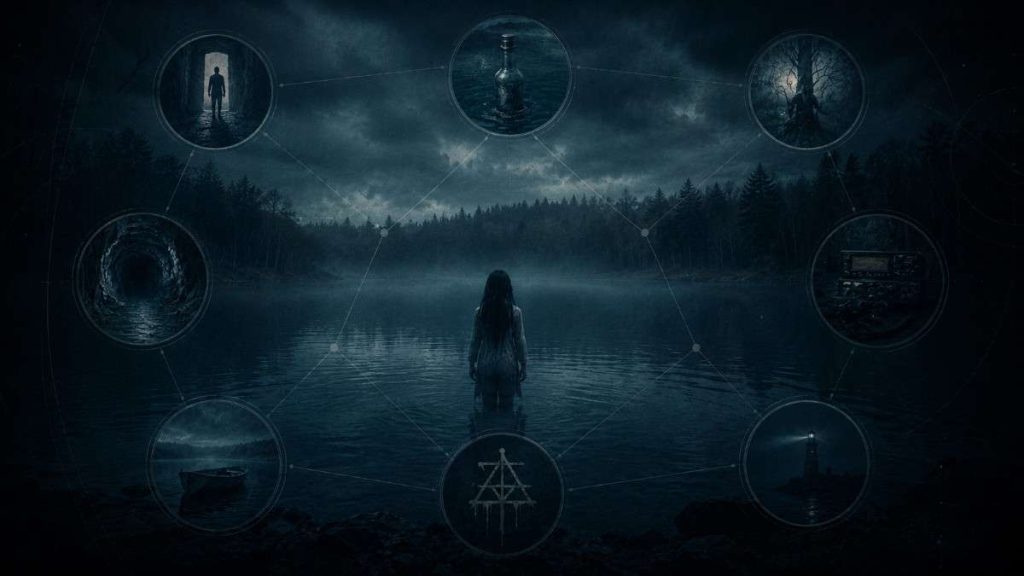
What separates this location from other FROM mysteries is the consistency of its detail across multiple sources. This is not a vague feeling or a symbol that different characters interpret differently. Ethan described it with sensory specificity. Victor’s drawings reflect imagery that aligns with that description. A post-death message names it as a place Ethan needs to find. Three independent signals, spread across the full run of the series, all point at the same place.
The distinction matters: a location named once by a child could be a dream image with no story weight. A location named by a child, corroborated by an adult survivor’s decades-old drawings, and then directed toward by a dead man through a radio is something the show has been building deliberately. FROM is not a show that repeats details by accident.
What the show has NOT done is confirm whether the lake is a physical body of water within the town’s visible geography or something that exists beneath or outside of it. That ambiguity is intentional, and it is where the most interesting theories live.
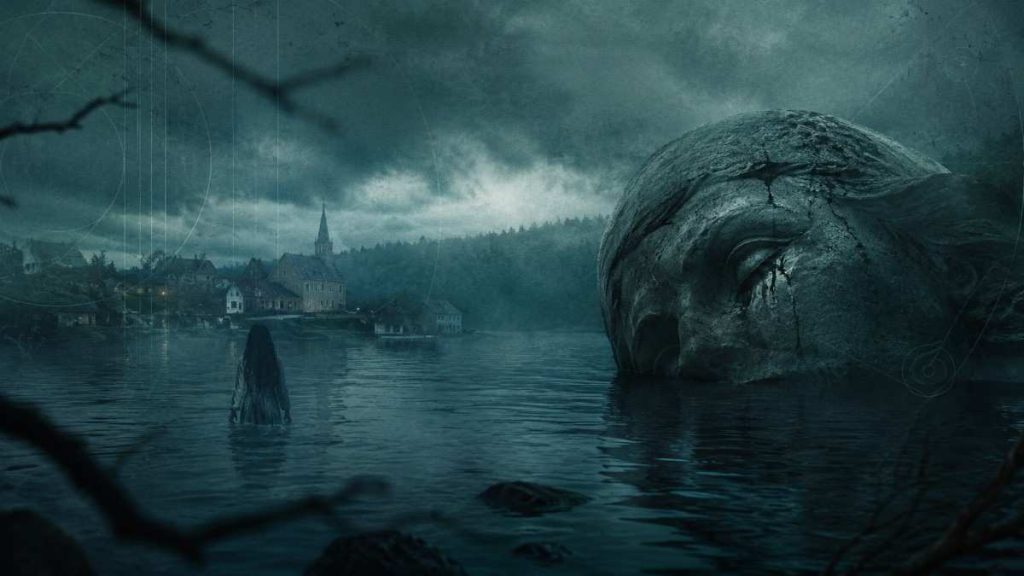
The First Mention: Ethan’s Season 1 Dream
Ethan Matthews first describes the Lake of Tears in Season 1, and he is explicit that what he experienced was not a drawing or an image he saw on a wall. He saw it. That distinction matters because it places Ethan in the category of direct witness rather than interpreter.
FROM has a consistent structural pattern with children. They perceive things that adults either cannot access or refuse to take seriously. Ethan fits this pattern completely. He arrived in the town as a young boy, and from early in Season 1 he was receiving information through dreams that no adult character could verify or explain.
The adults around Ethan at the time had bigger immediate concerns: surviving the nights, figuring out the town’s rules, keeping the family together. A child describing a lake with a strange name did not register as a lead worth following. That delay is part of what makes the reveal in Season 4 hit the way it does.
There is a quote from Ethan, referenced in promotional content around Season 4, that captures this exactly: “I saw the lake of tears. It wasn’t a drawing on the wall.” He is not relaying something secondhand. He is reporting a place he experienced directly in a dream state that FROM treats, consistently, as a legitimate channel of information rather than a psychological byproduct.
If you want context on why the town would communicate through a child’s dreams, the piece on what the town in FROM is covers the leading structural theories and why the town appears to select certain witnesses.
Victor’s Drawings and the Independent Corroboration
Victor is the longest-surviving resident of the town in FROM’s present timeline, which means his drawings function as an archive. He has been documenting what the town shows him, and what he has survived, for decades longer than any other character we follow.
His drawings depict imagery that aligns with Ethan’s description of the Lake of Tears. The underground framing appears in his visual records, suggesting the lake may not sit on the surface of the town’s visible geography. Spider imagery, which FROM fans have noted repeatedly, appears in connection with the same visual cluster. This is not a loose thematic resemblance. It is enough specificity that two characters, working independently across a significant span of time, are describing the same place.
The strongest version of this argument is not that Victor confirms Ethan. It is that Victor drew it FIRST. Victor was documenting the town’s architecture before Ethan’s family ever arrived. That means the Lake of Tears was already a recognized feature of whatever the town is, visible to a long-term survivor who had no connection to the Matthews family, before Season 1 begins. Ethan’s dream did not introduce the lake into the story. It introduced the lake to the audience.
The underground framing in Victor’s drawings raises a specific question about what “finding” the lake actually requires. If the lake is beneath the surface of the town rather than within its mapped geography, visiting it may involve accessing a layer of the town that most characters do not know exists. That changes the nature of the search entirely.

Season 4 Episode 2: What Actually Happens at the Lake
Season 4 Episode 2 is titled “The Lake of Tears,” and FROM naming an episode after a location is always a signal. The show does not distribute weight casually.
Ethan and Tabitha, along with other survivors, reach the lake. It is the first time any character physically stands at this location and interacts with it as a real place rather than a dream reference or a drawing. What they find is not an empty body of water waiting to be interpreted.
There is a rope running from the surface of the lake down to the floor beneath the water. The survivors pull it, and the rope surfaces a net from below. What the net contains is the reveal that connects the lake to the scarecrow threat, one of the most discussed developments in Season 4.
This is where the escape-route theory takes its first serious hit. If the Lake of Tears were simply a door out of the town, the thing waiting beneath the water would not be a new threat. The lake appears to be a source, a storage point, or an entry channel, and whatever has been using it was not waiting to help anyone leave. The scarecrow reveal through the lake also connects to the broader question of what the town’s infrastructure looks like beneath its surface.
Jim’s Message: Why a Dead Man Is Pointing to the Lake
Jim’s fate after Season 3 is covered in detail over at the piece on Jim’s death in FROM, but the short version for context: Jim does not survive into Season 4 as a living character.
What happens in Season 4 is that Ethan attempts radio contact expecting to reach his deceased brother Thomas. The voice that responds is Jim’s. This is already a departure from the show’s established pattern with post-death communication, which had previously leaned toward cryptic warnings and fragmented impressions rather than clear directives.
Jim tells Ethan to find the Lake of Tears. That is a directional instruction from a dead man. Not a warning. Not a symbol. A specific location and a clear action.
This is the first time in FROM that a post-death character delivers navigational information. Every other communication from dead or absent characters operates in the register of grief, guilt, and dread. Jim breaks that pattern by being specific, and specificity in FROM is rare enough to be treated as significant.
There are two ways to read this. The first is that Jim, having died, now has access to structural information about the town that he did not have while alive, and he is using that access to help Ethan. The second is darker: that whatever communicates through the radio is not Jim, but something using Jim’s voice and knowledge to direct Ethan toward the lake for reasons that may not be protective. FROM has given the audience no way to confirm which reading is correct.
Episode-by-Episode Clue Table
Every confirmed reference to the Lake of Tears across the series, mapped in order.
| Season / Episode | Character | Type of Reference | Key Detail |
|---|---|---|---|
| Season 1, Episode 1 | Ethan Matthews | Dream, verbal description | Names the Lake of Tears directly; describes it as a sensory experience rather than a visual image or drawing |
| Season 1 through Season 2 | Victor | Drawings | Creates imagery consistent with Ethan’s description, including underground scenes, a spider-like figure, and the lake; drawings predate Ethan’s arrival in town |
| Season 4, Episode 2 | Ethan, Tabitha, and the survivors | Physical visit | The group reaches the lake, discovers a rope connected to the lake floor, surfaces a net, and encounters the scarecrow |
| Season 4, Episode 2 | Jim (via radio) | Post-death message | Tells Ethan to find the Lake of Tears, marking the first direct guidance from a character after death in the series |
Note: If any Season 3 references to the lake exist, they fall between the Season 2 drawings and the Season 4 episode. The table above reflects confirmed appearances. The gap between Season 2 and Season 4 is itself notable. The show let the reference rest for an entire season before activating it.
The Leading Theories on What the FROM Lake of Tears Actually Is
The show has not confirmed any of these. What follows is a map of the evidence supporting each reading and the evidence that complicates it.
Theory One: The Lake as an Escape Route
The escape theory is the most popular among FROM fans, and it has real support in the text. Jim’s directive is the strongest piece of evidence. A dead man using his limited channel of communication to tell a child to find a specific place implies that place matters to the question of getting out. The show has established that the town’s survivors are always, in some register, looking for a way to leave.
The scarecrow reveal is what complicates this reading most directly. If the lake is a door, something was stored beneath that door, and what surfaced was a threat rather than a path. That does not disqualify the escape theory entirely. It is possible the lake serves both functions: a threat for those who approach it unprepared, and a passage for those who know how to use it correctly. FROM has done that before with other locations.
Theory Two: The Lake as a Threshold or Entry Point
The threshold theory builds on Victor’s drawings more than any other evidence. If the lake sits underground rather than on the town’s visible surface, it may function as a boundary between layers of whatever the town actually is. The rope, in this reading, is not incidental. Something is tethered. The net was not floating freely. Whatever was in that net was STORED, placed deliberately beneath the surface, accessible from above but not visible without knowing where to look.
This theory also accounts for the scarecrows in a way the escape theory cannot do as cleanly. If the lake is a threshold, the scarecrows were on the other side of it. Pulling the net brought them through. The lake, in this reading, is a membrane, and the survivors punctured it without knowing what they were releasing.
The theory’s limitation is that no character has passed through the lake in either direction. Everything so far has been retrieval, pulling things upward. The direction of travel, if the lake is a threshold, has only pointed one way.
Theory Three: The Lake as a Symbolic or Psychological Space
A minority reading among FROM fans treats “Lake of Tears” as a figurative description rather than a literal place name. The town in FROM responds to grief, trauma, and fear in documented ways. Emotional states have physical consequences in this show. A location named after weeping could be, on this reading, a place the town generates in response to accumulated loss rather than a fixed coordinate in its geography.
The reason this theory has staying power is that FROM uses objects and locations as containers for psychological meaning. The piece on FROM’s symbolic objects covers this in detail for the bottle mystery.
The reason the symbolic reading is the weakest of the three is Ethan’s explicit statement. He did not say he felt something or understood something. He said he SAW it. Sensory specificity argues strongly for a physical location. Dreams in FROM are not metaphors. They are transmissions.
Why the Lake of Tears Keeps Coming Back to the Children
Every primary witness to the Lake of Tears is a child or was a child when they first encountered it. Ethan is a boy. Victor drew the lake imagery during his years as a long-term survivor, but his drawings reflect a child’s visual logic because Victor’s psychology has always been read by the show as shaped by arriving in the town young.
FROM has built this pattern deliberately. Adult characters in the town operate within its rules because they have internalized those rules as survival tools. Children have not yet learned what to dismiss. The town, or whatever intelligence organizes the town’s architecture, appears to communicate most clearly through people who have not yet closed off the channels that adults stop using.
This is not a soft thematic flourish. It is a structural feature of how FROM moves information around its story. Ethan’s dreams are not decorative. They are the show’s most reliable transmission system. The fact that the Lake of Tears came to the audience through a child, and was corroborated by someone who arrived in the town as a child, is consistent with every other major piece of information the show has delivered through its youngest witnesses.
The question that follows from this is harder: why does the town want children to know about the lake? Communicating the location is deliberate. Whether the town is pointing survivors toward escape, toward a threat, or toward something it needs them to activate for its own reasons is not yet clear.
What We Still Do Not Know
FROM has answered the basic question of where the lake is and confirmed it is a real, interactable place. The harder questions are still open.
The scarecrow reveal changes the shape of the escape theory without disqualifying it. The show has not explained whether the scarecrows were placed in the lake by the town, by some other force, or whether they simply originate below and the lake is their point of emergence.
Jim’s voice through the radio remains unverified as actually Jim. FROM has a long history of the town using familiar faces and voices to manipulate its residents. The directive toward the lake could be genuine guidance from a dead man who now understands the town’s architecture. It could also be the town routing Ethan exactly where it wants him.
The rope connects to something beneath the water that has not been fully mapped. The net was one thing the rope was attached to. Whether the rope leads to other things, or to a structure below, has not been shown.
Victor’s drawings have not been fully decoded. The underground framing may reflect the literal geography of the lake, or it may reflect the psychological experience of the person who drew it. Victor’s reliability as a witness is high, but his drawings have never come with explanations.
And the central question remains untouched: has anyone ever actually escaped through the Lake of Tears, in any timeline, in any version of the town’s history? The show has given no indication either way. That silence may be the most deliberate thing about it.
FAQ
What is the Lake of Tears in FROM?
The Lake of Tears is a location in FROM that Ethan Matthews first described in a Season 1 dream, stating he saw it as a real sensory experience rather than an image. In Season 4 Episode 2, titled “The Lake of Tears,” it becomes a physical destination when Ethan, Tabitha, and other survivors visit it and discover a rope connected to a net beneath the water. The net surfaces what appears to be the source of the scarecrow threat. Whether the lake is an escape route, a threshold between layers of the town, or something else has not been confirmed.
When did Ethan first mention the Lake of Tears in FROM?
Ethan first described the Lake of Tears in Season 1, Episode 1, as part of a recurring dream. He was explicit that what he experienced was sensory and direct, not a visual image or a drawing he had seen. His description named the location and provided enough detail that it later aligned with independent imagery in Victor’s drawings, suggesting the lake is a recognized feature of the town’s architecture rather than a purely personal dream symbol.
What did they pull out of the lake in FROM Season 4?
Survivors pulled a rope from the surface of the Lake of Tears that ran down to the floor of the water. The rope was connected to a net, and hauling the net upward surfaced what revealed itself to be connected to the scarecrow threat in Season 4. This reveal suggests the lake functions as a storage or entry point for threats rather than simply a passive body of water, which complicates the popular theory that the lake is FROM’s escape route.
Is the Lake of Tears the way to escape FROM’s town?
That is the most widely discussed theory among fans, supported by Jim’s post-death directive telling Ethan to find the lake. The scarecrow reveal in Season 4 Episode 2 complicates the theory without disqualifying it. The show has not confirmed the lake leads to any exit. It is possible the lake serves multiple functions, as a threshold that poses a threat for the unprepared but offers passage to those who understand how to use it, but FROM has not given the audience confirmation of that reading yet.
What do Victor’s drawings show about the Lake of Tears in FROM?
Victor’s drawings include imagery consistent with Ethan’s description of the Lake of Tears, including what appears to be an underground setting and a spider figure associated with the same visual cluster. The critical detail is that Victor drew these independently and before Ethan’s family arrived in the town. His drawings function as retrospective confirmation that the lake existed as a known feature of the town’s structure for decades before Season 1 begins, which means Ethan’s dream was not a new discovery. It was a rediscovery.
Did Jim really tell Ethan to find the Lake of Tears, or was it something else?
In Season 4, Ethan attempts radio contact expecting his deceased brother Thomas and hears Jim’s voice instead. Jim delivers a clear directive to find the Lake of Tears. Whether the voice is genuinely Jim operating with post-death knowledge, or something in the town using Jim’s voice to manipulate Ethan, has not been confirmed. FROM has established that the town can use familiar faces and voices in deceptive ways, which means Jim’s directive should be treated as significant information that may or may not be trustworthy.
Why do children keep being the ones who perceive the Lake of Tears in FROM?
FROM has a documented pattern of children receiving information that adults miss or dismiss. Ethan saw the lake in dreams. Victor’s visual archive reflects imagery consistent with the lake, and Victor arrived in the town young. Adult characters in FROM have internalized the town’s rules as survival tools, which appears to close off the channels through which the town communicates its deeper structure. Children have not yet learned what to ignore, which may be exactly why the town routes its most important signals through them.
The Clue Has Always Been There
The Lake of Tears is not a mystery FROM invented for Season 4 to give the story new momentum. It is the oldest unsolved location in the show, sitting in plain sight since Episode 1, mentioned by a child that every adult around him was too busy surviving to take seriously.
That is the real answer to what the Lake of Tears is: it is the thing FROM has been telling the audience since the beginning, through the one character type the show consistently rewards for paying attention. Ethan saw it. Victor documented it. Jim named it from the other side of death. The show has never been hiding this. The audience just needed Season 4 to make it impossible to miss.
Watch every scene involving Ethan’s dreams with that frame in mind going forward. FROM’s children are not window dressing. They are the show’s most honest narrators, and the lake they keep pointing toward is where Season 4 is pointing everyone else.