What Does Anghkooey Mean? The Confirmed Translation
Anghkooey means “remember.” That translation was confirmed in the FROM Season 3 finale, which gave viewers the clearest explicit answer the show has provided on the word since the children first started using it.
Anghkooey does not belong to any real-world language. MGM+ confirmed on official social media that the word is constructed specifically for the show’s mythology. It was never pulled from an existing linguistic tradition. It exists only inside FROM’s world, which matters because a real-world origin would imply real-world meaning, and the showrunners are building something that does not follow real-world rules.
A popular theory circulating in Facebook comment sections claimed the word connected to a Korean term loosely meaning “falling behind from a group.” The showrunners have never supported that connection, and the MGM+ confirmation of the constructed-language origin effectively closes that door.
There were also early phonetic guesses from fans, “hungry,” “angry,” and a few more creative swings, based purely on how the word sounds when the children say it on screen. The Season 3 reveal made those obsolete. What the show confirmed is clean and specific: the children are telling certain people to remember.
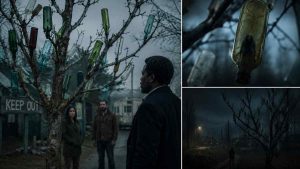
If you want to understand what that bottle symbol means inside the same mythological system, the FROM bottle symbol breakdown runs through the show’s broader sign language in detail.
Who Are the Children in FROM? What the Show Has Actually Told Us
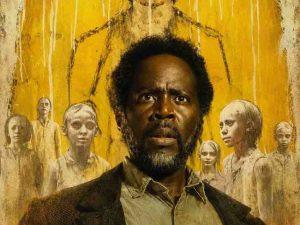
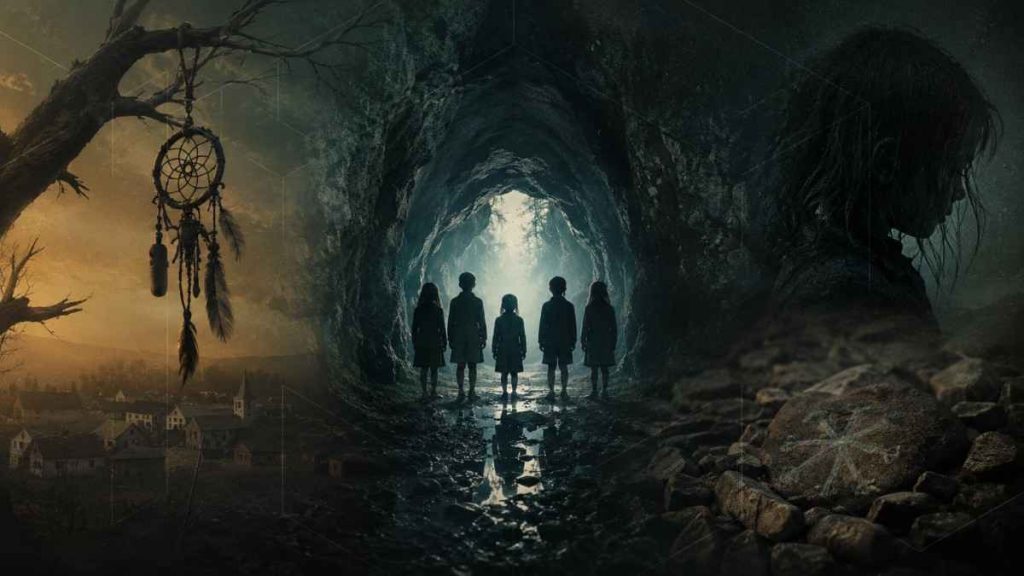
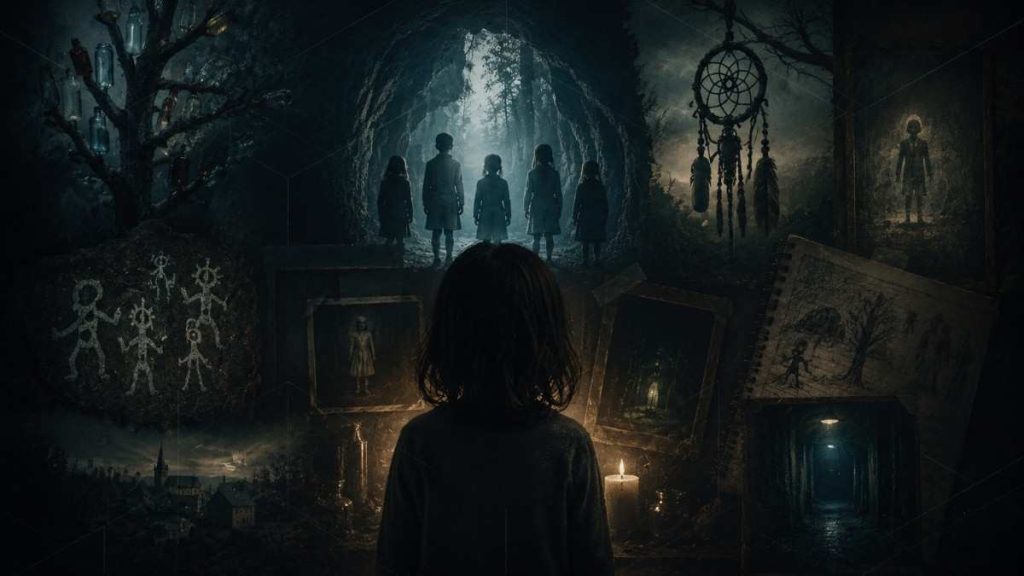
The children in FROM are not random background horror. They are the show’s most deliberate communication system, and the show has been careful about exactly how much it reveals about them.
Why Only Tabitha and Jade Can Hear Them
The children do not appear to everyone trapped in the town. They show up selectively, and the show has made it clear that Tabitha and Jade are their specific targets. The reason the show implies without stating outright is that both women have a connection to the town’s origin that runs deeper than their current visit. The past-life framework the show builds across Season 3 positions them as people who have been in this situation before, which makes them the only ones capable of receiving the message the children are trying to deliver.
The boy in white, who appears most consistently to Tabitha, is the clearest example of this. He is not threatening in the way the town’s creatures are threatening. He guides. He repeats. He waits.
The children’s behavior separates them from every other hostile or ambiguous entity in FROM. They do not attack. They do not trick. They communicate the same thing, over and over, until someone understands it. That patience is significant. Whatever they are, they are not operating on the same logic as the monsters.
What the show has not confirmed: the children’s identities, their nature as spirits or echoes or something else entirely, and whether they exist inside the town’s rules or outside them. The show has left all of that open on purpose.
What the Children Were Asking Tabitha and Jade to Do
“Remember” is a command, not a description. When the children say Anghkooey, they are not identifying themselves or narrating what is happening. They are asking Tabitha and Jade to do something specific: access memories from lives they lived in this town before the one they are currently living.
This is where the word becomes a mechanism rather than just a translation. The children are not saying “we remember.” They are saying “YOU remember.” The distinction is the entire point.
Tabitha and Jade are not observers of the town’s history. The show is building toward the idea that they are participants in it, that they have been here before, that something happened, and that the only way to change anything is for them to recover what they have already experienced and lost.
The implication woven through Season 3 is that remembering is the key to whatever cycle the town runs on. Whether that means breaking it, completing it, or something more complicated is still an open question. But the children are not asking anyone to be afraid. They are asking two specific people to wake up.
The Cave in FROM — What Happens There and Why It Matters
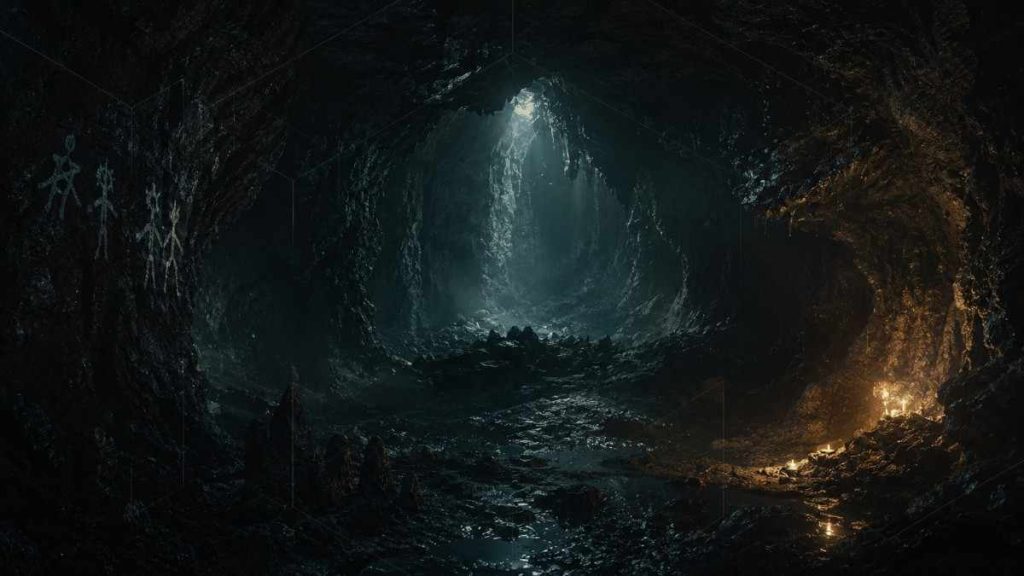
The cave is where the children want Tabitha to go. That is the simplest accurate statement about it, and the show has been deliberate about not saying much more than that on screen.
Across multiple episodes, the children direct Tabitha toward the cave rather than away from it. That directional consistency matters. In a show full of things designed to trap, confuse, or destroy the people caught in the town, the children are pointing at something they apparently want Tabitha to find. That makes the cave a destination, not a threat.
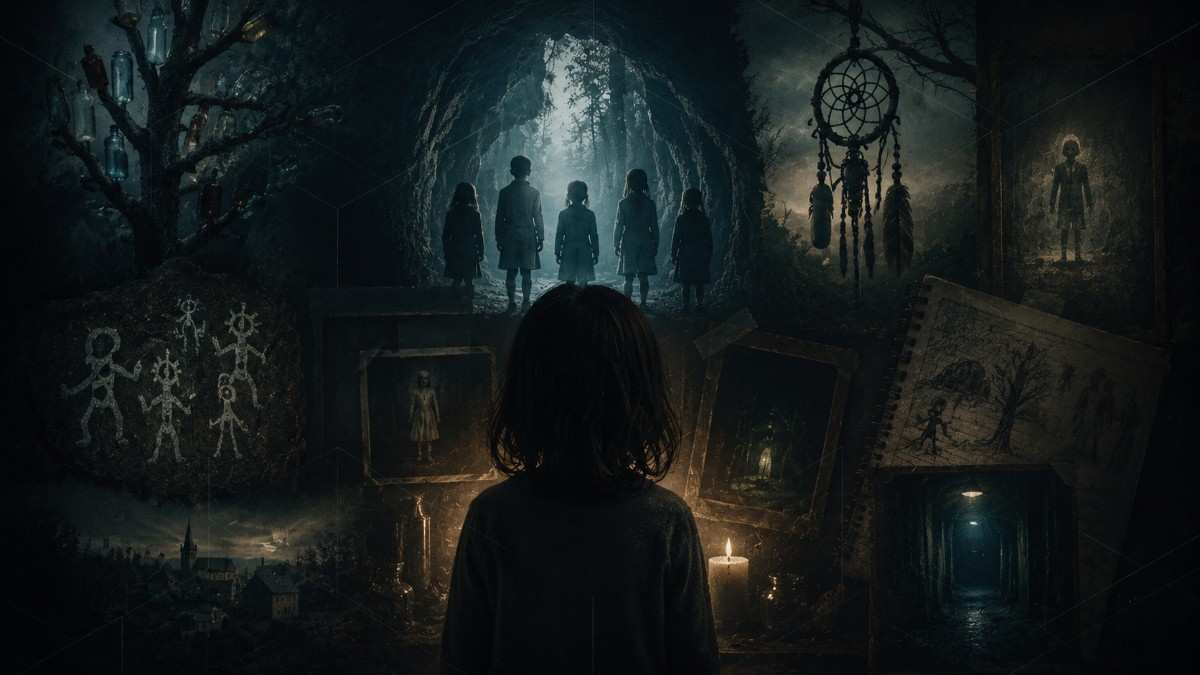
The visual language the show uses around the cave connects it to the same symbolic system running through the rest of FROM’s mythology. The markings, the structure, and the way light behaves inside it echo the sign systems used elsewhere, the talismans, the bottle trees, the colony house rituals. The cave is not sitting outside the mythology. It is embedded in it.
Fans following FROM lighthouse theories have drawn connections between multiple physical locations the show treats as significant, and the cave fits that pattern. Both locations seem to function as anchors for something older than the current group of trapped residents.
What the show has not confirmed: who built the cave, what originally happened inside it, and whether it is the same location glimpsed in various character visions across the series. The cave’s significance is established. Its history is not.
The Sacrifice Theory — What Reddit Got Right and What Is Still Guesswork
No existing breakdown of Anghkooey separates the fan theory components by confidence level. That gap is the whole problem with how this word gets discussed online. Everything gets treated as equally confirmed or equally speculative, which means nothing is actually useful.
The Core Theory and Where It Comes From
The dominant fan theory holds that the town was created through a sacrificial ritual, that the children were the original victims of that ritual, and that Tabitha and Jade are being guided toward either repeating or undoing it. The theory draws on the show’s visual language, the wicker-adjacent imagery, the tree symbolism, the way certain deaths in the show feel ceremonial rather than random.
Screen Rant’s fan theory analysis proposed that the boat symbol the show uses repeatedly represents a journey, and that “remember” is being used to tell Tabitha and Jade to recall a journey they completed in a past life. That theory is internally coherent and fits the available evidence. It is also completely unconfirmed.
The tree of death framework fans assembled from the show’s imagery connects the colony house rituals, the talismans, and the children into a single sacrificial logic. The argument is that every element viewers see is a remnant or echo of something that happened once, a long time ago, and has been repeating in degraded form ever since.
What the Season 3 Finale Actually Confirmed About the Sacrifice
The finale confirmed the word’s translation and reinforced the past-life framework for Tabitha and Jade. It deepened the case that both characters have history in the town that predates their current arrival. It showed the children as guides, not monsters, which the theory community had been arguing for two seasons.
What the finale did NOT confirm: who performed the original ritual, what it required, whether the children were its victims or its agents, and whether Tabitha and Jade’s past-life connection gives them any real power to change the outcome. The showrunners are clearly building toward a larger revelation. They have not delivered it yet.
The sacrifice theory is the best-supported fan framework available right now. It fits more of the evidence than any competing explanation. Fitting the evidence and being confirmed by the show are two different things, and FROM has earned enough trust to wait for the actual answer rather than assume the theory is complete.
Confirmed vs. Unconfirmed — A Full Breakdown
| Claim | Status | Source |
|---|---|---|
| Anghkooey translates to “remember” | Confirmed | FROM Season 3 finale |
| Anghkooey is not from any real-world language | Confirmed | MGM+ official social media |
| The children communicate specifically with Tabitha and Jade | Confirmed by on-screen events | FROM Seasons 2 and 3 |
| Tabitha and Jade have lived past lives in the town | Strongly implied, not explicitly stated | FROM Season 3 narrative framing |
| The cave is connected to the town’s origin ritual | Unconfirmed theory | Fan analysis |
| The children are the souls of the original sacrifice victims | Unconfirmed theory | Reddit and fan forums |
| “Remember” functions as a trigger for past-life recall | Supported by context, not stated outright | FROM Season 3 implications |
| The boat symbol and Anghkooey are connected | Unconfirmed theory | Screen Rant fan theory |
| The children can leave the town | Unconfirmed | Not addressed by the show |
| The ritual can be undone by Tabitha or Jade | Unconfirmed theory | Fan extrapolation |
What Anghkooey Changes About How You Watch FROM
Once you know Anghkooey means “remember,” every single scene with the children that came before it changes meaning retroactively. That is not a small thing.
Before the Season 3 confirmation, those scenes read as horror shorthand, creepy kids doing creepy things in a creepy town. After it, every one of those scenes is a scene about memory recovery. The children were never atmosphere. They were the most direct exposition the show has ever attempted, delivered in a form most viewers could not decode until the third season.
The show is not primarily about surviving the town. Surviving is what most of the cast is focused on, but that is not the show’s actual question. The actual question is whether anyone can remember enough of their own history to understand what the town fundamentally IS. The children are the mechanism for that project, and they have been running it the entire time.
This reframing reaches further than just the children. The Man in Yellow, the lighthouse, the colony house rituals, all of them potentially become part of the same memory-recovery architecture. If you want to understand where the Man in Yellow’s role in this system connects to the broader mythology, that piece runs through his role in the town’s power structure. The children and the Man in Yellow operate on opposite sides of whatever the town actually wants, and knowing that changes how every scene reads.
The viewers who caught onto this earliest, the ones who flagged the children as guides rather than threats from Season 2 onward, were not being overly charitable. They were reading the show correctly. The whispered word was never background noise.
FAQ — Anghkooey and the FROM Children
What does Anghkooey mean in FROM?
Anghkooey means “remember.” The FROM Season 3 finale confirmed this translation explicitly. The children use the word specifically when communicating with Tabitha and Jade, two characters the show connects to the town’s origin through past lives. The word functions as a command: the children are not describing something, they are asking Tabitha and Jade to actively access memories from previous lives they lived inside the town. The translation had been the subject of fan debate for over a year before the Season 3 confirmation settled it.
What language is Anghkooey from?
Anghkooey is not from any real-world language. MGM+ confirmed on official social media that the word is constructed specifically for FROM’s fictional mythology. It was invented for the show and has no equivalent in Korean, any other language, or any documented linguistic tradition. Fan theories connecting it to Korean terms or other languages are not supported by the showrunners, and the official confirmation of its constructed origin effectively closes those debates.
Who are the children that Tabitha keeps seeing in FROM?
The children are figures who appear selectively to Tabitha and Jade across Seasons 2 and 3. They do not appear to the general trapped population of the town. Their behavior is not hostile — they guide, warn, and repeat rather than attack. The show strongly implies they are connected to the town’s origin, but has not confirmed whether they are past victims, spirits, echoes of former residents, or something else entirely. The boy in white is the most prominent figure in this group and appears most consistently to Tabitha.
Is the sacrifice theory about the FROM children actually confirmed?
No. The theory that the children were victims of an original sacrificial ritual that created the town is fan-constructed from visual clues and narrative framing across the series. The Season 3 finale reinforced the past-life framework and confirmed the children as guides rather than threats, but it did not confirm who performed any original ritual, what it required, or whether the children were its victims or participants. The sacrifice theory fits the available evidence better than competing explanations — fitting the evidence is not the same as confirmation.
Why can only Tabitha and Jade hear the children in FROM?
The show implies that Tabitha and Jade have a specific connection to the town’s origin that the other trapped residents do not share. The past-life framework developed in Season 3 positions both women as people who have lived in the town before their current arrival, making them the only characters capable of receiving the children’s message. The children’s communication is not random — it is targeted. The show has not provided an explicit in-world explanation for the mechanism, but the selectivity is clearly intentional rather than arbitrary.
What does the cave have to do with Anghkooey and the children?
The children direct Tabitha toward the cave across multiple episodes, making it a deliberate destination rather than an incidental location. The cave appears to be physically connected to the town’s origin mythology, potentially the site of the original ritual or event that created the trap the town represents. The show uses visual language around the cave — markings, structure, light — that echoes the same symbol system running through the rest of FROM’s mythology. What happened there originally, who built it, and what Tabitha is supposed to do when she arrives has not been confirmed.
What is the most common objection to reading Anghkooey as a past-life trigger?
The most common pushback is that FROM is vague enough that almost any reading can be made to fit, and that treating “remember” as a past-life trigger specifically is a fan interpretation built on top of an already-fan-interpreted show. That objection has merit. The past-life framing is supported by Season 3’s narrative choices rather than any explicit statement from the show or showrunners. Viewers who want a confirmed mechanism will not find one yet. What they will find is a pattern of evidence strong enough that the past-life reading is the most coherent available explanation, not a random guess.
FROM has always been a show that gives you the pieces before it gives you the picture. The children whispering Anghkooey were never decorative horror, they were the closest the show has come to explaining itself directly, wrapped in a word that took three seasons to translate.
Now that “remember” is confirmed, the more pressing question is what Tabitha and Jade are supposed to do with that instruction. Memory is only useful if it leads somewhere actionable. Whether it leads to escape, to sacrifice, or to something the show has not named yet is still genuinely open, and FROM has earned enough goodwill to sit with that uncertainty rather than demand a resolution.
What you can do right now is watch the children’s scenes again from Season 2 onward with the translation in hand. They read completely differently. The show has been telling you what it is about for longer than most viewers realized and the children were always the ones doing the telling.