What Is the Significance of the Bottle Trees in FROM? The Folklore Behind the Show’s Creepiest Detail
TL;DR
- Bottle trees are a real folk tradition with roots in West and Central African spiritual practice, not something invented for the show
- The tradition holds that glass bottles hung on trees trap evil spirits at night, drawn in by reflected light and destroyed by morning sun
- Blue glass is the most protective color in the tradition because it represents the boundary between the living world and the spirit world in Kongo cosmology
- Victor’s mother Miranda built the bottle trees in the township deliberately, which means someone in the town’s history understood what the place was and tried to fight back
- The Farway Tree is built as a bottle tree, and in folk tradition, bottle trees are placed at thresholds between worlds
- The numbers on the papers inside the bottles correspond to specific locations, which maps directly onto the tradition’s logic of targeted, intentional containment
Most viewers clock the bottle trees in FROM the same way they clock the fog or the locked doors. Creepy background detail. Atmospheric. Probably meaningless. They register it as set decoration chosen because it looks unsettling, and then they move on.
That instinct is completely wrong, and it changes how the show reads once you correct it.
Bottle trees are a documented, centuries-old protective tradition rooted in West and Central African spiritual belief. They were not invented for television. They were not chosen for FROM because they look spooky in a field. They were chosen because the people making this show understood what bottle trees actually do in the tradition they come from, and the show has been quietly using that operating logic to tell you something specific about what the township is and how it can be fought.
What most viewers miss is that Victor’s mother Miranda was not just grieving or eccentric. She was practicing something. And the thing she was practicing has a documented history, a specific cosmology, and a set of rules that map directly onto what the bottle trees in FROM are shown doing.
This piece covers where the bottle tree tradition actually comes from, how it was believed to work, and why the specific details the show has given us about the township’s trees are not coincidences. By the end, you will have a framework for what the show is building toward that the surface-level lore recaps completely miss.
What Are Bottle Trees, and Are They a Real Thing?
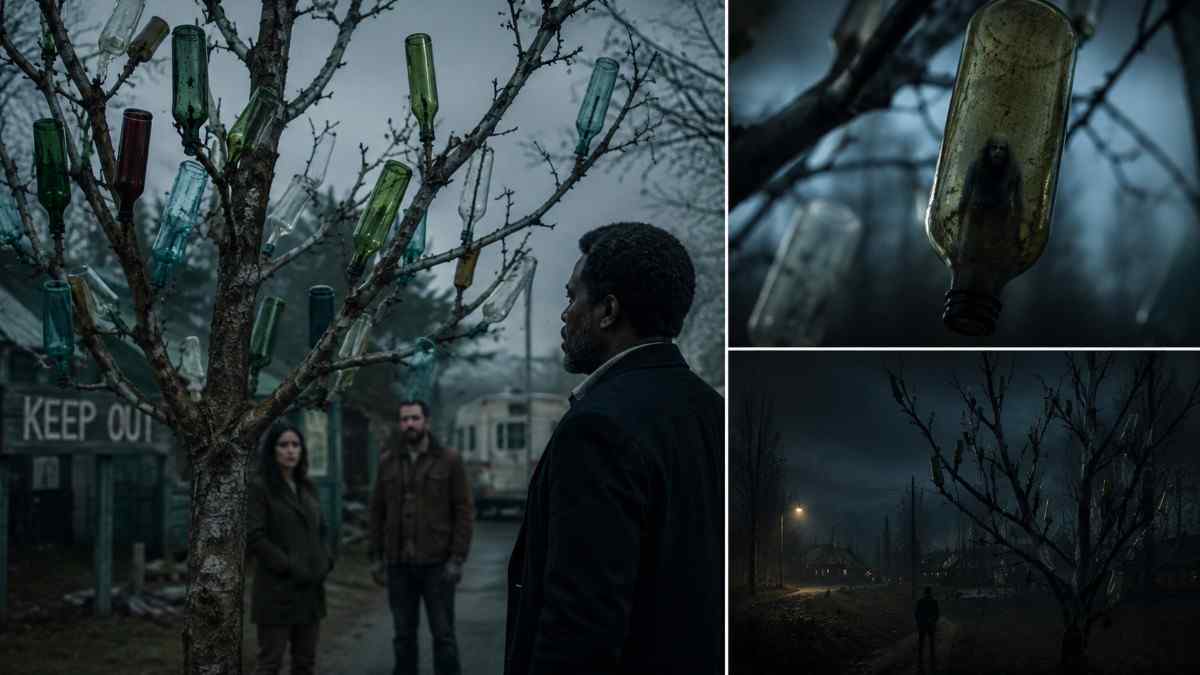
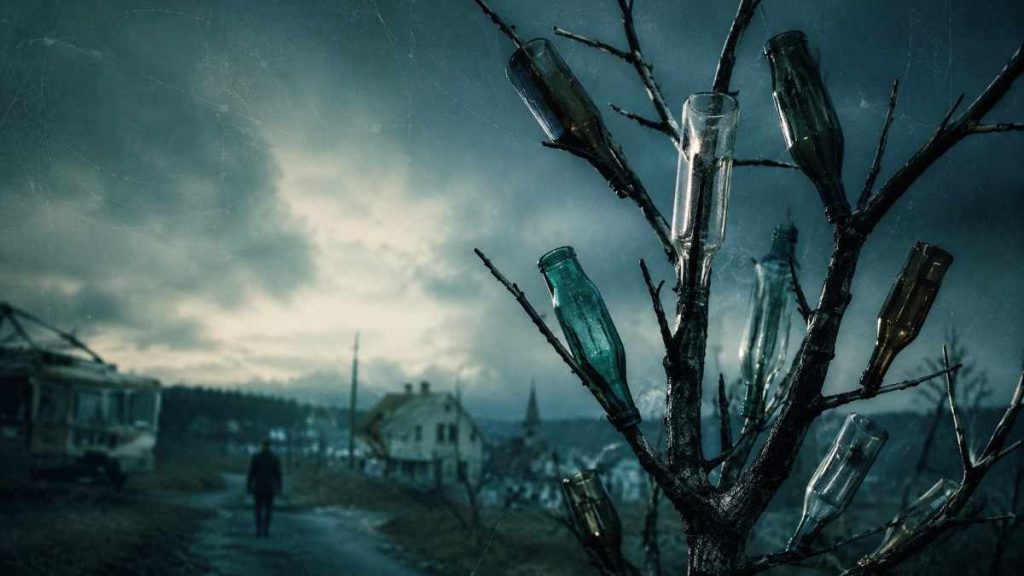
Yes, bottle trees are completely real. A bottle tree is exactly what it sounds like: a tree, traditionally bare-branched or dead, hung with glass bottles to ward off or trap evil spirits. The practice is documented across the American South, particularly in South Carolina, Georgia, Mississippi, and Louisiana, and it is still actively practiced today. The Smithsonian Gardens has documented the tradition as part of American folk art history, and you can find examples in public and private gardens throughout the Southeast.
The key detail that gets lost when people think of them as folk art is that they were not originally decorative objects. They were functional within a specific belief system, built to do a specific job. The aesthetic came second. The purpose came first.
Where Did the Bottle Tree Tradition Actually Come From?
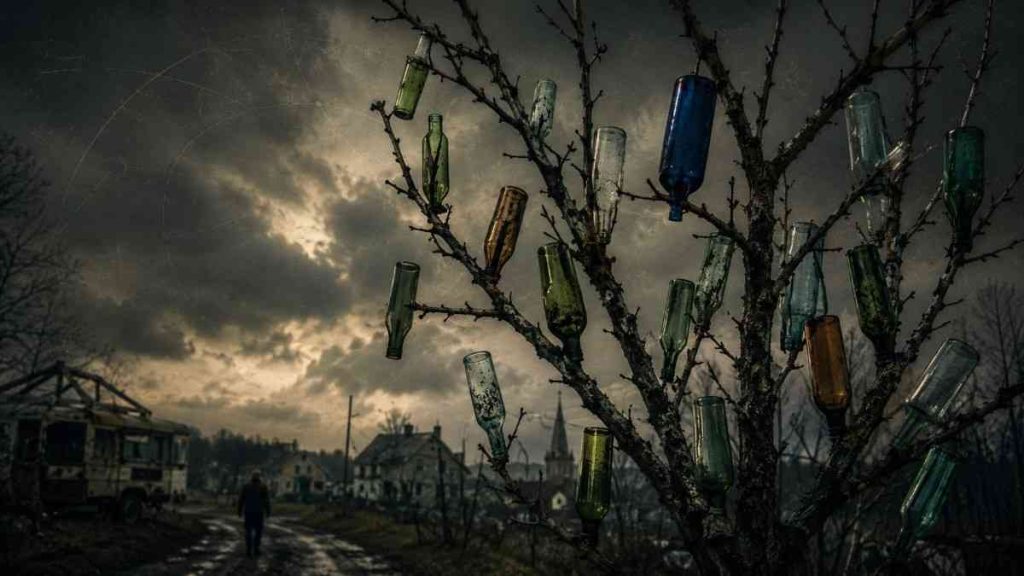
The bottle tree tradition traces its deepest roots to West and Central Africa. It arrived in the American South through the forced migration of enslaved people, and it carried its original spiritual logic largely intact before blending with other folk traditions over generations.
The Kongo Connection
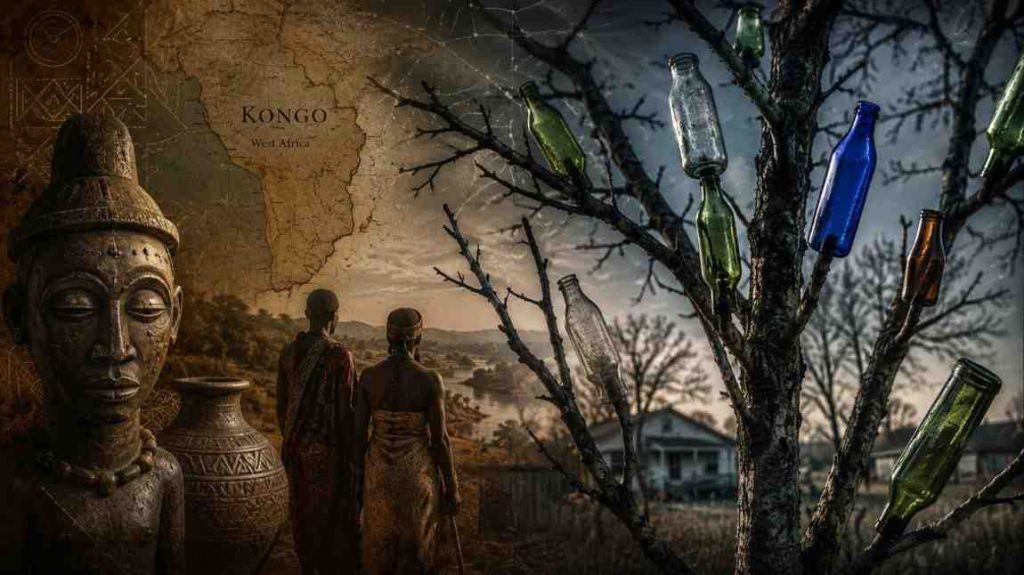
The most direct origin of the Southern bottle tree tradition is the BaKongo people of Central Africa, whose descendants lived across what is now the Democratic Republic of Congo and neighboring regions. Kongo spiritual cosmology is organized around a symbol called the cosmogram, a circular diagram representing the cycle between the living world and the spirit world, divided at its center by water or a reflective surface.
In Kongo belief, water and reflective surfaces mark the boundary between the living and the dead. Spirits exist in a mirror world on the other side of that boundary. Glass, which reflects and distorts light, acts as a threshold, a material that sits at the edge of both worlds simultaneously.
This is why glass objects, including bottles, were used in BaKongo spiritual practice to attract, contain, and neutralize spirits. A bottle was not a metaphor for containment. It was literal containment technology within the belief system. Researchers trace versions of this practice back at least 700 years in its African form, with some scholars noting similar spirit-bottle traditions in the Arabian Peninsula going back further still.
How Enslaved People Carried the Tradition to the American South
Enslaved Africans transported from the Congo Basin to the American South brought the cosmological framework with them. By the 18th and 19th centuries, bottle trees were appearing in Southern states, with the highest concentration in the Lowcountry regions of South Carolina and Georgia. Those regions had large populations of people taken specifically from Central and West Africa, which is why the tradition is most strongly documented there.
Over time, the practice blended with other African American spiritual traditions, including hoodoo, and eventually spread more broadly into Southern folk culture, adopted by both Black and white Southerners. That spread often came with the original cosmological meaning stripped away. The trees became “folk art” or “Southern quirk” rather than active spiritual practice for many people who inherited the tradition.
The blue glass preference survived that dilution, though. In Kongo cosmology, blue and indigo represent the spirit world boundary. Blue glass bottles are considered most effective at attracting and holding spirits precisely because the color signals to a spirit that it has reached the threshold between worlds. That specific detail is not a regional aesthetic preference. It is a theological one.
How the Tradition Actually Works (The Mechanics Matter for Understanding FROM)
The operating logic of bottle trees is where this tradition connects directly to what FROM is doing, and it is the part that most folklore summaries skip over. Understanding the mechanics is not optional if you want to understand why the show’s specific details matter.
Here is how the tradition holds that bottle trees work:
- Spirits are drawn to bright, reflective, or shiny objects, particularly at night when the veil between worlds is considered thinner
- A spirit moving through an area is attracted to the light caught in a glass bottle
- Once the spirit enters the bottle through its opening, it becomes trapped inside
- When morning sunlight hits the bottle, the spirit inside is destroyed, or in some regional variations, held in permanent imprisonment
- The narrow neck of the bottle prevents escape once the spirit has entered
The placement logic matters enormously. Bottle trees work as perimeter defense, not as single-point protection. You place them between your home and the direction from which threats can approach. You place them at thresholds, at entry points, at the boundaries of the space you are protecting. A single bottle tree in the middle of a field does much less than a bottle tree standing at the edge of your property facing the dark.
The number and arrangement of bottles matters in some regional traditions as well. More bottles create more traps. Specific placement corresponds to specific threat directions. The practice is intentional and spatial, not random.
How Bottle Trees Appear in FROM — What the Show Actually Shows
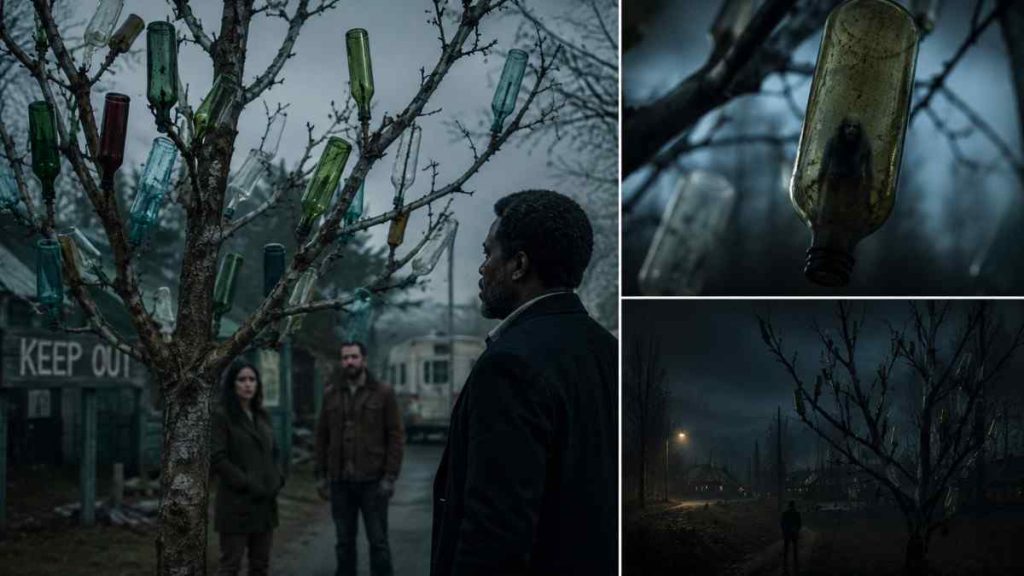
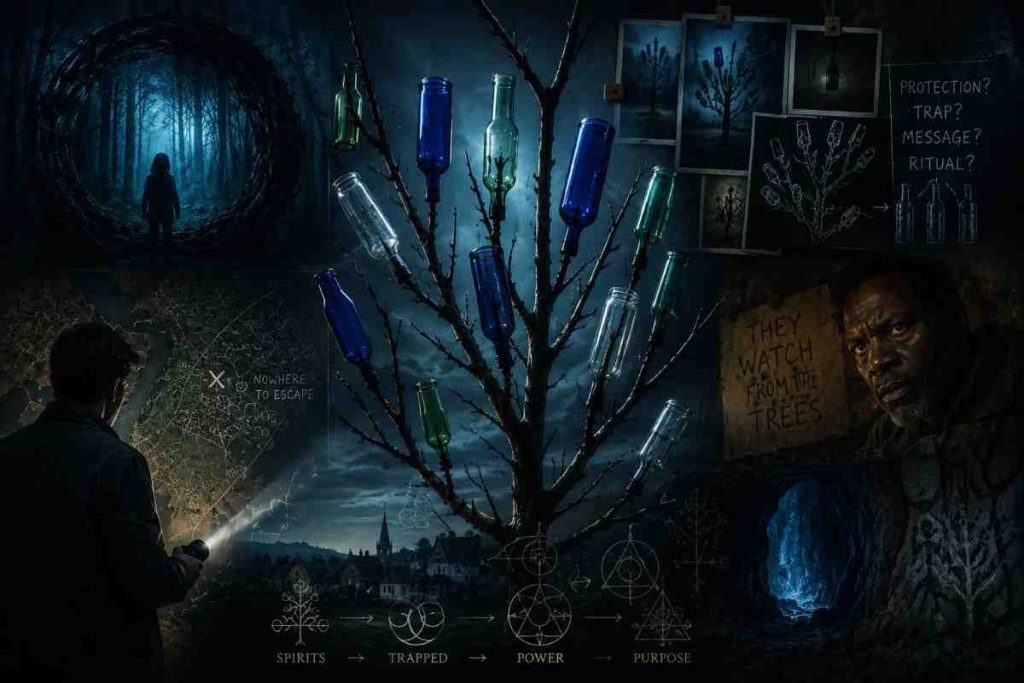
The show establishes at minimum two bottle trees within the township, and both were built by Victor’s mother, Miranda. She constructed them before the main timeline of the show, which is the detail that changes everything. Someone in the township’s history did not stumble onto bottle trees as decoration. A specific woman with a specific name deliberately built them in a specific tradition that has a documented purpose: to trap and contain malevolent entities that cross between worlds.
One of the trees in FROM is a Farway Tree. In the show’s logic, Farway Trees function as portals connecting different locations within or connected to the township, with one known example leading to the Lighthouse. The show placed a portal INSIDE a structure that, in real-world folk tradition, is specifically designed to trap entities that travel between worlds. That is not a set decoration choice. That is a writers’ room choice with theological implications.
Season 3 added the detail that cannot be ignored: papers inside the bottles contain numbers, and those numbers correspond to specific locations. Fan analysis of what the show has confirmed points to the bottles functioning as addresses or coordinates, where entering a Farway Tree while holding or referencing a specific number takes you to the corresponding location. Miranda was not just building protection. She was building a navigation system INSIDE that protection, a way to direct movement through controlled thresholds rather than leaving them open to whatever the township contains.
This is consistent with everything the folklore actually prescribes. Bottle trees are most effective when placed by someone who understands the nature of the threat. They are not generic warding. They are specific to the kind of entity that travels, that can be attracted, and that can be contained. Miranda built exactly what someone with knowledge of that tradition would build.
What Does This Tell Us About the Town in FROM?
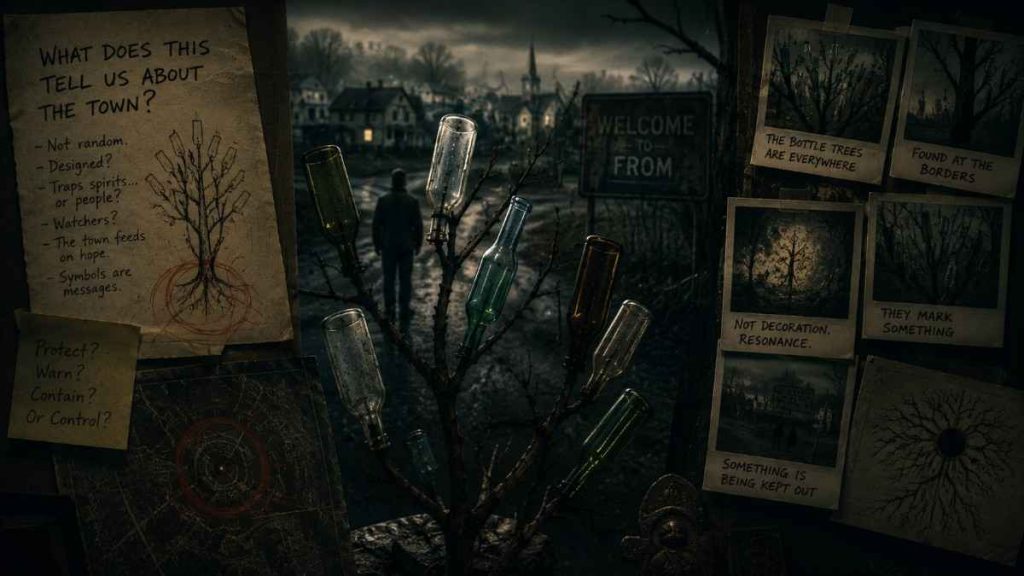
Miranda was not a passive victim who happened to like folk art. She was doing something active and informed, and the thing she was doing has a centuries-long tradition behind it specifically designed for situations involving malevolent entities crossing between worlds.
Two things follow from that.
The first is about what the township’s creatures actually are within the show’s logic. Bottle trees work on spirits that can be attracted and lured. The tradition is not built for random, uncontrollable chaos. It is built for entities that follow rules, that respond to specific stimuli, that can be directed. If Miranda chose bottle trees as her defense, she was operating from a framework that said the things in this town are the kind of things that can be caught. That is a meaningful constraint on what the show’s monsters are and how they function.
The second is about the Farway Tree specifically. In folk tradition, you place a bottle tree at a threshold because that is where a traveling spirit is most vulnerable. It is between places, neither fully in the world it came from nor in the world it is entering. Miranda built her most significant bottle tree AT the threshold. She understood where the point of leverage was. You can find more about what the township itself might be in what is the town in FROM, but the bottle tree placement is the most direct evidence the show has given us that the town has a knowable structure and not just chaos with a monster budget.
The numbers extend this further. Original Kongo practice is spatial and intentional. You do not scatter protection randomly. You place it with purpose. Each bottle corresponding to a specific location maps perfectly onto that logic, targeted containment rather than broad warding, a system built by someone who thought carefully about what each threshold needed.
The show is not using folk tradition as atmosphere. It is using the tradition’s internal logic to argue that the township operates by rules, that those rules are ancient enough to have been recognized and documented in human history, and that someone has been fighting back against the town using that knowledge for much longer than the current survivors have been there.
Why Blue Glass and Why Does It Keep Appearing in the Show?
The blue bottles in FROM are not an aesthetic preference. Blue glass is the most theologically specific detail in the entire bottle tree tradition. In Kongo cosmology, blue and indigo represent the boundary between the living world and the spirit world, the color of the water that divides them in the cosmogram. When you hang blue bottles on a tree, you are communicating something to any spirit that approaches: you have reached the boundary. This is as far as you go.
FROM uses predominantly blue bottles on its trees, consistent with the tradition’s most protective configuration. Whether that came from a writers’ room discussion of Kongo cosmology or a production designer who did their research, the result is accurate to the tradition in the detail that matters most.
Blue bottles do not just look like the most dangerous color. In the belief system the show is drawing from, they ARE the most dangerous color for a spirit to encounter. They are the color that marks the limit of permissible territory.
What Does This Mean for FROM’s Bigger Mystery?
If Miranda built the bottle trees with real knowledge of what they do, two questions sit at the center of Season 3 and beyond. Where did she get that knowledge? And did it work?
The Farway Tree is functional, which in the show’s logic means something is moving through it. Whether that represents the tradition working correctly, with movement being directed and contained through intentional thresholds, or represents the township itself exploiting the structure Miranda built, is exactly the tension the show is building toward. The answer to that question will say a great deal about whether Miranda was winning or whether she was outmaneuvered. For a show that keeps seeding questions about whether the Man in Yellow in FROM represents protection or threat, Miranda’s bottle trees sit in the same ambiguous territory.
The broader point the show is making with this choice is worth sitting with. FROM is rooting its mythology in real, documented human attempts to understand and resist forces that feel completely beyond comprehension. The bottle tree tradition was developed by real people who looked at something terrifying and said: we can figure out the rules. We can build something that fights back. Miranda said the same thing. The show’s bet is that she was right, and that the rules of the township are not arbitrary but are grounded in something old enough that a grieving woman in a nightmare town could reach back and find them.
That is not a comforting thought exactly, but it is a more hopeful one than the alternative. The town is not chaos. It has a system. And somewhere in the bottles, the numbers, and the blue glass, someone left a map.
Frequently Asked Questions
What are the bottle trees in FROM?
The bottle trees in FROM are trees hung with glass bottles that were built by Victor’s mother, Miranda, inside the township. The show establishes that they are connected to a real folk tradition, specifically the Southern and West African practice of hanging bottles on trees to trap or repel evil spirits. In FROM’s version of this tradition, at least one of the bottle trees is also a Farway Tree, a portal that connects different locations within or near the township. The numbers on papers inside the bottles correspond to specific destinations.
Who made the bottle trees in FROM?
Miranda, Victor’s mother, built the bottle trees in the township. She constructed them before the main timeline of the show, meaning someone in the town’s history had knowledge of what the township was and actively tried to use a centuries-old protective tradition against it. The show also connects Miranda to a hometown called Camden, suggesting she may have had prior knowledge of bottle tree folklore before the town took her.
Are bottle trees a real Southern tradition?
Yes, bottle trees are a genuine, documented folk tradition in the American South. The practice traces back to the BaKongo people of Central Africa and was brought to the American South by enslaved Africans, particularly to the Lowcountry regions of South Carolina and Georgia. The Smithsonian Gardens has documented the tradition, and examples can still be found across the Southeast today. They were built to trap evil spirits drawn in by reflected light and to destroy them with morning sunlight.
What do the numbers on the bottles in FROM mean?
The numbers on papers inside the FROM bottle trees appear to function as addresses or coordinates corresponding to specific locations within or connected to the township. The show’s Season 3 established this detail, and fan analysis points to the numbers being used to direct travel through the Farway Tree: entering the tree while referencing a specific number takes you to the corresponding location. This maps onto the real folk tradition’s logic of intentional, targeted placement rather than general warding.
Why are bottle trees associated with blue glass?
Blue glass is the most theologically specific element of the bottle tree tradition. In Kongo cosmology, blue and indigo represent the boundary between the living world and the spirit world, specifically the color of the water that divides them in the Kongo cosmogram. Hanging blue bottles on a tree signals to an approaching spirit that it has reached the limit of its permissible territory. Blue glass is not a regional aesthetic preference. It is a functional choice within the belief system, considered the most effective color for attracting and trapping entities that cross between worlds.
What is the Kongo cosmogram and why does it matter for FROM?
The Kongo cosmogram is a circular symbol used in BaKongo spiritual practice representing the cycle between the living world and the spirit world, divided at its center by water. Reflective surfaces, including glass, represent that boundary in the cosmological framework. This is the theological foundation for why bottles attract spirits in the tradition. FROM’s bottle trees borrow directly from this logic: the township contains entities that cross between worlds, and the bottles are placed at thresholds specifically to catch them at the moment of crossing.
Is there any evidence in FROM that the bottle trees actually work?
The Farway Tree is functional as a portal, which cuts both ways. It could mean Miranda’s construction succeeded in creating a controlled threshold, directing movement through an intentional point rather than leaving the boundary open and undefended. It could also mean the township exploited the structure she built for its own purposes. The show has not resolved this, but the fact that the numbers inside the bottles produce specific results suggests the system Miranda built has some operative logic, whether that logic is working in the survivors’ favor is the open question the show is building toward.
The single most important thing to take away from FROM’s bottle trees is that someone in that township’s past was not confused or helpless. Miranda looked at something ancient and horrifying and reached back into a tradition specifically built for that kind of horror. The bottle tree tradition was developed over centuries by people who believed that even the most terrifying spiritual threats operated by rules, and that those rules could be learned and used.
Watch the show with that in mind. Every time a bottle tree appears in the frame, it is not set decoration reminding you that things are strange. It is the show reminding you that the town has a structure, that structure has been partially decoded before, and that the path forward probably runs through understanding what Miranda understood.
The Farway Tree numbers are the detail to keep tracking. If the show honors the logic it has set up, those numbers are not random. They are a map left by someone who had already started figuring the township out, left behind for whoever came next and was paying close enough attention to find it.