What FROM Is and Why the Timeline Is So Hard to Track
FROM follows a rotating ensemble of characters who are all trapped in the same anonymous small town with no way out. New people arrive by accident, nobody leaves by choice, and every night the monsters come. The show’s mystery is structural. Each season reveals something that reframes everything you thought you understood about the seasons before it.
The timeline is hard to track for three specific reasons.
The Town runs on its own internal clock. Characters count days and nights, not dates. There are no timestamps. Fan communities on Reddit and the official FROM wiki have calculated the in-universe elapsed time at roughly three to four weeks across all three completed seasons, which feels impossibly compressed given everything that happens.
Episodes do not always follow consecutive in-universe days. Some episodes run parallel storylines happening on the same night from different characters’ perspectives. Others jump forward by a day or two without announcement. Watching weekly makes this feel natural. Returning after a long break makes it feel like a puzzle with half the pieces missing.
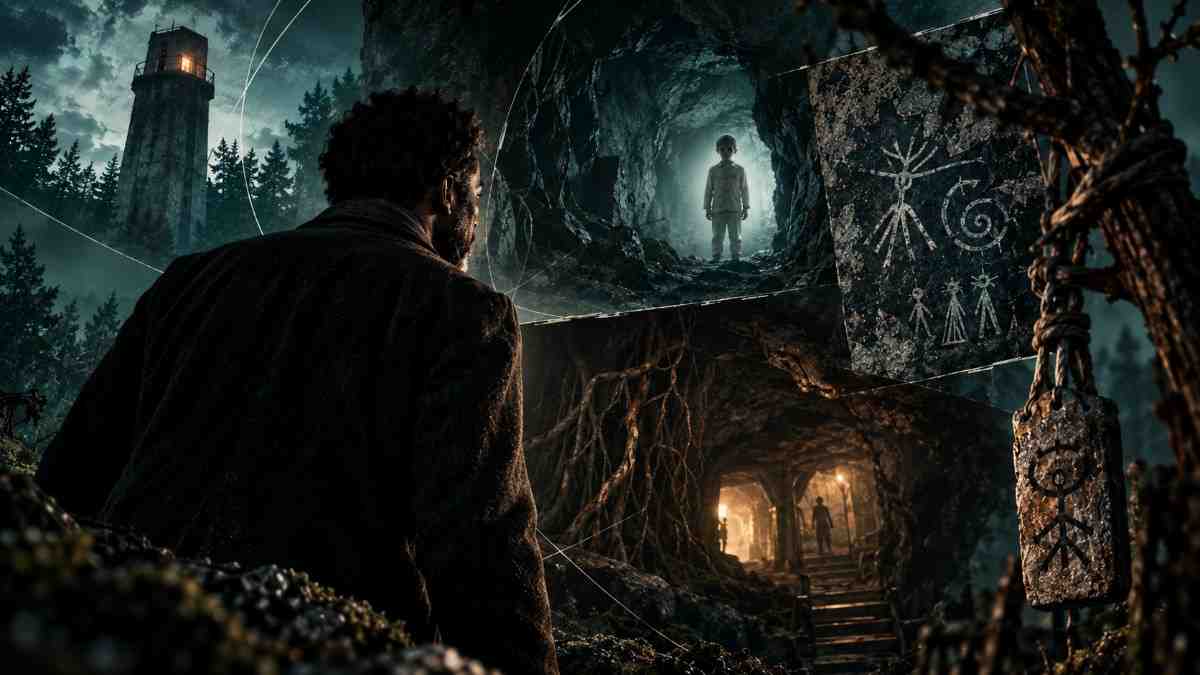
Victor, the Town’s longest-surviving resident, arrived as a child and has been there for decades. His history predates every other living character by so much that the show is effectively running two timelines simultaneously: the short, intense timeline of the Matthews family and the long, opaque timeline of everything that happened before they arrived. His presence is the show’s reminder that the mystery is generational.
This guide uses broadcast episode order because that is how the show was designed to be experienced. The mystery is built in reveal order, not chronological in-universe order. Reading it this way shows you the architecture.
Season 1 Timeline: Night 1 Through the First Crisis
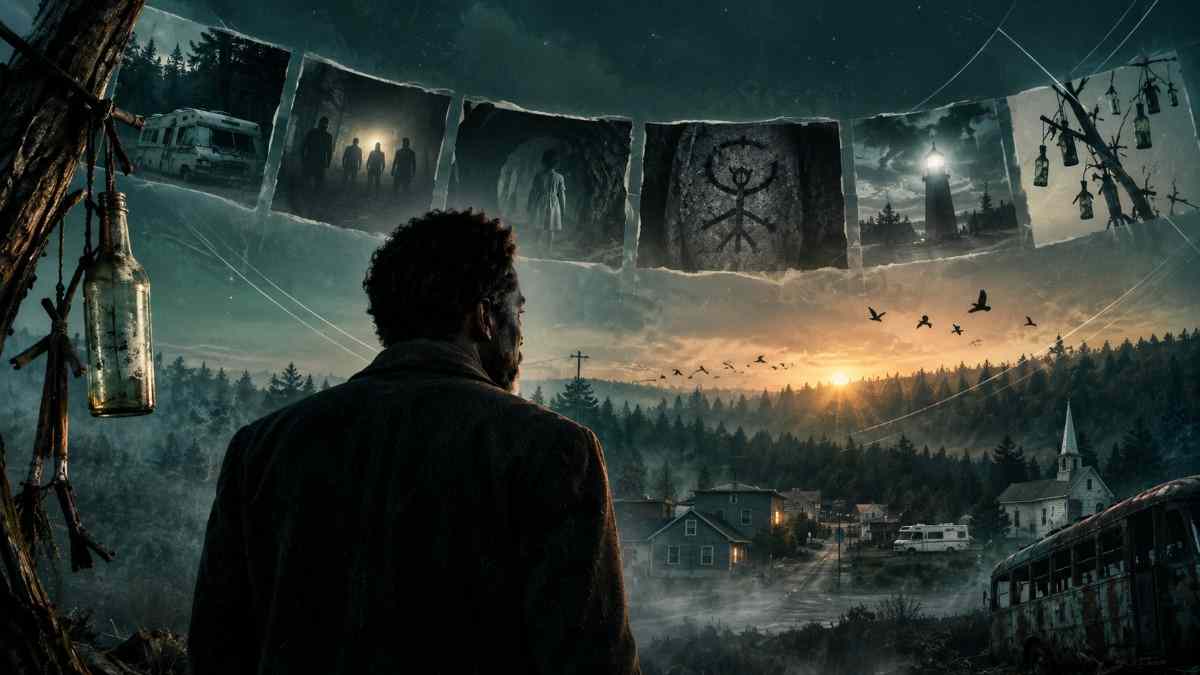
Season 1 runs ten episodes and covers the first days after the Matthews family’s arrival. It establishes every foundational rule the show builds on and closes with multiple simultaneous crises that make Season 2 feel inevitable.
S1E1 — “Pilot” (The Matthews Family Arrives)
The Matthews family, including Jim, Tabitha, their teenage son Ethan, and their daughter Julie, takes a wrong turn on a rural road and finds themselves in a small town they cannot navigate out of. They are quickly absorbed into the existing community of residents living in Colony House and surrounding farmhouses. Boyd Stevens runs the community with the kind of authority that comes from surviving long enough to know the rules.
The monsters appear at nightfall. They look like people. They are not people. The talismans hanging on every door and window frame are the only thing keeping residents alive.
What we learned: The Town traps people, something comes at night, and the people already living there have built an entire survival infrastructure around a threat they cannot explain.
S1E2 — “The Way Things Are Now” (The Cost of One Night)
The community buries the people killed during the pilot’s night attack. The Matthews family begins processing that this is not a nightmare they will wake from. Boyd moves through the grief with practiced efficiency because he has done this before and will do it again.
The monster behavior follows patterns. They test boundaries. They probe for weaknesses. The talisman protection holds, and that consistency is the first hard rule the show establishes: the talismans work, even if nobody knows why.
What we learned: The talisman system is the difference between life and death, but it is not fully understood by anyone currently living in the Town.
S1E3 — “Choosing to Stay” (Sara’s Warning)
Sara, a young woman already living in Colony House, begins behaving erratically and claims she is hearing voices that give her instructions. The community does not know what to do with her. Jade, a tech entrepreneur who arrived with the Matthews family, starts cataloguing strange symbols carved and painted throughout the Town.
Sara’s voices are introduced as something distinct from the monsters. The show sets them up as a separate signal, a different frequency running through the Town’s operating system.
What we learned: The Town communicates with certain people directly. It is not yet clear whether Sara is being guided or being used.
S1E4 — “It Isn’t Real” (The Road That Loops)
Jim and Boyd drive out of Town along the main road, going as far as they can before the geography resets and they find themselves back where they started. The road loops. No matter how far you go, you end back in the Town.
This is the first hard geographic rule the show confirms on screen. The boundary is not a fence or a wall. It is a spatial impossibility built into the landscape itself.
What we learned: The Town’s borders are not physical in any conventional sense. Escape requires something other than distance.
S1E5 — “Tow Truck” (Victor’s Past Surfaces)
Victor, the Town’s longest-surviving adult resident, starts sharing fragments of what he has witnessed over his decades there. He arrived as a child. He has been here long enough to watch multiple groups of survivors arrive, struggle, and mostly die. His survival strategy is not heroism. It is pattern recognition accumulated over a very long time.
Victor’s drawings of symbols around Town match exactly what Jade has been cataloguing. This establishes that the symbolic language scattered throughout the Town predates every current resident. Someone was writing these symbols before anyone alive today arrived. For more on the figure Victor keeps drawing obsessively, the Man in Yellow in FROM has been a central piece of the mythology since this episode.
What we learned: The symbols are not graffiti or random markings. They form a consistent language that someone, or something, has been maintaining for generations.
S1E6 — “Book 74” (The Journals)
The community finds a collection of journals left by previous Town residents. These records span what appear to be multiple generations of trapped groups. They document the same survival rules, the same failed escape attempts, and the same baffling observations about Town behavior, all reaching the same dead ends.
The number 74 in the title is not decorative. It implies this is the seventy-fourth book in a continuing record. The Matthews family is not the latest exception to some unusual circumstance. They are the latest iteration of a very old trap.
What we learned: People have been arriving in and dying in the Town for generations. The cycle is older than anyone currently alive there.
S1E7 — “Love Your Neighbour” (Colony House Fractures)
The social pressure inside Colony House breaks into open conflict. A resident is killed not by the monsters but by another person. This is the show shifting the threat taxonomy. The Town does not need the monsters to destroy communities from within. Human desperation handles that.
The monsters, meanwhile, show behavioral adaptation. They test different entry points and different approaches when standard tactics are blocked. They are not mindless.
What we learned: The Town breaks people from the inside as efficiently as the creatures break them from the outside. Survival requires holding both threats simultaneously.
S1E8 — “Fixing Barb” (Medical Crisis)
Kristi, the community’s closest thing to a doctor, manages a critical medical situation with supplies that were never meant to sustain long-term care for a whole community. The episode functions as a stress test of the survival infrastructure Boyd has built, and the infrastructure barely passes.
A new creature behavior appears here. The monsters can mimic human voices accurately enough to lure residents outside after dark. This is a significant escalation of their threat profile. They are not just physically dangerous. They can manipulate.
What we learned: The monsters use cognitive traps, not just physical force. Survival requires mental discipline, not just locked doors.
S1E9 — “The Way Back” (Boyd Goes Past the Trees)
Boyd pushes past the tree line at the edge of Town, further than any current resident has confirmed going before. What is beyond the trees is not more forest or open countryside. The spatial logic breaks down in ways the show deliberately refuses to explain cleanly.
The Town does not exist in normal geography. Whatever boundary the trees represent, crossing it leads somewhere that operates by different rules entirely.
What we learned: The Town may not be a location on any map. Its edges suggest something dimensional rather than geographical.
S1E10 — “Oh, the Places We’ll Go” (Season 1 Finale: The Infection Begins)
Boyd returns from beyond the tree line carrying a parasite. A worm-like organism under his skin, visible and moving. This is the show’s first evidence that the Town’s rules extend into the human body, not just the surrounding environment.
Sara shoots Jim in the episode’s final act. The shooting is not random. The show frames it as directed. The season ends with Boyd infected, Jim’s survival unknown, and Sara’s motivations still locked away.
What we learned: Going past the Town’s boundaries carries a physical cost. And Sara may not be making her own decisions.
For the specific question of whether Jim survives the shooting, the full breakdown of whether Jim dies in FROM covers what the show reveals across subsequent seasons.
Season 1 Overall: What the Town Revealed Before Season 2
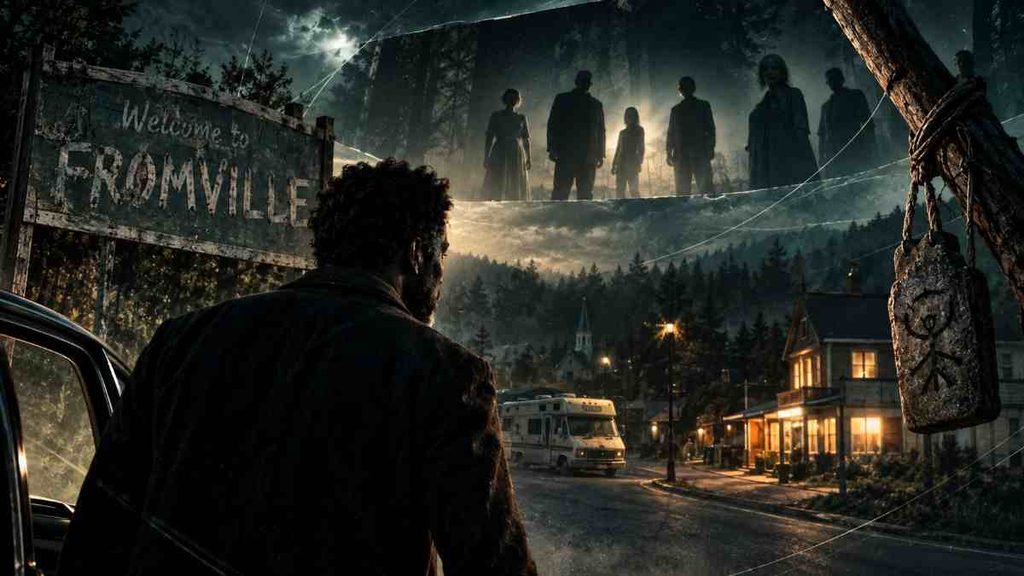
Season 1 closes with four confirmed rules and two major open questions.
The four confirmed rules:
- Talismans protect against the creatures, and the protection is reliable even if the mechanism is unknown
- The road loops and conventional geography cannot be used to escape
- The tree line leads somewhere that is not normal space
- The Town contains a symbolic written language that predates every living resident
The two open questions carried into Season 2:
- What exactly did Boyd bring back with him, and what does it want?
- Who or what is directing Sara, and why did it want Jim shot?
By the end of Season 1, Donna has been in the Town for roughly two years, making her one of the longer-serving survivors among the main cast. Victor has been there for decades. The gap between those two experiences is part of what makes Victor’s perspective so valuable and so unsettling. He has watched cycles of newcomers arrive, and he knows how most of them end.
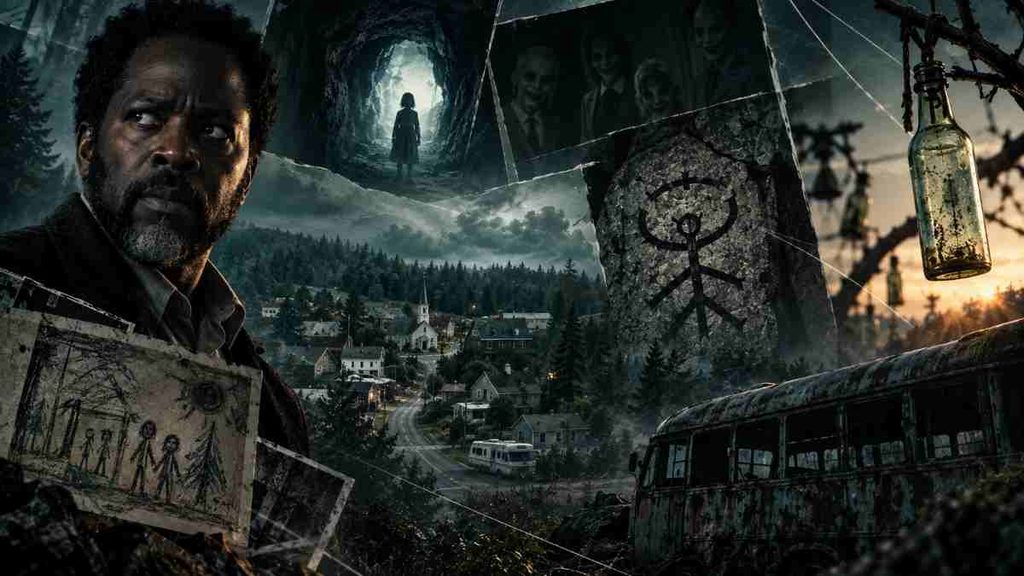
Season 2 Timeline: The Tower, the Infection, and the Boy in White
Season 2 runs ten episodes and is where the mythology machinery accelerates. The show stops introducing rules and starts showing how the rules interact. The boy in white appears. The tower matters. Boyd’s infection becomes a narrative engine.
S2E1 — “Strangers in a Strange Land” (New Arrivals, New Questions)
New residents arrive in Town, as they always do, seemingly by accident and without warning. Boyd’s worm infection continues to develop. Tabitha begins experiencing visions that operate on a different register than anything the community has encountered before.
Tabitha’s visions show a lighthouse and a boy dressed in white. These images are not connected to the symbol system Jade has been mapping. They appear to be a separate communication channel, a different layer of the Town’s operating architecture running in parallel.
What we learned: The Town may be using more than one method to communicate with residents. Different people receive different signals.
S2E2 — “Blood Ties” (The Worm Gets Worse)
Boyd’s infection deteriorates visibly and rapidly. The worm is not just a parasite behaving like a parasite. It responds to specific stimuli. It shows behavioral patterns that suggest something intentional about its presence in his body.
Kenny steps into a larger leadership role as Boyd becomes less reliable. The community’s dependency on a single authority figure is shown to be a structural weakness.
What we learned: Boyd did not simply bring back a physical illness from beyond the tree line. He may have brought back something that was placed there deliberately.
S2E3 — “Tether” (Sara Returns)
Sara is reintegrated into the community after the events of the Season 1 finale. She is watched closely and trusted minimally. Her own accounts of what directed her to shoot Jim are fragmented and contradictory, not because she is lying, but because the signal she receives does not translate cleanly into language.
The episode’s treatment of Sara reframes her completely. She is not a villain. She is a receiver for something the Town is transmitting on a frequency only she can hear.
What we learned: Whatever is communicating through Sara is not straightforwardly malevolent. It operates on a logic that the current group of survivors cannot yet access.
S2E4 — “Highway to Hell” (Jade’s Symbol Obsession)
Jade’s investment in the symbol system crosses from curious to consuming. Other residents begin expressing genuine concern about his mental state. He is connecting symbols to specific physical locations around Town with increasing precision.
The symbols are not decorative warnings or territorial markings. They correspond to specific places. The symbol system functions like a map or a set of coordinates. Someone built this as a navigational tool.
What we learned: The symbol language has an operational purpose. The person or thing that created it intended for someone to be able to read and use it.
S2E5 — “Shiny Happy People” (The Children and the Cicadas)
The episode shifts focus to the Town’s children and specifically to Ethan, who has been forming connections with the Town’s stranger elements more freely than the adults around him. Strange sounds, cicada-like in quality but not quite right, begin appearing as a recurring audio signal in certain locations.
The children’s willingness to engage with things that adults reflexively fear becomes a recurring theme here. Ethan’s openness to the Town’s stranger communications is framed not as recklessness but as a different kind of attunement.
What we learned: Children in the Town may be processing its signals differently than adults. The Town’s communication system may be calibrated to different receivers at different ages.
S2E6 — “Where the Dead Wait” (Underground)
The existence of tunnels beneath the Town is confirmed. The underground system connects locations in ways that do not map cleanly onto the above-ground geography, which is consistent with the Town’s overall spatial logic.
Boyd, still managing his infection, encounters something in the underground that shifts his understanding of what the worm is doing to him. The infection is not simply destroying him. It may be changing him in a directed way.
What we learned: The Town has an underground dimension that operates by the same impossible spatial rules as its above-ground geography. The worm may be a transformation process, not just a disease.
S2E7 — “The Way of All Flesh” (Monsters with History)
The episode provides the deepest look yet at the creatures themselves. Specifically, the show reveals fragments of who some of the monsters may have been before they became what they are now. The idea that the creatures were once people is introduced not as a confirmed fact but as a visible possibility.
This is a major mythology escalation. If the monsters were once human, then the Town has a process for turning people into the thing that kills people. The implications for every current resident are uncomfortable.
What we learned: The creatures may not be external threats imported into the Town. They may be what the Town makes out of certain people over time.
S2E8 — “Forest for the Trees” (Tabitha’s Tower)
Tabitha’s visions intensify and begin pointing toward a specific structure: a tower. The tower is not immediately visible to other residents, which positions Tabitha as another receiver in the Town’s communication network, alongside Sara and, in a different way, Victor.
The boy in white appears more clearly in her visions during this episode, moving through spaces that look like the Town but feel like a memory of it rather than the Town itself.
What we learned: The tower is not just a physical location. It may be a focal point for whatever system the Town is using to communicate with selected residents.
S2E9 — “Pas de Deux” (Boyd’s Choice)
Boyd reaches a decision point about his infection. The worm has progressed far enough that he can feel it influencing his cognition, not just his body. He is faced with a choice between two options, neither of which has a guaranteed outcome.
The community’s politics have also fractured further in Boyd’s diminished capacity. Boyd’s internal decay and the community’s structural decay are mirrors of each other.
What we learned: The Town’s physical threats and its social pressures are designed to work together. When one weakens a person, the other attacks.
S2E10 — “Fromage à Trois” (Season 2 Finale: The Tower Stands)
Tabitha reaches the tower. What she finds there reframes her visions and provides the season’s major mythology advancement: the tower is a constructed interface, something built intentionally to mediate between the Town’s residents and whatever controls it.
The season closes with Tabitha falling, or being taken, and arriving somewhere outside the Town’s visible geography. Boyd’s infection resolves in a way that leaves him changed but alive. Multiple characters are now scattered across different layers of the Town’s reality.
What we learned: The Town has infrastructure. Someone or something built the tower deliberately, and that builder intended for certain people to find it.
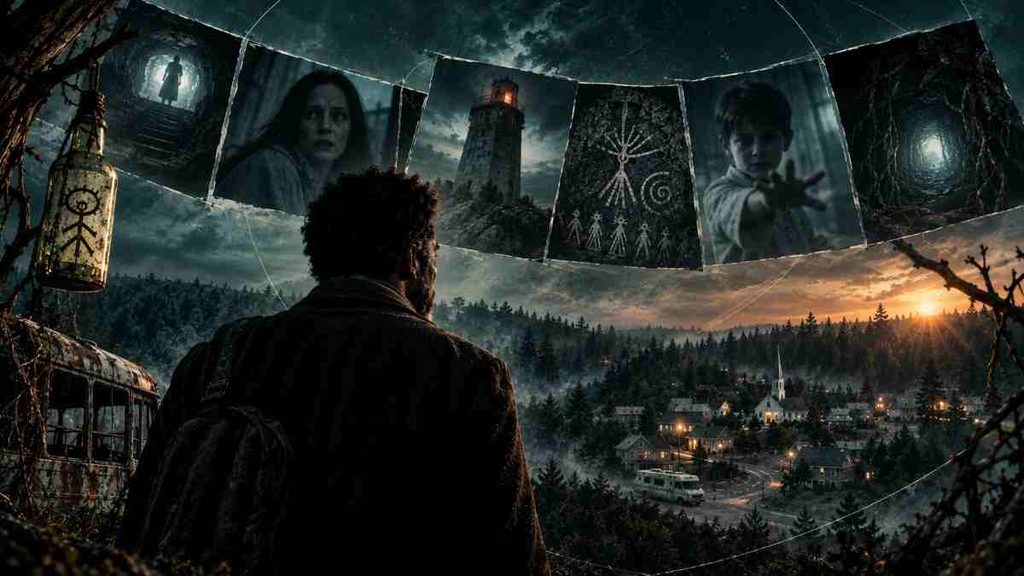
Season 2 Overall: What Changed Before Season 3
Season 2 closes several Season 1 open questions and opens a new tier of complexity.
Questions answered by end of Season 2:
- Boyd’s infection is not simply fatal. It is transformative and apparently intentional.
- Sara is a receiver for an intelligence operating within the Town that is distinct from the monsters.
- The symbol system maps to real locations and has an operational purpose.
Questions that arrived new in Season 2:
- What is the tower, who built it, and what is it for?
- Where did Tabitha go when she fell?
- If the monsters were once people, who started that process and why?
- Who is the boy in white and which layer of the Town does he belong to?
Season 2 is also where the show’s scope expands from “how do we survive” to “what is this place and who made it.” That shift is irreversible. Season 3 operates entirely in the new expanded frame.
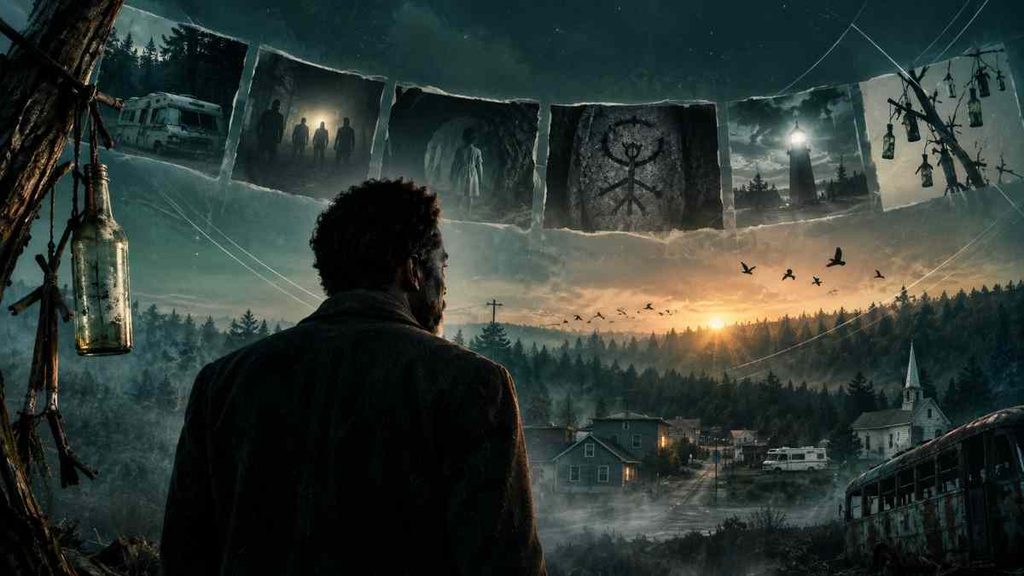
Season 3 Timeline: The Boy in White, the Roots of the Mythology, and What Lies Below
Season 3 runs ten episodes and represents the deepest mythology excavation the show has done. The boy in white becomes a named presence. The origins of the Town’s trap are approached directly for the first time. Characters are separated across different experiential layers of the same location.
S3E1 — “New Enemies, New Dangers” (The Separation Begins)
Season 3 opens with the community more fractured than it has ever been. Characters are spread across Colony House, the farmhouses, and in Tabitha’s case somewhere that appears to be a different temporal or spatial layer of the Town entirely.
The boy in white is seen by multiple characters in this episode, not just Tabitha. This removes him from the category of “one character’s private vision” and places him in the category of “something real that exists in the Town’s space.”
What we learned: The boy in white is not a hallucination. He is a presence inside the Town, operating under different rules than both the residents and the monsters.
S3E2 — “Into the Woods” (Ethan’s Connection)
Ethan’s relationship with the Town’s stranger elements deepens in ways that unsettle the adults around him. He is connecting with the boy in white more directly than any other character. The show continues to frame this as the Town’s communication system finding a receiver.
A new creature behavior appears: the monsters begin showing what looks like recognition toward specific individuals. This is different from their usual predatory scanning.
What we learned: The Town is sorting its residents into categories. Some people are targets. Some people may be something else entirely.
S3E3 — “Where Do We Go From Here” (The Farther Shore)
Tabitha’s experience in the layer she arrived in after the tower becomes clearer. She is in what appears to be a version of the Town with different physical rules, a place where time either does not move the same way or where different periods of the Town’s history coexist.
She encounters evidence of previous groups of survivors in this layer, records and objects that could not have survived in the main Town timeline.
What we learned: The Town may contain multiple temporal layers. What looks like history may be an adjacent present.
S3E4 — “Love in a Hopeless Place” (The Community Rebuilds)
Back in the main timeline, the remaining community members make a deliberate effort to stabilize their social structure. New leadership arrangements form around Boyd and Donna as pragmatic co-authorities.
The episode provides crucial personal history for several secondary characters, filling in backstory that reframes their behavior across the previous two seasons. The show uses this quieter episode to do mythology maintenance, confirming small details that earlier episodes had left ambiguous.
What we learned: The community’s survival depends as much on its social architecture as its physical defenses. Both require constant repair.
S3E5 — “The Kindness of Strangers” (The Boy Speaks)
The boy in white speaks directly to a character for the first time with enough clarity to establish intentionality. He is not random and he is not just an echo. He has something specific to communicate, and he has been waiting for the right receiver to be in the right position.
What he communicates in this episode reframes the entire origin of the monsters. The creatures are not an external threat that the Town is burdened with. They are part of the Town’s designed function.
What we learned: The monsters serve a purpose within the Town’s system. The trap was built with all its components intended.
S3E6 — “Sins of the Father” (Victor’s Deepest Memory)
Victor’s past is excavated further than any previous episode. A recovered memory reveals what happened to his mother and the other residents from his original arrival group, and specifically what the Town did to them over time.
This episode is the most direct confrontation with the question of whether anyone has ever successfully escaped. What Victor remembers suggests that some people did leave, or something that looked like leaving, but the nature of that departure is ambiguous in ways the show deliberately refuses to clean up.
What we learned: People may have left the Town before. What that departure cost them and where they went is not yet fully answered.
S3E7 — “Les Fleurs du Mal” (The Worm Returns)
The worm infection becomes relevant again, this time in a different character. The show’s return to this plot thread establishes that the infection is not a one-time anomaly Boyd stumbled into. It is a recurring feature of the Town’s environment for people who go past certain boundaries.
The infection’s relationship to the transformation process that creates the monsters becomes more explicit here. The worm is not separate from the creature question. They are part of the same system.
What we learned: The Town has a process for turning humans into something else. The worm is one stage of that process.
S3E8 — “The Hand You’re Dealt” (Jade’s Reckoning)
Jade reaches the point where his symbol research has produced a complete enough map to act on. He knows where certain things are. He can read enough of the language to understand instructions. What he chooses to do with that knowledge becomes the episode’s central dramatic question.
The symbol system is shown in this episode to include warnings alongside instructions. Some of what is written in the Town is not a guide. It is a record of what went wrong for previous readers.
What we learned: The symbol language includes failure documentation. Previous residents got far enough to leave warnings, which means previous residents got further than the current group has yet reached.
S3E9 — “The Beginning and the End” (Origins Approached)
The show makes its closest approach yet to the Town’s actual origin. Not the full answer, but the shape of it becomes visible. The Town was created. It was designed. The purpose it was designed for is darker and more specific than “trap people.”
Tabitha’s layer converges toward the main timeline in ways that suggest the separation is itself a designed feature, not a random consequence of the tower fall.
What we learned: The Town has a creator and a purpose. Both are more specific than the show has previously allowed. The full answer is being saved.
S3E10 — Season 3 Finale: “The Last Ride” (Everything Changes)
The Season 3 finale closes the boy in white thread with enough clarity to reframe his entire function across the show. He was not a guide. He was not a warning. He was a key, and specific characters were always the intended locks.
Multiple characters reach new positions: physically, informationally, and in terms of their relationship to the Town’s system. The finale does not answer the central question of what the Town is for, but it makes that question answerable in a way it was not before.
Boyd’s arc through three seasons reaches a point of genuine transformation rather than just survival. What he is now is not what he was when the Matthews family arrived.
What we learned: The Town’s pieces are assembling. Season 4 is not more mystery. It is the phase where the mystery pays off.
For a full explanation of what the Town actually is and the current best understanding of its nature, the dedicated piece on the Town in FROM covers the mythology in full.
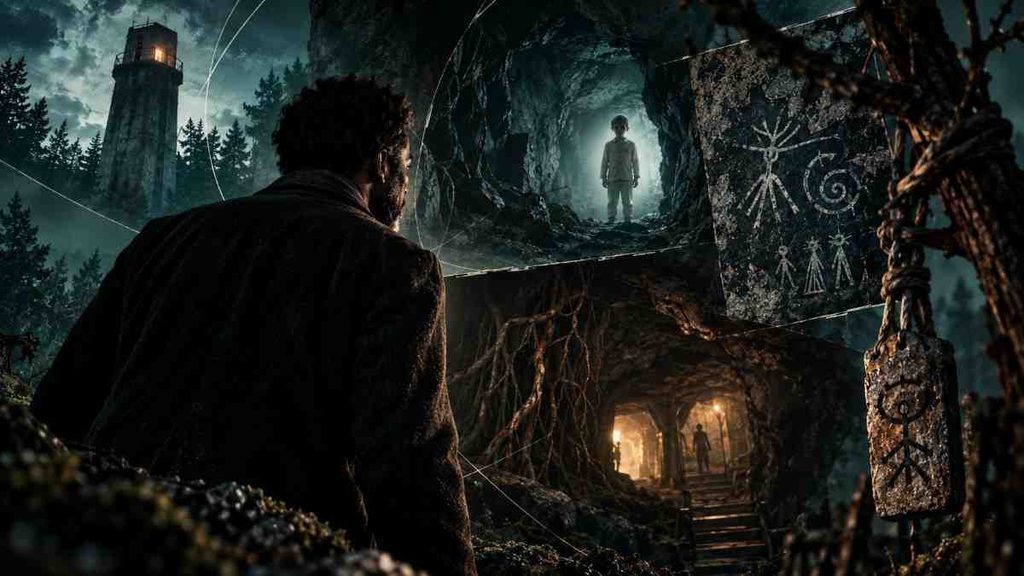
Season 3 Overall: What the Show Has Built Across Three Seasons
Three seasons in, the show has done something structurally unusual. Most mystery shows build toward answers and then reveal them. FROM has been building toward the shape of the answer, the architecture of the mystery, before delivering the content of it. Season 3 completes that architectural phase.
The four mythology threads and where they stand after Season 3:
The talismans: Still functioning, still unexplained mechanically, but now understood to be part of the Town’s designed system rather than an organic protection.
The symbol language: Readable enough to navigate. Contains instructions and warnings from previous residents. At least one character now has enough fluency to act on it.
The boy in white: Fully present, intentional, and revealed as a functional element of the Town’s system rather than a supernatural bystander.
The origins of the creatures: Confirmed as a transformation process. The worm is one stage. The Town has a designed method for converting certain people.
What Season 4 is being set up to answer:
- Who built the Town and for what specific purpose
- Whether escape is possible and what it actually means to leave
- What happened to Tabitha across the different temporal layers
- What Boyd’s transformation makes him capable of
Season 4 Timeline: The Answers Start Arriving
Season 4 began airing in 2025. This section is updated after each new episode. The entries below cover what has aired as of the current update.
S4E1 — “From the Beginning” (The Full Scope Opens)
Season 4 opens by placing multiple characters in positions they could not have occupied before Season 3’s finale. The spatial separation that characterized Season 3 has partially resolved, with characters who were in different layers of the Town now occupying a version of the same space.
The mythology development in the Season 4 premiere is the most direct the show has been: a character receives information about the Town’s origin that is stated plainly rather than presented as a vision or a fragment. The show is signaling that the answer phase has begun.
What we learned: Season 4 is operating in a different register than the previous three seasons. The mystery is not deepening. It is beginning to resolve.
S4E2 — “What We Leave Behind” (The Cost of Knowing)
The second episode establishes that receiving clear information about the Town’s origin carries a cost. Characters who know more are in more danger, not less. The Town’s system appears to monitor its own knowledge distribution.
Boyd’s transformed state gives him capabilities that the episode begins to clarify, though not fully. What he can do now is related to what the Town is, which means his arc is converging with the mythology’s central reveal.
What we learned: Knowledge in the Town is not neutral. The system responds to people who understand it too clearly.
Frequently Asked Questions
How much time has actually passed in FROM across all seasons?
Fan calculations based on day-night cycles across the three completed seasons place the in-universe elapsed time at roughly three to four weeks. The show is deliberately imprecise about this, but the consensus from close tracking of episode dialogue and lighting conditions lands in that range. The Matthews family arrived in what functions as late spring or early summer in the Town’s recurring weather, and roughly a month’s worth of days has passed since then across all aired content.
How long has Victor been in the Town in FROM?
Victor arrived in the Town as a young child, and visual and dialogue evidence across three seasons suggests he has been there for somewhere between thirty and fifty years. He has watched multiple full groups of survivors arrive and largely die. The journals found in Season 1 reference Book 74, which suggests the record-keeping predates even Victor’s arrival, meaning the Town has been operating this cycle for at least several generations before the current story began.
Are the monsters in FROM actually former humans?
Season 2 introduces this possibility visibly and Season 3 moves it toward confirmation. The worm infection Boyd carried back from beyond the tree line is shown to be an early stage of the same transformation process that creates the creatures. The show has not delivered a clean final statement on this, but the evidence across three seasons points strongly toward the creatures being the Town’s processed version of certain former residents.
Does anyone ever successfully leave the Town in FROM?
Season 3, specifically Victor’s recovered memories in the “Sins of the Father” episode, suggests that some people from earlier survivor groups did experience something that resembled departure. Whether that constitutes actual escape, transfer to another layer, or something else entirely is left deliberately ambiguous. No character in the current main cast has successfully left and returned with confirmed information about the outside world. Tabitha’s experience across the tower events comes closest, but her situation remains unresolved.
What is the significance of the talismans in FROM?
The talismans keep the monsters out of any structure they are hung in. This is the show’s first and most reliable rule. Through Season 3, the mechanism remains unexplained, but the system is now understood to be a designed feature of the Town rather than a naturally occurring protection. Someone or something built the talisman system into the Town’s architecture. Whether that builder intended the talismans as mercy or as a management tool is one of the questions Season 4 is positioned to answer.
What is the boy in white in FROM?
The boy in white appears in visions experienced by Tabitha starting in Season 2 and becomes visible to multiple characters by Season 3. He is confirmed as a real presence inside the Town’s space, not a hallucination. Season 3’s finale reframes his function: he is a designed element of the Town’s system, operating as a form of key that certain characters are the intended locks for. His full nature and origin are part of what Season 4 is building toward.
What is the worm that Boyd gets in FROM?
Boyd returns from beyond the tree line at the end of Season 1 carrying a parasitic worm organism visible under the skin. Through Season 2, the worm shows behavioral responses to stimuli, suggesting intentionality beyond simple parasitism. Season 3 connects the worm to the creature transformation process, establishing it as one phase of the system that the Town uses to convert certain people into the monsters. Boyd’s survival of the infection, rather than full transformation, makes him something new that the show’s mythology has not yet fully defined.
Is FROM confirmed to have an ending planned, or is it being made up as it goes?
The showrunners John Griffin and Jeff Pinkner have stated in interviews that the show has a planned ending and that the mythology is structured toward a specific resolution. Season 3’s shift toward answers over additional questions is consistent with this claim. Season 4’s more direct mythology delivery in its early episodes reinforces that the show is in its concluding phase rather than its expansion phase. FROM is not a show that has been running on audience engagement indefinitely. The shape of the answer has been visible since Season 1. Season 4 appears to be where that shape gets filled in.
What This Timeline Actually Shows You
Reading every episode in order does something that watching the show casually cannot. The mystery’s construction becomes visible. Each rule established in Season 1 turns out to be load-bearing for a reveal that lands in Season 3. The boy in white appearing vaguely in Season 2 visions and appearing clearly in Season 3 space is not a production upgrade. It is a planned progression. Every season has been tightening the same set of questions.
The single most important thing to carry into Season 4 is this: the Town was built. It has a creator, a purpose, and a system. Every strange feature, the looping road, the talismans, the symbols, the worm, the boy in white, is infrastructure. Season 4 is the season where the infrastructure’s purpose becomes readable.
Come back to this page after every new Season 4 episode. Each new entry will be added within 24 hours of air time. The mythology is moving fast now, and the timeline matters more, not less, as the answers arrive.